


 US
 CA
 GB
 NZ
Digital investments often assume that staff will have time to learn new ways of working. These assumptions may receive less attention than software features and project scope. Yet teams need time to learn while continuing to deliver care every day.
A health system’s ability to manage change affects how quickly benefits appear and whether they last. When implementation takes longer than teams have available, it becomes harder to deliver and sustain the expected financial benefits.
Why staff capacity matters in digital health implementation
Oudbier and colleagues’ 2024 review of 33 reviews offers a useful starting point. Training appeared in 22 reviews, while increased workload appeared in 16. The findings also included concerns about professional identity and the quality of communication with patients. These are concerns about how technology changes clinical work and why making a system available is only one part of implementation.
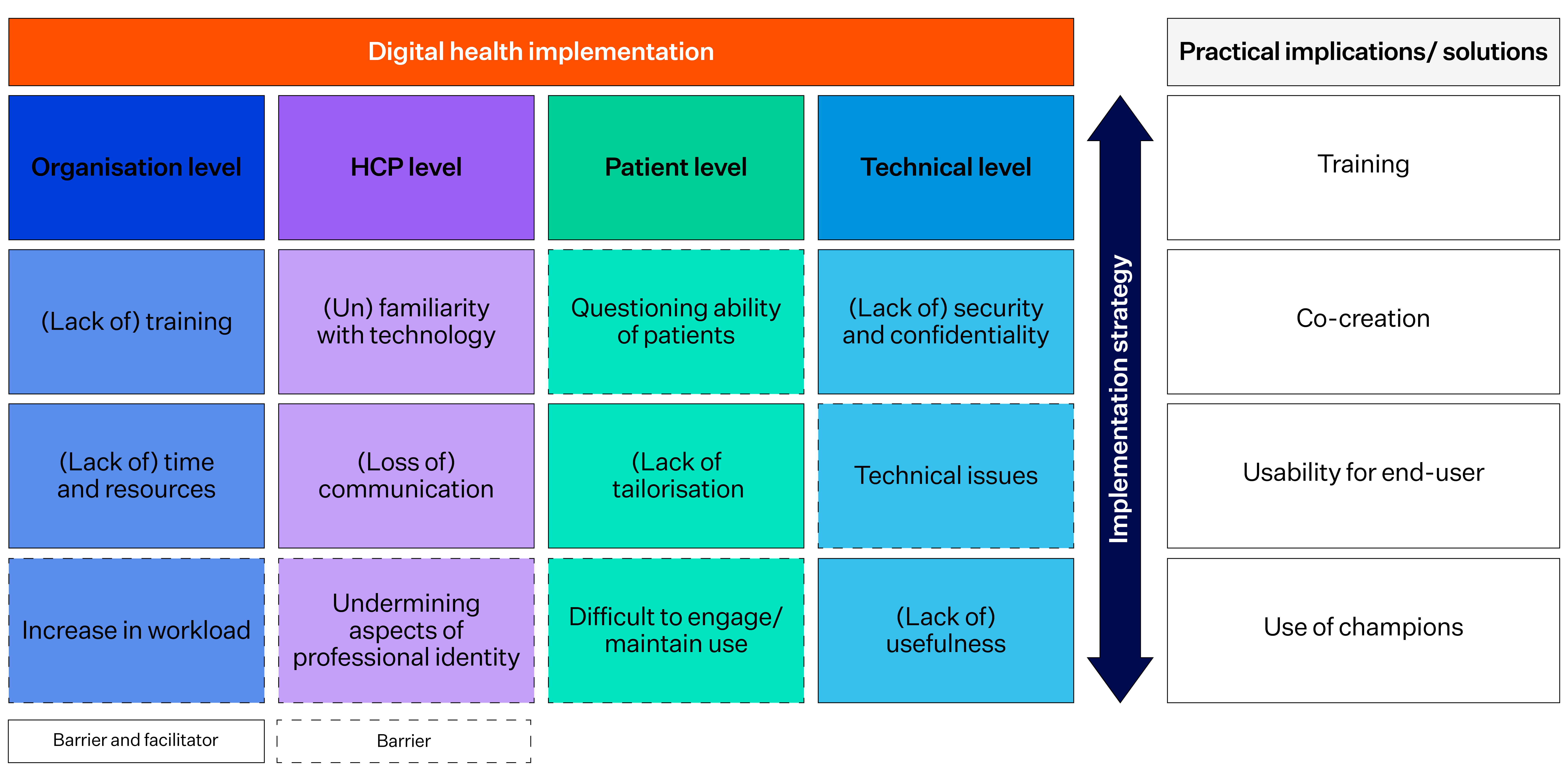
Source: Oudbier and colleagues, BMJ Open (2024)
The evidence also invites caution about describing training as the single bottleneck everywhere. A 2025 systematic review identified inadequate training, usability problems, and infrastructure deficiencies. Time and training are central dependencies, but their value partly rests on the working conditions around them. Staff need a usable system and an opportunity to apply what they learn.
Digital health teams need capacity to support change.
The capacity of the implementation team deserves equal attention. In the 2025 AMDIS and WittKieffer survey, 72% of physician informatics leaders identified upskilling their teams as a talent challenge. The same proportion identified the creation of development opportunities for existing team members. Meanwhile, 83% reported that their responsibilities had expanded over the preceding two years.
The teams expected to support organisational learning are managing their own expanding learning requirements.
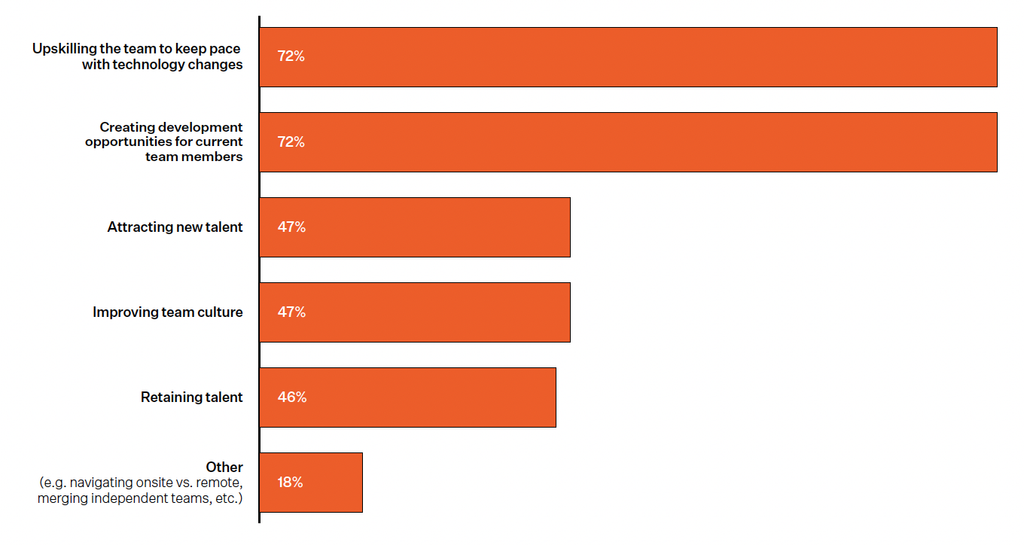
Source: AMDIS and WittKieffer, Physician Informatics Executive Survey Results 2025
There is also a relevant Australasian perspective. Butler-Henderson and colleagues’ analysis of the 2023 specialist digital health workforce census found that fewer than half of respondents who answered the qualification question held a formal specialist digital health qualification. Professional development was frequently self-directed. The sample was concentrated in Australia and New Zealand, which limits global generalisation but makes the findings particularly relevant to our region.
Formal qualifications provide only one measure of capability, but the findings still warrant attention to the funding of specialist development.
Include implementation capacity in investment decisions.
These dependencies belong in decisions about how resources are allocated across the technology portfolio. Several projects may each have an attractive business case while drawing on the same small group of clinical informatics leaders. Approving them together creates a delivery commitment that should be tested against those people’s availability.
Consider an illustrative training requirement of two hours for 2,000 staff. That represents 4,000 staff-hours before accounting for practice or subsequent support. The organisation must decide how that time will be covered. The economic cost persists even when the work is absorbed into existing salaries, because other activities receive fewer hours as a result.
Training design matters too. A 2024 scoping review of EHR training for inpatient nurses identified the importance of tailoring training and providing opportunities to practise after formal instruction. It also highlighted the contribution of trainers with nursing backgrounds. These findings support a practical approach: learning should reflect the work staff will perform and continue as their experience develops.
Enterprise scale adds another complication: local services have different starting points. Krahe and colleagues’ 2025 review of digital health implementation in rural Australia recommended tailoring interventions to local needs and mobilising appropriate resources. A rollout model developed in a major hospital needs careful examination before it is applied to a smaller service with limited capacity to release staff. A common platform can still require different implementation arrangements.
Build lasting capability and measure benefits.
There is also a longer-term capability decision. Goldacre’s 2022 review of NHS data use argued for coherent platforms supported by skilled teams, drawing attention to the duplicated effort created by fragmented approaches. Although the report concerns research and analysis, its underlying logic is relevant here: repeated investment in isolated projects can consume specialist capacity that could otherwise support shared capabilities.
This also changes the quality of the growth conversation from a vendor perspective. Before committing to a delivery timetable, the commercial team should understand which customer roles are required and how much time implementation will demand. Contractual milestones should reflect those dependencies, with responsibilities made explicit on both sides. A customer that can implement successfully has a firmer basis for evaluating further investment. For the vendor, repeatable implementation methods and credible benefit measurement should form part of the growth model.
The American Hospital Association’s discussion of informatics talent adds a further consideration. Development opportunities and succession planning help sustain the leadership needed for change. An implementation plan becomes vulnerable when essential knowledge sits with a few people whose development receives little attention.
Progress reporting should follow the investment through to changed practice. Training attendance provides useful information, while demonstrated competence and sustained use provide a stronger view of adoption. Financial evaluation then needs to establish what happened to any time released, including whether it supported additional care or reduced expenditure. Productivity assumptions require evidence from the operating model.
The strategic task is to align the pace of technology purchases with the capacity to implement them effectively. Leaders should be able to explain whose time each investment requires and how that capacity will be funded. This gives health systems a more credible view of the return and clinical teams a workable route to delivering it.
Explore Amadeus AI to see how connected health data, clinical workflows and benefits realisation capabilities can support health system change.
Authored by Tom Varghese, Global Product Marketing & Growth Manager at Orion Health.
References
- Alotaibi N, Wilson CB, Traynor M. “Enhancing digital readiness and capability in healthcare: a systematic review of interventions, barriers, and facilitators.” BMC Health Serv Res. 2025;25:500.
- AMDIS, WittKieffer. Navigating Change & Growth: Insights Into Physician Informatics Leadership. Physician Informatics Executive Survey Results 2025. WittKieffer; 2025.
- American Hospital Association. “3 takeaways to retain top clinical informatics talent.” AHA Center for Health Innovation Market Scan. 22 July 2025.
- Bernardi L. Healthcare as a consumer product: navigating the system with price and quality in mind. Exit Planning Exchange. Publication date not stated in supplied copy.
- Butler-Henderson K, Gray K, Arabi S. “Roles and responsibilities of the global specialist digital health workforce: analysis of global census data.” JMIR Med Educ. 2024;10:e54137.
- Fixing fragmented spend: 5 ways health systems are regaining control through procurement governance. Healthcare Dive. October 19, 2026. Sponsored content by Staples.
- ForNex Health. Hospitals are outsourcing their IT departments. Four just did it in September. October 7, 2026. Commercial commentary.Krahe MA, Baker S, Woods L, Larkins SL. “Factors that influence digital health implementation in rural, regional, and remote Australia: an overview of reviews and recommended strategies.” Aust J Rural Health. 2025;33:e70045.
- Goldacre B. Better, Broader, Safer: Using Health Data for Research and Analysis. Executive Summary. Department of Health and Social Care; 2022.
- Krahe MA, Baker S, Woods L, Larkins SL. Factors that influence digital health implementation in rural, regional, and remote Australia: an overview of reviews and recommended strategies. Aust J Rural Health. 2025;33:e70045.
- Montás MC, Klasa K, van Ginneken E, Greer SL. Strategic purchasing and health systems resilience: lessons from COVID 19 in selected European countries. Health Policy. 2022;126:853–864.
- Oudbier SJ, Souget-Ruff SP, Chen BSJ, Ziesemer KA, Meij HJ, Smets EMA. “Implementation barriers and facilitators of remote monitoring, remote consultation and digital care platforms through the eyes of healthcare professionals: a review of reviews.” BMJ Open. 2024;14(6):e075833.
- Nguyen OT, Vo SD, Lee T, Cato KD, Cho H. “Implementation and delivery of electronic health records training programs for nurses working in inpatient settings: a scoping review.” J Am Med Inform Assoc. 2024;31(11):2740–2748.