


 US
US CA
CA GB
GB NZ
NZHealth systems have spent years investing in digital transformation, but much of that investment is still funded as individual projects. The real value of digital health, however, comes after implementation, through ongoing use, integration, maintenance and improvement.
That creates a fundamental mismatch: we are increasingly relying on digital health as infrastructure, but often funding it as something temporary.
Why should digital health be funded as infrastructure?
A project has a defined scope and an expected end date. Digital infrastructure does not.
Core digital health capability requires lifecycle investment, operating funding, standards stewardship, cyber resilience, change capability and clinical governance. These requirements continue long after go-live.
Transform Health estimated that digital transformation across 78 low- and lower-middle-income countries would require US$12.5 billion over five years. Around half of the projected investment relates to operational costs, including maintenance, replacement equipment, refresher training, software licensing, and support.
The distinction matters because implementation is only the beginning of the economic life of digital health technology.
Digital health strategies are becoming national infrastructure strategies.
This shift is increasingly reflected in national and international policy.
The World Health Organization’s Global Initiative on Digital Health aims to help countries move beyond experimental projects towards sustainable digital ecosystems supported by policy, governance and digital public infrastructure. Similarly, the World Bank recommends incorporating digital capability into routine annual health planning and budgeting.
Across the world’s largest economies, national strategies increasingly focus on foundational capabilities such as interoperable health records, data exchange, digital identity and shared platforms.
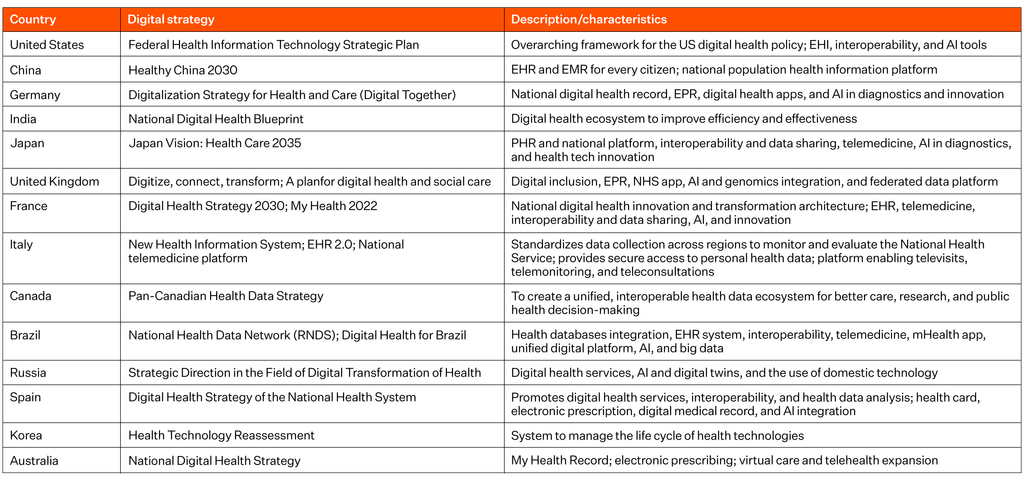
Source: Tortorella et al., Journal of Medical Internet Research (2026)
The implication is significant. Digital health is becoming a connected part of how modern health systems operate, rather than a collection of separate technologies.
How do digital health standards create long-term value?
Australia’s 2026 National Framework for Digital Health Standards describes standards as foundational infrastructure for connected care, bringing shared infrastructure, APIs, terminology and common data models into a nationally coordinated approach.
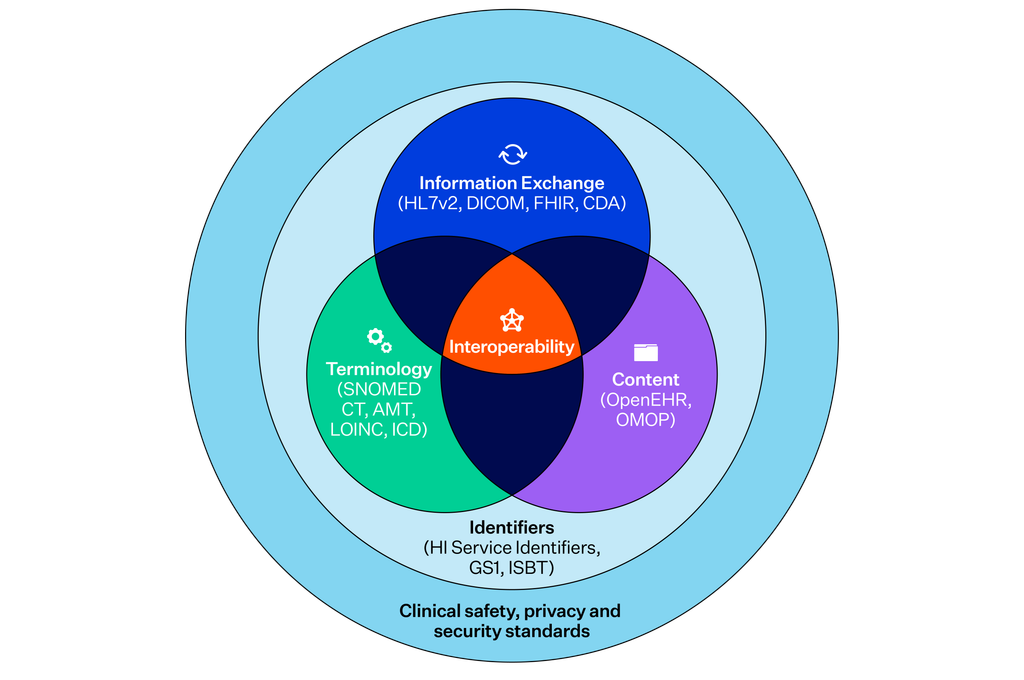
Source: Australian Digital Health Agency, National Framework for Digital Health Standards (2026)
Common standards can reduce bespoke integration and rework as technologies move between hospitals and jurisdictions. That creates option value: once trusted data exchange and reusable standards exist, the next service faces a smaller integration problem.
For health systems, this can make new capabilities easier to adopt and capital easier to direct towards incremental value. For technology providers, it creates a more scalable environment for innovation.
Therefore, technical architecture and investment strategy become increasingly difficult to separate.
Why does long-term digital health investment matter?
Digital transformation is not purely technical. A 2026 Journal of Medical Internet Research viewpoint describes healthcare transformation as a sociotechnical system, identifying short-term cost orientation, weak change management, poor data governance and legacy technology as recurring constraints.
A deployment can therefore be technically successful and still become an economically weak asset if workflows remain unchanged, adoption stalls, or implementation capability disappears as the project team does.
Evidence from Canada provides an alternative. Jaana and colleagues describe the long-term expansion of virtual care at a major cardiac hospital, where funding evolved alongside clinical evidence, engagement and technology partnerships. Funding became part of the sustainability model rather than a one-off implementation decision.
The same issue matters in Aotearoa New Zealand. Deloitte’s 2025 analysis of sustainable healthcare highlights fragmentation and legacy technology, as well as the impact of structural change and political cycles on long-term initiatives.
Can digital infrastructure support more proactive healthcare?
Ultimately, digital infrastructure matters because it enables different models of care.
Connected information, interoperable systems and sustained digital capability can help health systems move beyond responding to episodes of illness towards more proactive, preventative and community-based care.
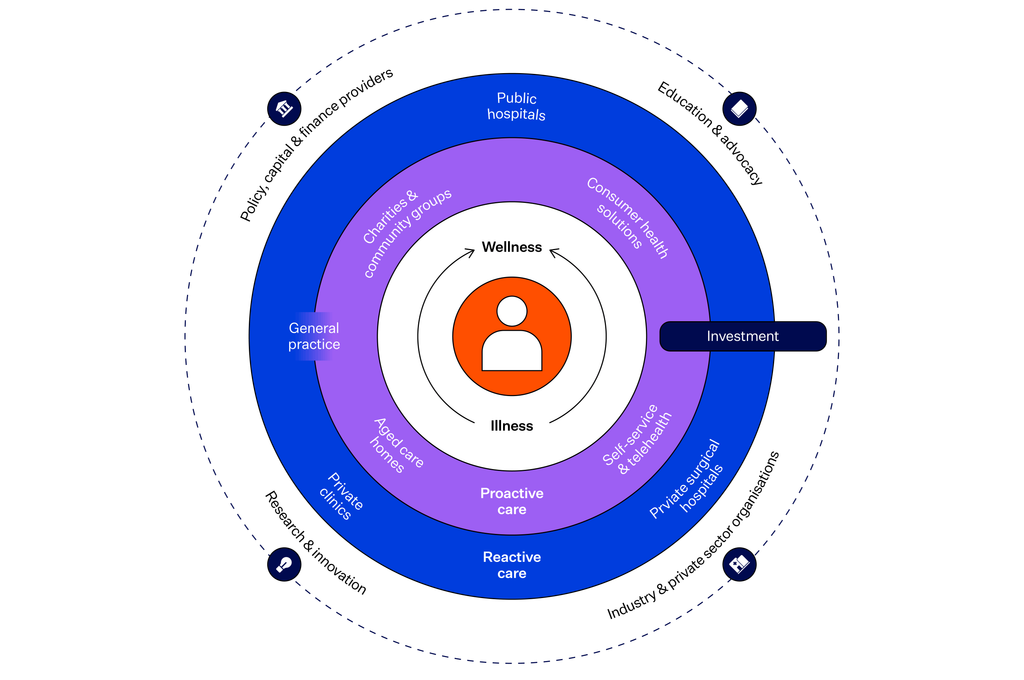
Source: Deloitte New Zealand, Healthy systems: Technology driving sustainable healthcare (2025)
That transition cannot depend on temporary infrastructure. If digital capability is expected to support care continuously, the investment behind it must be equally durable.
What is the economic case for sustained digital health investment?
Treating digital health as infrastructure should not mean giving technology an open-ended budget. It should raise the standard of investment discipline.
Boards and executive teams should understand the total cost of ownership, expected service levels, and measurable clinical outcomes, with clear criteria for renewal, optimisation, or retirement.
The potential return is substantial. Australia’s Productivity Commission estimated in 2024 that better integration of digital technology could save more than A$5 billion annually, including up to A$5.4 billion through improved use of electronic medical record data to reduce hospital stays, as well as further savings from avoiding duplicate tests.
But those benefits do not come from technology alone. They depend on how well it is integrated, adopted and improved over time.
Digital health funding needs to match its economic life.
The question for health leaders is no longer simply which digital projects deserve funding.
It is about which capabilities should remain part of the health system in the long term, which outcomes justify continued investment, and where shorter-term innovations are optimal.
Digital health now shapes how information moves, how clinicians work, how resources are allocated and how new models of care scale. Funding architecture should reflect that operating reality.
If health systems expect digital capability to behave like infrastructure, they need to fund and govern it like infrastructure, too.
Authored by Tom Varghese, Global Product Marketing & Growth Manager at Orion Health.
References:
- Abbott, G. (2025). Healthy systems: Technology driving sustainable healthcare. Deloitte New Zealand.
- Australian Digital Health Agency. (2026). National framework for digital health standards. Australian Government.
- Godfrey, A., & Powell, D. (2024). UK funding agency launches digital health hubs: A new catalyst for change? npj Digital Medicine, 7, 5.
- Jaana, M., MacPhee, E., Sherrard, H., & Walker, M. (2024). Sustaining e health innovations in a complex hospital environment: Learning through evidence. Frontiers in Digital Health, 6, 1346085.
- Labrique, A. (2025). From infrastructure to impact: Why foundations matter in digital health. Bulletin of the World Health Organization, 103(2), 83–83A.
- Productivity Commission. (2024). Leveraging digital technology in healthcare. Australian Government.
- Tortorella, G., Fogliatto, F., Vassolo, R., Mac Cawley, A., & Tlapa, D. (2026). Digital transformation in health care: Are we on the right track? Journal of Medical Internet Research, 28, e90380.
- Transform Health. (2022). Closing the digital divide: More and better funding for the digital transformation of health. Transform Health.
- World Bank. (2023). Digital in health: Unlocking the value for everyone. World Bank.
- World Health Organization. (2024). Global initiative on digital health: Coordinated support for country led digital health transformation. World Health Organization.