


 US
US GB
GB AU
AU NZ
NZThe technology is rarely the hardest part of digital health.
That may sound counterintuitive in a sector where conversations often revolve around artificial intelligence, interoperability, patient portals, wearables and apps. The technical foundations matter. Systems must be secure, reliable and able to operate across increasingly complex health information environments. But once a solution is live, a more difficult question emerges:
Will people still use it when the novelty wears off?
This is where many digital health strategies become overly optimistic. Technology can enable transformation, but sustained value depends on human behaviour. Digital health succeeds when patients and clinicians continue using a tool because it consistently helps them achieve better outcomes.
For patients, that might mean taking medication more consistently, understanding a care plan, tracking symptoms or seeking care earlier. For clinicians, it could mean accessing better information at the point of care, reducing duplication, improving communication or making safer decisions with less cognitive effort.
The real measure of success is not digital engagement. It is a meaningful change.
Why digital engagement metrics only tell part of the story
Many organisations still judge success using product metrics such as logins, feature activation or time spent in an application. While useful, these measures rarely tell the whole story.
A patient can spend significant time in a portal without improving their health. Equally, a clinician may only use a tool briefly during a consultation, yet that interaction could fundamentally improve a clinical decision.
The strategic question is therefore not how much people use digital health tools, but what that use enables.
Research across digital health consistently points to five conditions that support sustained engagement.
1. Relevance: meet people where they are
People return to digital tools when they solve problems that matter to them.
A patient managing cancer-related distress has very different needs from someone checking laboratory results. Rural communities face different constraints from urban users. Likewise, clinicians working in emergency departments have different workflow requirements from those in primary care.
Relevance means matching the right tool, message and timing to each user’s real-world context.
2. Effort: remove unnecessary friction
Even valuable technology loses users when it creates unnecessary work.
Multiple logins, repetitive notifications, manual data entry, poor workflow integration and confusing interfaces all increase friction. For patients, these become reasons to disengage. For clinicians, they add cognitive burden and administrative workload.
At enterprise scale, small usability issues quickly lead to lower adoption, higher support costs, and reduced return on investment.
3. Trust: the foundation of digital health
Healthcare asks people to share highly sensitive information and often change behaviour based on digital recommendations.
Trust is built through:
- clinical credibility
- transparency
- privacy and security
- consistent reliability
- recommendations from trusted clinicians.
For healthcare organisations, trust is more than a compliance requirement. It is a strategic asset that directly influences adoption.
4. Capability: Technology alone is not readiness
Many digital programmes assume users are ready simply because technology is available.
Reality is far more complex.
Patients differ in digital literacy, health literacy, confidence, connectivity and available support. Healthcare professionals vary in training, perceived usefulness and organisational backing.
The Unified Theory of Acceptance and Use of Technology (UTAUT) helps explain why. Adoption increases when people believe technology improves performance, is easy to use, is supported by trusted peers and is backed by an environment that enables success.
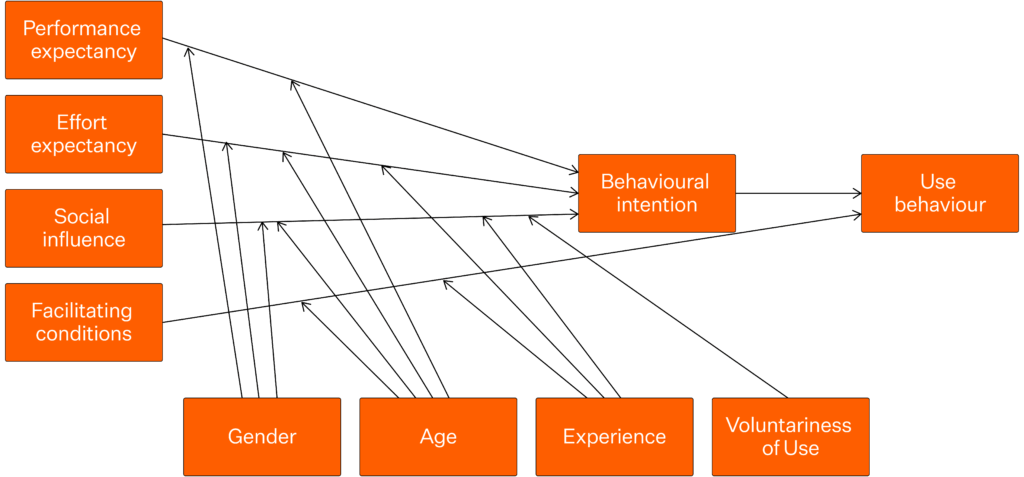
Source: Alotaibi, N., Wilson, C. B., & Traynor, M. (2025). Enhancing digital readiness and capability in healthcare. BMC Health Services Research.
5. Feedback: help users see progress
People continue using digital tools when they can clearly see value.
That value does not always need to be a clinical outcome. It may simply be:
- fewer missed appointments
- better sleep
- quicker access to information
- greater confidence
- more productive conversations with care teams.
Without visible progress, engagement gradually becomes an obligation rather than motivation.
Sustainable digital health requires service transformation.
Technology alone does not create sustainable healthcare.
The NHS perspective on digital innovation argues that long-term success comes from integrating technology with clinical practice, behavioural science, process redesign and knowledge management.
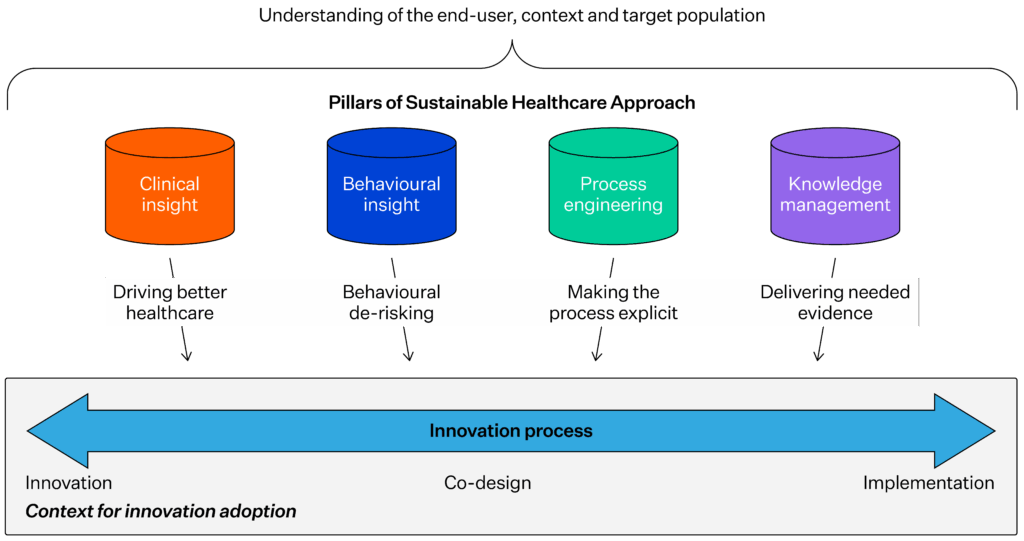
Source: Cripps, M., & Scarbrough, H. (2022). Making digital health “solutions” sustainable in healthcare systems. Frontiers in Digital Health.
Similarly, the ENGAGE Framework positions engagement as a continuous cycle that moves from enrolment and activation through behaviour change, habit formation, evidence generation and ongoing improvement.
Rather than measuring activity, it focuses on creating measurable health outcomes over time.
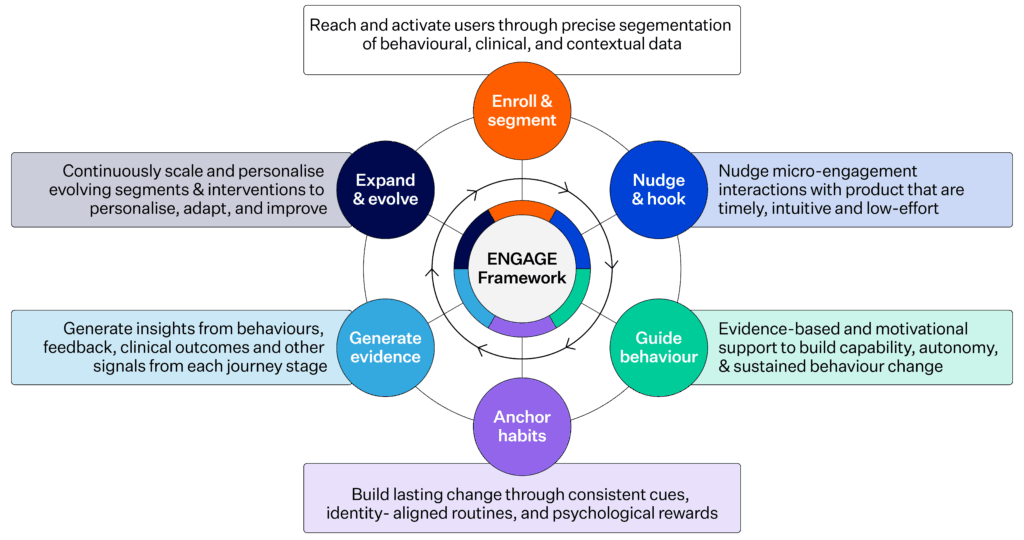
Source: Eiselt, A. K., Kirkendall, S., Xiong, E., Langner, D., & Goldfarb, M. (2026). Achieving clinically meaningful outcomes in digital health: The ENGAGE Framework. Frontiers in Digital Health.
Engagement is a product strategy, not an implementation problem.
One of the biggest mistakes organisations make is treating engagement as something customer success teams solve after deployment.
In reality, engagement is designed much earlier.
It is shaped by product architecture, clinical workflow design, onboarding, evidence generation, training, measurement and commercial strategy. If sustained adoption depends on extraordinary implementation effort, the product has not yet been designed for scale.
Healthcare technology leaders, therefore, need to think beyond features and functionality. Success depends on whether solutions can be trusted, integrated into everyday workflows and continue delivering value across diverse clinical settings.
The future belongs to useful technology.
People keep using digital health tools when those tools become indispensable to the way care is delivered.
That usefulness comes from aligning technology with clinical need, human behaviour, trusted workflows and measurable outcomes. Technology may open the door, but sustained engagement is earned through relevance, usability, trust and continuous value.
Healthcare organisations that understand this distinction will be far better positioned to realise lasting value from their digital investments.
Authored by Tom Varghese, Global Product Marketing & Growth Manager at Orion Health.
References
- Alotaibi, N., Brown Wilson, C., & Traynor, M. (2025). Enhancing digital readiness and capability in healthcare: A systematic review of interventions, barriers, and facilitators. BMC Health Services Research, 25, 500.
- Carini, E., Villani, L., Pezzullo, A. M., Gentili, A., Barbara, A., Ricciardi, W., & Boccia, S. (2021). The impact of digital patient portals on health outcomes, system efficiency, and patient attitudes: Updated systematic literature review. Journal of Medical Internet Research, 23(9), e26189.
- Cripps, M., & Scarbrough, H. (2022). Making digital health “solutions” sustainable in healthcare systems: A practitioner perspective. Frontiers in Digital Health, 4, 727421.
- Eiselt, A. K., Kirkendall, S., Xiong, E., Langner, D., & Goldfarb, M. (2026). Achieving clinically meaningful outcomes in digital health: A six step, cyclical precision engagement framework (ENGAGE). Frontiers in Digital Health, 7, 1713334.
- IQVIA Institute for Human Data Science. (2024). Digital health trends 2024. IQVIA.
- Kane, H., Wubbenhorst, W. H., King, D., Gehr, C., Dillard, L. K., & Murray, S. G. (2024). User engagement with mHealth interventions to promote treatment adherence and self management in people with chronic health conditions: Systematic review. Journal of Medical Internet Research, 26, e50508.
- Montalescot, L., Baussard, L., & Charbonnier, E. (2024). Factors associated with digital intervention engagement and adherence in patients with cancer: Systematic review. Journal of Medical Internet Research, 26, e52542.
- Organisation for Economic Co operation and Development. (2025). Building people centred digital health systems. OECD Publishing.
- Rodriguez, J. A., Shachar, C., & Bates, D. W. (2022). Digital inclusion as health care: Supporting health care equity with digital infrastructure. NPJ Digital Medicine, 5, 114.
- World Health Organization. (2024). Global Initiative on Digital Health.