


 US
US GB
GB AU
AU NZ
NZ
The term population health is now firmly embedded in health system strategy. Yet it remains widely misunderstood.
Too often, population health is treated as a programme to be delivered, rather than an outcome that reflects how effectively a health system functions as a whole. This distinction matters. Population health is commonly defined as the health outcomes of a group of people and the distribution of those outcomes across a population. Crucially, this definition focuses on what happens, not what is done.
Outcomes such as life expectancy, disease burden, quality of life, and patterns of inequality cannot be “rolled out” through a single initiative. They emerge over time, shaped by the cumulative performance of systems, policies, and partnerships.
Why healthcare alone cannot deliver population health outcomes.
Evidence consistently shows that healthcare services explain only a fraction of population health outcomes. While access to timely, high-quality care is essential, it is far from sufficient.
Wider determinants, such as income, education, housing quality, employment, transportation, and environmental conditions, play a far greater role in shaping health over the life course. As a result, no standalone programme, however well designed, can deliver sustained population-level improvement in isolation.
Many population health initiatives demonstrate short-term success but fail to scale or endure. One of the most persistent reasons is structural misalignment. Payment models, governance arrangements, and performance metrics are often designed around episodic care rather than long-term prevention or equity. Even effective interventions struggle to remain financially viable or strategically prioritised within these constraints.
Population Health Management vs Population Health Outcomes
This highlights an important distinction that is often blurred.
Population health management refers to a set of tools, frequently data-driven, used to identify, segment, and support specific groups. These tools can be powerful. However, population health itself is the outcome that emerges when those tools are embedded within a coherent and aligned system.
In other words, population health is not something a system does; it is something a system produces.
Systems, not silos, drive population health improvement.
The strongest evidence for improving population health points to the need for coordinated action across multiple domains.
The King’s Fund population health framework identifies four interdependent pillars:
- Wider determinants of health
- Health behaviours and lifestyles
- Integrated health and care systems
- Places and communities
Progress does not occur within these pillars individually, but at their intersections, where policy, services, data, and communities reinforce one another over time.
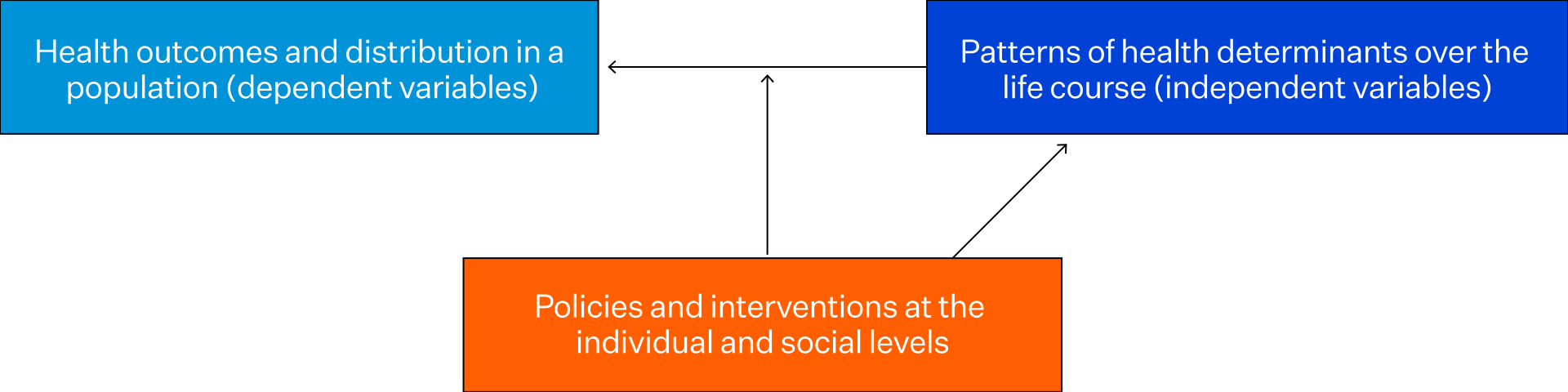
Source: Kindig & Stoddart, American Journal of Public Health (2003)
This model illustrates how health outcomes emerge from the interaction between determinants across the life course and policy interventions at both individual and social levels.
Why data maturity matters for population health
Effective population health depends not just on data availability but on how data is aggregated, interpreted, and applied.
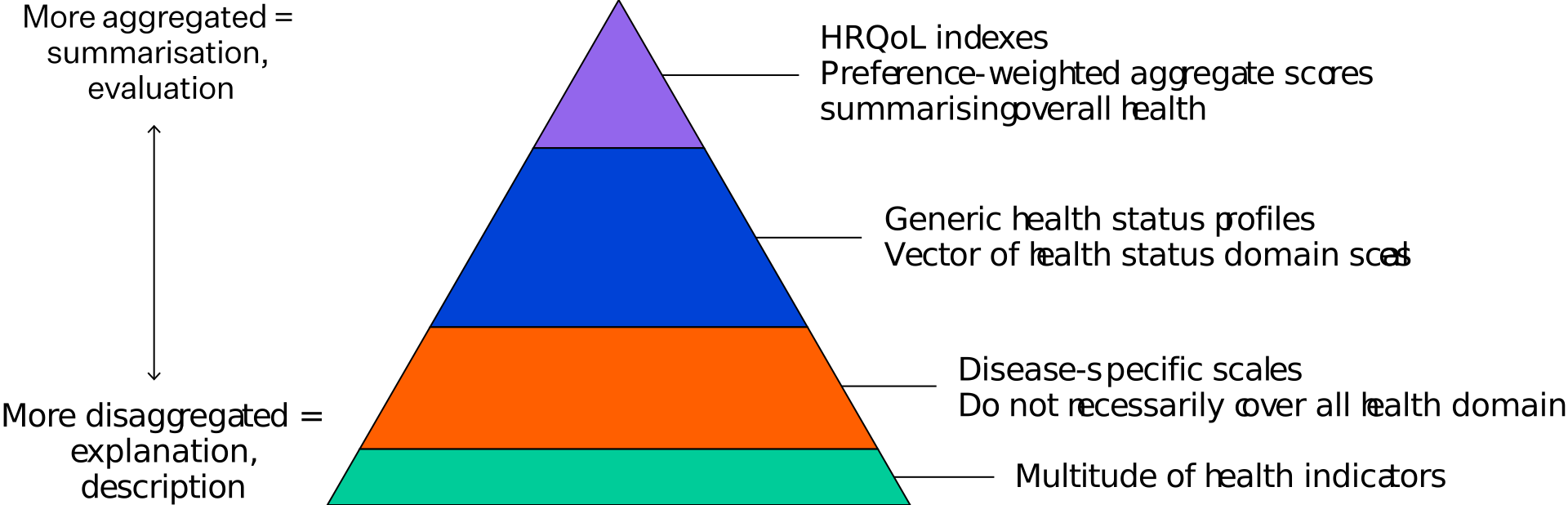
Source: Annual Review of Public Health
This pyramid illustrates how disaggregated indicators facilitate explanation and insight, while more aggregated measures enable evaluation and informed decision-making. Mature population health systems require capability across the entire data spectrum, from raw indicators to outcome-level measures such as health-related quality of life.
Without this foundation, population health efforts risk focusing on activity rather than impact.
Rising health spending, stagnant outcomes
The urgency of this shift is underscored by global spending trends.

Source: OECD, Health at a Glance 2025
Despite health expenditure rising to an average of 9.3% of GDP across OECD countries in 2024, outcomes remain uneven. In 16 countries, health now accounts for more than 10% of the economy, underscoring the need to ensure that investment translates into measurable population-level benefits.
More spending, without system-wide alignment, does not guarantee better health.
Lessons from cancer outcomes: foundations matter
Global cancer outcomes illustrate this clearly. Improvements in survival and reductions in mortality are closely linked to prevention, early detection, equitable access to care, and robust population-level data systems.
Where these foundations are weak, outcomes suffer, regardless of advances in treatment. This pattern reinforces a consistent lesson: population health gains are cumulative and system-dependent.
Population health is a long-term journey.
Population health is inherently long-term. It reflects years of sustained investment, policy alignment, and institutional learning.
Framing population health as a programme risks short-termism, expecting rapid returns from interventions that require durable, cross-sector commitment. Seen through a systems lens, population health is not an initiative with a start and end date. It is the product of how incentives, governance, data, and partnerships are aligned over time.
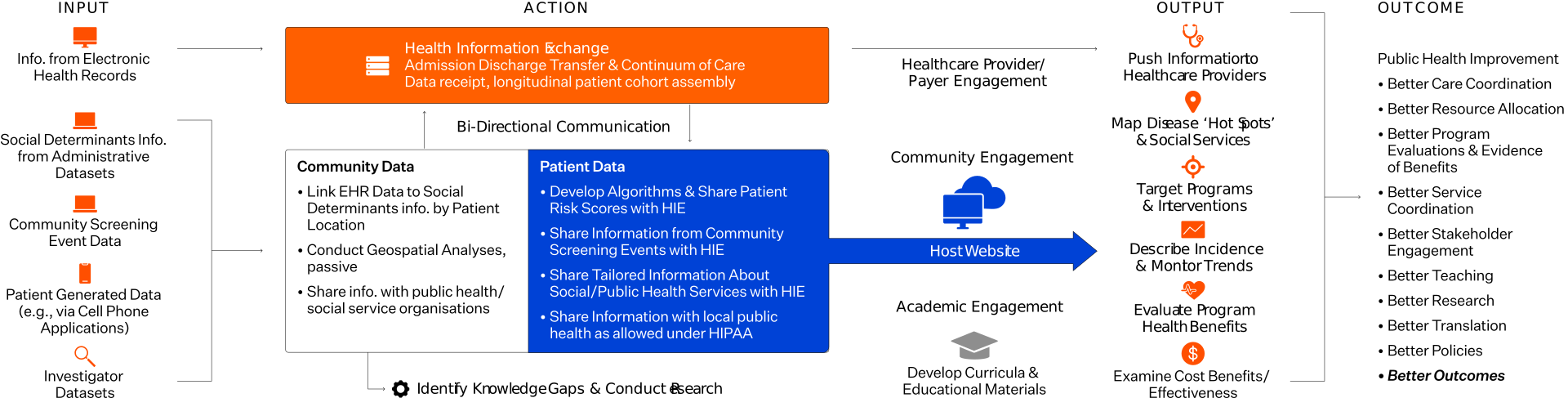
Source: Korzeniewski et al., Online Journal of Public Health Informatics (2020)
This model illustrates how health information exchange facilitates coordination among providers, communities, and public health agencies, transforming data into actionable insights and outcomes
What this means for health system leaders
For health system leaders, this reframing is critical. The key question is not whether a population health programme exists, but whether the system itself is designed to deliver healthier, more equitable outcomes over time.
That means aligning incentives with prevention, enabling data to flow across organisational boundaries, and supporting partnerships that extend beyond healthcare into communities and social services.
Turning population health insight into action.
Population health outcomes depend on connected data, shared accountability, and systems that continually learn and improve over time. This is where modern health information exchange and intelligence platforms play a foundational role, connecting clinical, social, and community data to support informed decision-making at scale.
Explore how Orion Health helps health systems manage populations and improve outcomes:
Authored by Tom Varghese, Global Product Marketing & Growth Manager at Orion Health.
References
- Buck, David, Alex Baylis, Durka Dougall, and Ruth Robertson. A Vision for Population Health: Towards a Healthier Future. London: The King’s Fund, 2018.
- Holmes, Jonathon. What Is a Population Health Approach? London: The King’s Fund, 2022.
- Jokhadze, Natia, Arunangshu Das, and Don S. Dizon. “Global Cancer Statistics: A Healthy Population Relies on Population Health.” CA: A Cancer Journal for Clinicians 74, no. 3 (2024): 224–226.
- Kaplan, Robert M., and Ron D. Hays. “Health-Related Quality of Life Measurement in Public Health.” Annual Review of Public Health 43 (2022): 355–373.
- Press, Matthew J., et al. “Modeling the Financial Viability of a Population Health Program: A Formidable Challenge for Health Systems.” NEJM Catalyst Innovations in Care Delivery, 2025.
- Moran, Andrew. “Population Health Is a Journey Not a Destination.” LinkedIn, July 30, 2019.