


 CA
CA GB
GB AU
AU NZ
NZ
The NHS in England is approaching near-universal Electronic Patient Record (EPR) coverage. By March 2026, 95% of trusts are expected to have implemented or significantly upgraded an EPR, supported by £1.9 billion to establish a baseline level of digital capability (NHS England, n.d.; Lawrence & Krelle, 2025).
EPRs sit at the centre of the government’s strategic shifts: from analogue to digital, from hospital to community, and from sickness to prevention. They digitise hospital records, enable secure information sharing within organisations, and provide the foundation for innovations such as ambient voice technology.
However, widespread coverage does not automatically translate into meaningful impact. The infrastructure is largely in place. The challenge now is delivering measurable returns across organisations, not just within them.
EPR coverage is high, but advanced use remains uneven
While roll-out has accelerated, the depth of use varies significantly.
The Health Foundation points out that while most trusts now have an EPR, not all are using the more advanced features. In the first year of the Digital Maturity Assessment, only a few trusts used tools like integrated prescribing or shared records with other hospitals.
This signals an important shift.
The main question now is not whether digital systems are in place, but whether they are actually helping to improve productivity, safety, and the quality of care.
Two decades of EPR policy: progress, setbacks, and hard lessons
This is not the NHS’s first attempt at digital transformation.
The National Audit Office (NAO) has repeatedly highlighted the complexity of large-scale digital change, shaped by legacy systems, integration challenges, and governance constraints. Earlier national programmes consumed substantial funding but struggled to deliver the full promised benefits.
The lesson is consistent: technology alone does not transform services. Sustainable improvement requires clinical engagement, behaviour change, workforce capability, and continuous optimisation.
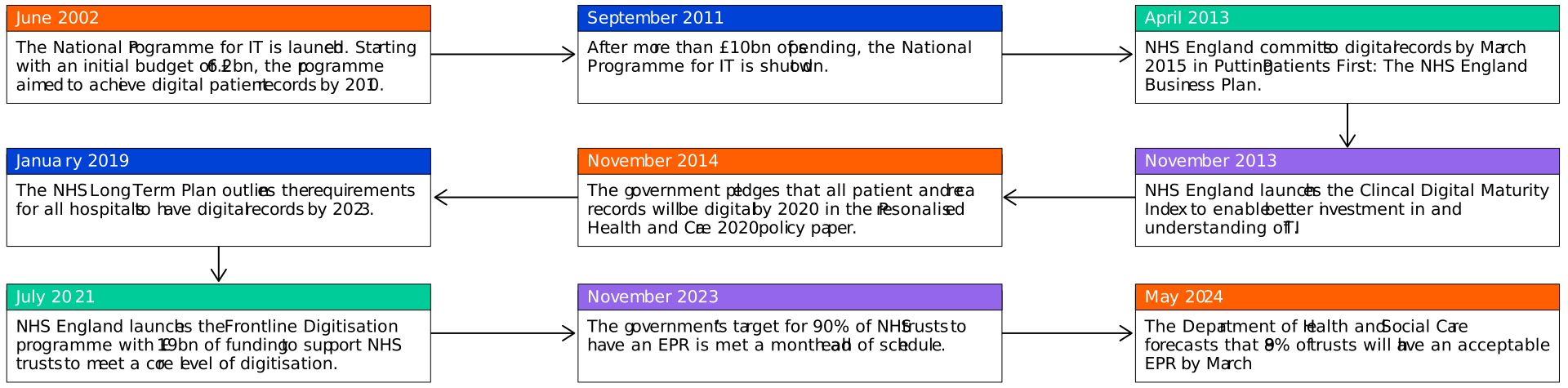
The evolution of national ambition over the past two decades illustrates this clearly.
Source: The Health Foundation
From the £6.2 billion National Programme for IT launched in 2002, which closed in 2011 after spending more than £10 billion, through to successive “paperless” targets in 2015, 2020 and beyond, digital strategy has been repeatedly reset.
By November 2023, 90% of NHS trusts had an EPR. Forecasts in May 2024 projected that 98% would have a suitable EPR by March 2026.
The infrastructure milestone is largely being reached. But history makes one point clear: installation is not transformation.
From digitisation to care improvement: The maturity journey.
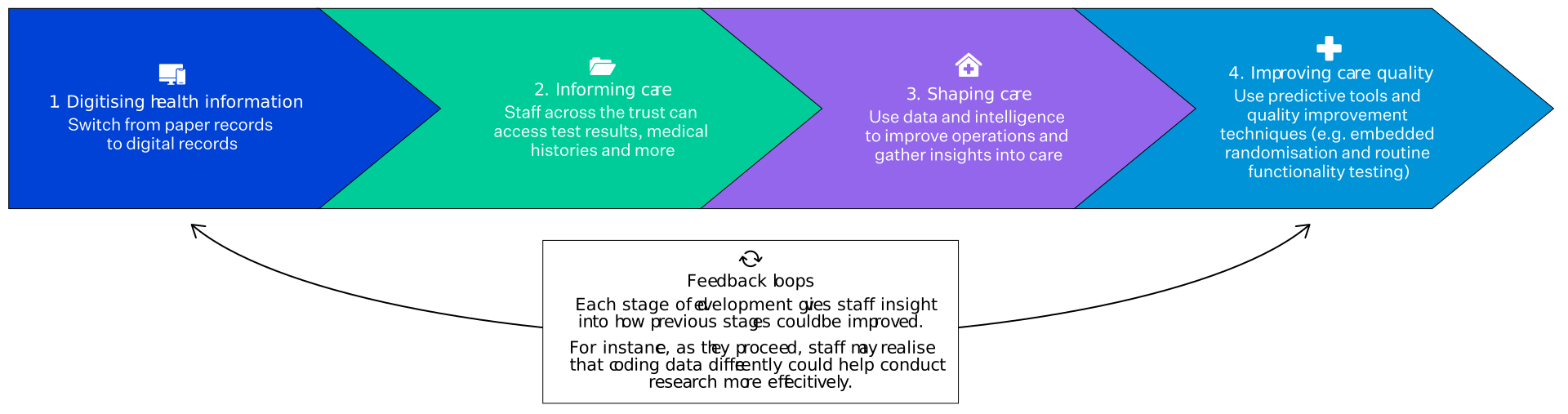
To understand the optimisation challenge, it helps to examine how EPR value typically evolves over time.
Source: The Health Foundation
Most organisations move through four broad stages:
- Digitising health information – Replacing paper with electronic records.
- Informing care – Making results, histories, and documentation accessible.
- Shaping care – Embedding decision support, predictive tools, and operational insight.
- Improving care quality – Applying advanced analytics and structured quality improvement.
Each stage builds capability. As staff use the system, workflows are refined, coding improves, and data becomes more reliable.
Yet many organisations remain between the first and second stages. The significant productivity gains policymakers seek typically emerge only in stages three and four, when data actively shapes care delivery and system performance.
And this is where a structural barrier becomes clear.
The Optimisation Gap: Where EPRs stop at organisational boundaries
One main reason for the value gap is that most EPR programmes do not go beyond the boundaries of each organisation.
Trusts have made genuine progress in optimising their EPRs locally. Workflows are configured, users trained, templates refined. But those improvements often do not follow the patient when they move between settings.
As a result, clinicians frequently encounter incomplete information. A recent medication change recorded by a GP, an allergy noted in primary care, or a specialist’s report from another trust may not be visible in the local EPR.
The consequence is duplicated effort, time spent chasing information, and unnecessary data re-entry. More importantly, clinical decisions may be made without the full context.
When data stops at organisational boundaries, optimisation stalls. Improving systems locally will not boost overall productivity if information stays scattered.
This “optimisation gap” is explored further in the EPR Network’s latest white paper, featuring contributions from Orion Health, which highlights why adoption, integration and cross-system data sharing are essential to unlocking real productivity gains. Read The Optimisation Gap: Why Having an EPR Isn’t the Same as Using It Well here.
Extending value through shared care records
That is why improvements need to go beyond single organisations.
Shared Care Records (ShCRs) help solve this problem by linking data from hospitals, primary care, community, and mental health services. Importantly, they do this without replacing local EPRs.
Instead of enforcing a single system, Shared Care Records create a longitudinal, cross-organisational view of the patient. They allow clinicians to see critical information regardless of where care was delivered.
The benefits are practical and immediate:
- Reduced duplication of tests and documentation
- Improved patient flow across settings
- Better multidisciplinary coordination
- A foundation for system-wide analytics and population health insight
Shared Care Records turn separate digital systems into a connected network. This means improvements made locally can benefit the whole system.
They also lay the groundwork for a true Single Patient Record, not as a single platform, but as a unified view across the care ecosystem.
The Frontline Productivity Programme: formalising the reset
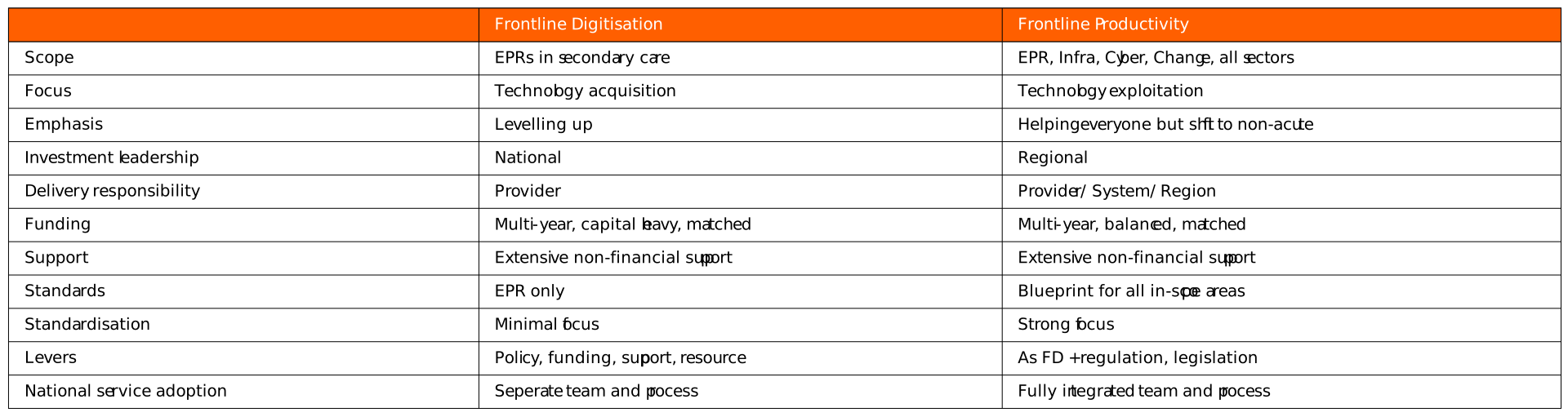
NHS England’s upcoming Frontline Productivity Programme, launching in April 2026, reflects this strategic pivot.
It succeeds the Frontline Digitisation initiative and aligns with the NHS 10-Year Health Plan and statutory productivity requirements. The focus shifts from acquiring infrastructure to extracting measurable operational value.
Source: Digital Health
Where Frontline Digitisation prioritised EPR deployment in secondary care, Frontline Productivity expands the scope to include:
- EPR optimisation
- Infrastructure and cyber security
- Change management
- Cross-sector systems integration
In other words, the programme acknowledges that productivity gains depend on how well systems work together, not just how well they function individually.
Why optimisation is harder and more important than roll-out
Deployment is a finite project. Optimisation is ongoing.
Trusts must redesign workflows, embed decision support, improve data quality, and build sustainable digital capability. This requires leadership, clinical engagement, and long-term commitment.
International examples show the scale of effort required. NYU Langone introduced its EPR in 2008 and spent 15 years developing advanced, data-driven capabilities, including predictive modelling and real-time dashboards.
An EPR that is live but underused can increase administrative burden rather than reduce it.
Real value depends on:
- First-time-right data entry
- Consistent pathway execution
- Strong clinical ownership
- Effective interoperability across services
Without sharing data between organisations, even the best EPRs cannot deliver all the productivity benefits.
The Era of Delivering Returns
The NHS is entering a more demanding phase of digital maturity.
The focus is shifting from just buying systems to actually getting results from them. Success will not be judged by how many trusts have an EPR. Instead, it will depend on how well these systems, connected across organisations, help frontline staff, improve patient care, and make the system stronger.
Having an EPR is only the beginning. To get the most value, organisations need to share data, coordinate care across different settings, involve clinicians, and treat information as a key resource.
If your organisation is moving from deployment to optimisation, now is the time to focus on interoperability and longitudinal patient views that extend beyond the hospital.
To learn how Orion Health’s Shared Care Record solutions help NHS regions get more value from their EPRs and connect care across boundaries, see our approach here:
Authored by Tom Varghese, Global Product Marketing & Growth Manager at Orion Health.
References:
- Cheshire, R. (2026, February 27). From digital acquisition to digital exploitation: Why NHS frontline productivity depends on adoption. FutureScot.
- Healthcare Innovation Consortium (HIC). (2026). The optimisation gap: Why having an EPR isn’t the same as using it well. Electronic Patient Record (EPR) Network. Available at: https://hicdigital.co.uk/the-optimisation-gap-why-having-an-epr-isnt-the-same-as-using-it-well/ (Accessed: 11 March 2026).
- Lawrence, A., & Krelle, H. (2025, April 19). The NHS must get more out of the EPRs it has purchased. The Health Foundation.
- Lovell, T. (2026, January 12). Details of NHS digital productivity programme leaked online. Digital Health.
- National Audit Office. (2020). Digital transformation in the NHS (HC 317, Session 2019–2021).
- NHS England. (n.d.). Digitising the frontline.