


 CA
CA GB
GB AU
AU NZ
NZ
Healthcare has invested heavily in structured interoperability standards. HL7 FHIR, SMART on FHIR, and related implementation guides have matured technically and gained regulatory endorsement (HL7 International, n.d.; ONC, 2020).
However, adoption data shows there are still challenges.
Fourteen years after FHIR was introduced, 79% of countries have national implementation guides, but only 20% report using them widely (Firely, 2025). The gap is not purely technical. High coordination costs, loss of semantic meaning, and complex implementation still slow things down. Creating an implementation guide takes time, while real-world workflows keep changing.
Standards perform well in high-volume, repeatable use cases. But they are less flexible for specialised workflows like rare disease registries, complex referrals, or clinical trial matching.
In this setting, a new idea is emerging: Conversational Interoperability (COIN), also known as Language-First Interoperability (LFI).
What is Conversational Interoperability (COIN)?
Conversational Interoperability is an emerging approach in which autonomous agents use natural language to agree on data exchange needs before carrying out those exchanges via structured APIs.
Instead of defining every data element ahead of time, agents figure out the details in real time:
- What information is required?
- In what format should it be provided?
- How to assemble and route it across systems?
Agents can bridge structured FHIR data and unstructured clinical notes, dynamically resolving workflows.
Importantly, COIN does not reject standards. Instead, it offers a new way to use them. Agents may still rely on FHIR APIs, eligibility services and terminology standards once requirements are clarified through conversation.
| Topic | COIN (Conversational Interoperability) |
|---|---|
| What is it | Use of natural language (chat/voice) to access and act on healthcare data across systems. |
| Is it a formal standard (like Hl7/FHIR)? | No |
| Is it a recognised industry concept? | Emerging |
| Built on existing interoperability standards? | Yes – FHIR, HL7 and APIs |
| Requires AI / LLM technology? | Yes |
| Requires secure APIs? | Yes |
| Requires structured clinical data? | Yes (for safe execution) |
| Requires structured user input? | No |
| Requires governance and compliance controls? | Yes |
| Can it work without interoperability foundations? | No |
| Is it just a chatbot? | No |
| Does it replace traditional interoperability? | No – It builds upon it. |
| Can it orchestrate across multiple systems? | Yes – at a higher maturity |
| Is it widely deployed today? | No – is an early stage |
| Maturity level globally | Early / Emerging |
| Approximate concept emergence | ~2022-2024 (post LLM era) |
| Driven by LLM advances? | Yes |
| Main benefit | Simplifies access to complex health data |
| Main risk | AI accuracy, trust and governance |
The framing is important. COIN is not yet an institutional infrastructure. It is exploratory, shaped largely by advances in large language models.
From data exchange to intent fulfilment
Traditional interoperability asks:
Can System A send data to System B?
COIN, on the other hand, asks a different question:
Can System A understand user intent and orchestrate data across systems to fulfil it?
The diagram below presents a conceptual five-layer Clinical Intelligence Network (CIN) model. This framework builds on established interoperability and learning health system architectures, integrating semantic interoperability, data orchestration, governance, and AI-driven reasoning into a unified structure.
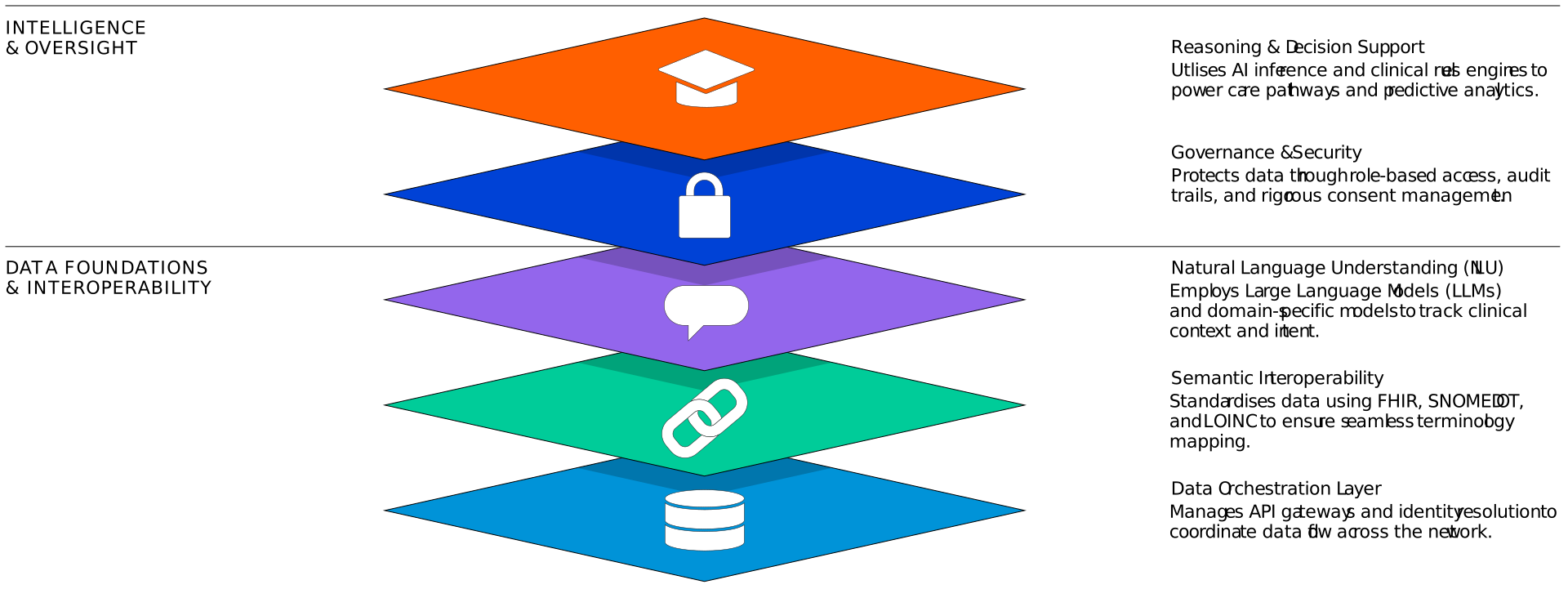
The 5 Layers of Clinical Intelligence Networks (CIN)
At its foundation sit data orchestration and semantic interoperability layers, enabled by standards such as FHIR, SNOMED and secure APIs. Above these are natural language understanding, governance and security controls, and reasoning engines that support decision-making and care pathways.
In this model, Conversational Interoperability functions as the interface, while Clinical Intelligence Networks represent the governed infrastructure that enables it.
This distinction is important. Without strong data foundations, identity assurance and audit mechanisms, conversational capability risks becoming surface-level automation rather than a trusted clinical infrastructure.
The question then becomes how this conceptual architecture performs when tested in practice.
Early experimentation: HL7 Connectathon demonstrations
At a recent HL7 Connectathon in the US, a small group implemented and tested COIN scenarios across multiple use cases.
Demonstrations included specialist referrals, clinical trial matching, rare disease registry reporting, prior authorisation simulations, and guideline-driven decision support.
There was also a demonstration of a cardiology referral agent that verified providers, checked insurance and scheduled appointments within a live EHR environment. When a structured JSON payload failed to parse, the agents went further and negotiated an alternative format, thus completing the workflow.
Other teams demonstrated bidirectional trial matching, in which agents acted as both client and server to dynamically negotiate eligibility criteria. The breadth of use cases prompted one participant to describe the moment as the birth of a new interoperability paradigm.
A first-of-its-kind pilot in the United States
One early example shows both promise and risk.
Utah has launched a pilot program that allows an AI system to autonomously renew certain prescription medications without a doctor’s direct involvement.

As shown above, the Utah pilot was intentionally designed with clear clinical guardrails.
The AI system is authorised to renew prescriptions only for a defined list of approximately 190 existing chronic medications. High-risk and controlled medicines are explicitly excluded from the programme.
If a renewal request is routine and no clinical red flags are detected, the AI can issue the refill directly to the pharmacy. However, if uncertainty arises or potential risk factors are identified, the case is escalated to a human clinician for review.
This structured escalation pathway keeps the system within a tightly bounded scope, positioning it as controlled automation rather than unrestricted autonomy.
Vendor data from 500 external cases indicated that AI treatment plans matched those of human clinicians in approximately 99.2% of cases (Politico, 2026).
If models like this incorporated conversational negotiation across systems, the shift would move from decision support towards partial clinical execution. That would materially increase regulatory, safety and liability exposure.
These risks are real, not just theoretical. Research has already shown safety problems with conversational medical assistants when there are not enough safeguards (Bickmore et al., 2018). The WHO also stresses the need for strong governance and ethical oversight in AI for health (WHO, 2021).
Does conversational negotiation re-create integration complexity?
A common objection is that conversational negotiation risks reintroducing point-to-point complexity.
However, supporters argue that each agent represents a reusable capability. In theory, agents can converse with multiple complementary agents, enabling more linear scaling rather than quadratic integration growth.
If traditional standards solve the n² problem structurally, COIN may attempt to address it behaviourally.
That remains an open question.
Governance: The deciding factor
Technical feasibility alone will not determine whether COIN matures beyond experimentation.
Issues such as identity verification, authentication, consent, and auditability remain unresolved in this model. Mark Kramer has proposed adapting mandate-based delegation and cryptographically verifiable consent models to manage agent authority.
There is a clear tension here:
- Natural language negotiation introduces interpretive flexibility
- Governance demands deterministic boundaries
It is still unclear whether these two needs can work together at a large scale.
Framing COIN as a replacement for FHIR misunderstands the proposition. Right now, conversational interoperability is viewed as something that works alongside existing standards. Standards lay the groundwork, and if COIN develops further, it could help with negotiation on top of those standards.
Strategic implications for health platforms
If conversational agents become a primary integration surface, differentiation may shift.
Platforms may compete not only on API maturity, but on:
- Agent intelligence and safety
- Identity assurance mechanisms
- Governance frameworks
- Traceability and audit controls
For enterprises, three practical questions emerge:
- Where are coordination costs highest today?
- Which workflows sit in the long tail where standards adoption is weakest?
- Could conversational negotiation reduce integration friction without compromising compliance?
Administrative tasks and referral management could be good, lower-risk areas to test these ideas.
An emerging layer, not yet infrastructure
COIN, or Language-First Interoperability, appears to be in its formative phase. Conceptually, it emerged post-LLM advancements between 2022 and 2024. It is not widely deployed. Governance models are evolving. Evidence is early.
There are some demonstrations showing COIN can work, but there is no agreement yet among institutions.
The next layer of healthcare interoperability might not be a new technical standard. Instead, it could involve systems that agree on meaning before sharing structured data.
Whether this approach becomes part of the core infrastructure or stays experimental will depend more on trust, governance, and clinical responsibility than on technical ability.
This was a case for an emerging paradigm. This article presents early views on the technology and should not be relied on as legal or clinical advice. Readers should verify key claims with primary sources before acting
Explore the future of interoperability.
Interoperability is evolving. Whether through structured standards, intelligence platforms or emerging conversational models, the objective remains the same: coordinated, safe and scalable care.
See how Orion Health is creating secure, standards-based data foundations that are ready for the next wave of innovation.
Authored by Tom Varghese, Global Product Marketing & Growth Manager at Orion Health.
References
- Achiam, J., Adler, S., Agarwal, S., Ahmad, L., Akkaya, I., Aleman, F. L., et al. (2023). GPT-4 technical report. arXiv.
- Bickmore, T. W., Trinh, H., Olafsson, S., O’Leary, T. K., Asadi, R., Rickles, N. M., & Cruz, R. (2018). Patient and consumer safety risks when using conversational assistants for medical information: An observational study of Siri, Alexa, and Google Assistant. Journal of Medical Internet Research, 20(9), e11510.
- Firely. (2025). FHIR adoption survey 2025.
- Gosmar, D., Dahl, D. A., & Coin, E. (2024). Conversational AI multi agent interoperability, universal open APIs for agentic natural language multimodal communications. arXiv.
- HL7 International. (n.d.). FHIR overview. https://www.hl7.org/fhir/overview.html
- Kramer, M. (n.d.). Why conversational interoperability is essential for the future of healthcare. LinkedIn. https://www.linkedin.com/pulse/why-conversational-interoperability-essential-future-mark-kramer-retre/
- Mandel, J. C. (n.d.). Conversational interoperability takes shape: Read out from HL7. LinkedIn. https://www.linkedin.com/pulse/conversational-interoperability-takes-shape-read-out-from-mandel-md-379fc/
- Office of the National Coordinator for Health Information Technology. (2020). 21st Century Cures Act: Interoperability, information blocking, and the ONC Health IT Certification Program. Federal Register, 85, 25642–25961.
- Politico. (2026, January 6). Artificial intelligence is prescribing medications in Utah. https://www.politico.com/news/2026/01/06/artificial-intelligence-prescribing-medications-utah-00709122
- World Health Organization. (2021). Ethics and governance of artificial intelligence for health: WHO guidance.. “Germans Trust ‘Dr AI’ More Than Doctors Who Use It.” Medscape, February 18, 2026