

 US
US CA
CA GB
GB NZ
NZ
Artificial intelligence is no longer a distant possibility for healthcare. It has transitioned decisively from hype to operational reality, delivering measurable improvements in productivity, accuracy, safety, and clinical outcomes. While the broader market remains crowded and volatile, and many start-ups will inevitably fail, this is not a verdict on AI’s value. Instead, it reflects the complexity and maturity required to shift from prototypes to a safe and dependable clinical infrastructure.
The shift from experimentation to operations
The evidence showcased at the HLTH 2025 conference signalled a clear transition: AI is no longer defined by pilots. Health organisations across the United States are reporting tangible outcomes, including reduced denials, increased coding accuracy, improved operating room scheduling, and more streamlined workflows.
Clinical leaders emphasised a consistent theme:
The AI technologies that will succeed are those that integrate seamlessly into workflows, deliver reliable value at scale, and support the entire organisation, rather than those that rely on novelty.
This mirrors the adoption curve of earlier major healthcare technologies. Once the initial excitement fades, survival depends on embedding the practice into routine. In 2025, AI-enabled documentation tools will have become the clearest expression of this maturity.
Ambient Intelligence: first to deliver repeatable real-world impact
Ambient intelligence and AI-enabled scribing continue to stand out as the most advanced and consistently validated AI category in healthcare. Across multiple studies, clinicians report:
- Significant reductions in documentation time
- Higher-quality clinical notes
- Better consultation experience and patient interaction
- Positive impact on after-hours work
- High clinician acceptance
A major rapid review of real-world evidence found these benefits across varied settings. Even in cases where burnout didn’t change at scale, sentiment and engagement improved markedly, a crucial signal for workforce sustainability.
Enterprise-scale proof: AI can deploy safely and quickly
A large US academic health system proved that ambient scribing can be deployed enterprise-wide, supporting thousands of clinicians simultaneously. Adoption was driven by strong governance frameworks: safety monitoring, clear risk controls, structured training, and support processes.
This challenges the assumption that AI must be slow and fragmented to be rolled out effectively. When governance is strong and the organisation is prepared, scaling can be both rapid and safe.
Meanwhile, a multicentre study involving over 200 clinicians found statistically significant reductions in burnout after just 30 days, with lower cognitive load and improved patient engagement.
These are not theoretical benefits; they relate directly to one of healthcare’s most urgent issues: workforce sustainability.
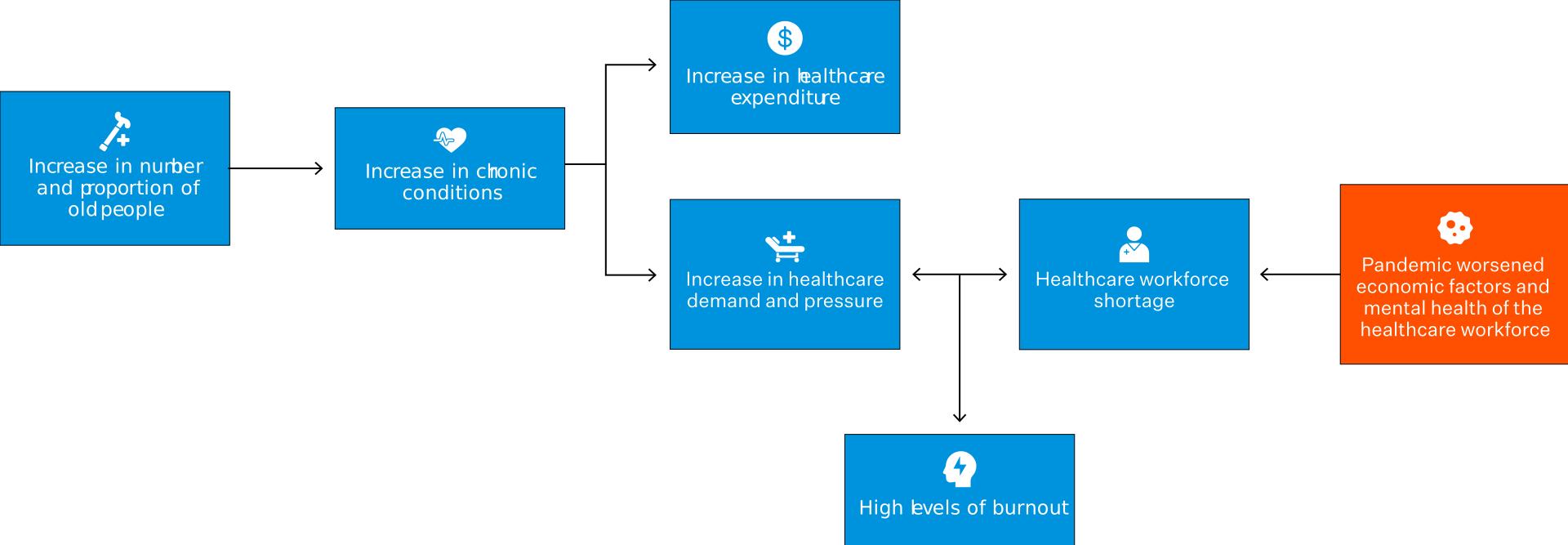
Source: European University Hospital Alliance, 2024. Rethinking healthcare systems in Europe: A call for urgent, Europe-wide and EU-funded research and collaboration.
This graph highlights the structural pressures facing health systems, pressures that make AI-enabled efficiency not optional, but essential.
Global momentum: adoption patterns demonstrate maturity
International deployments reinforce AI’s growing resilience and reliability:
- Alberta’s large-scale pilot processed thousands of conversations and is now expanding across emergency departments for more than 800 clinicians.
- Released as an open-source platform, it demonstrates transparency, reproducibility, and scalability, even in high-pressure emergency care environments.
These examples demonstrate that well-designed AI tools can excel in complex, real-world environments
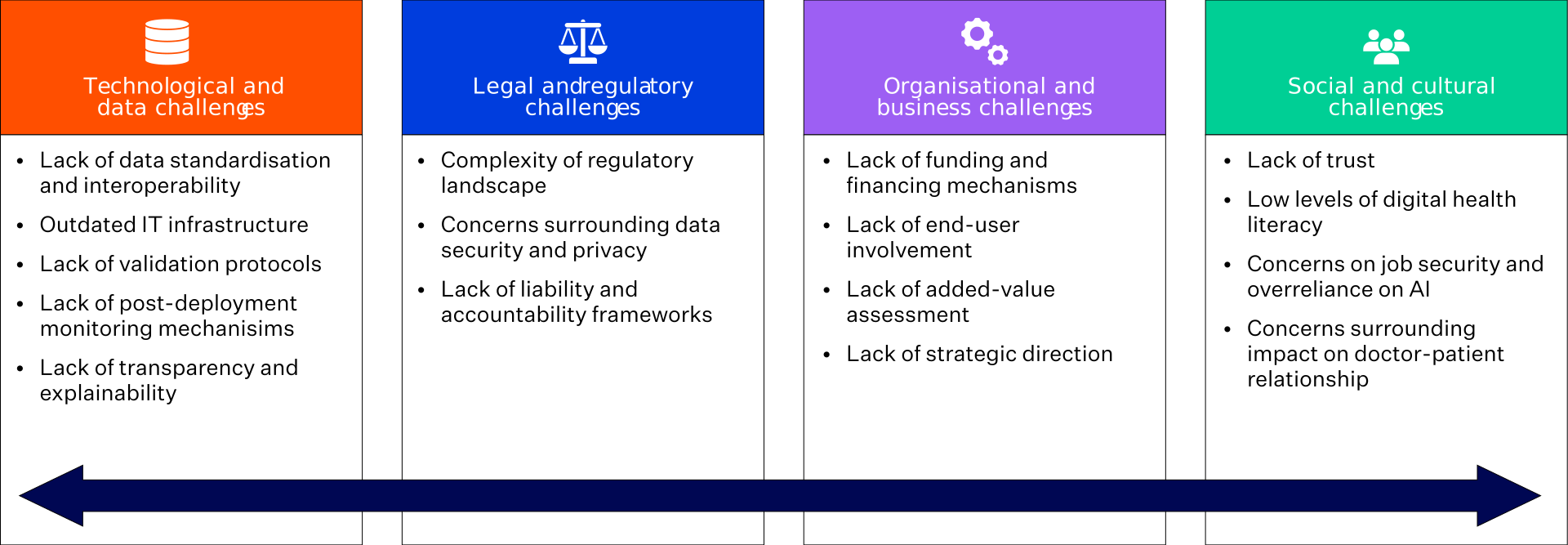
Source: https://health.ec.europa.eu/publications/study-deployment-ai-healthcare-publications-office-
eurep_en
This graph contextualises why many start-ups struggle: the sector demands high standards for safety, data quality, validation, interoperability, and regulatory compliance.
Regulation is not a barrier; it’s the foundation of trust
Rising regulatory expectations are filtering out poorly governed tools while strengthening those that can deliver sustainable value.
Canada’s ML-enabled medical device guidance focuses on:
- transparency and explainability
- robust evidence requirements
- drift detection and lifecycle monitoring
- fairness and bias controls
Many early-stage companies are simply unprepared for this level of scrutiny.
The NHS TEST (Technology Evaluation Safety Test) framework similarly demands:
- platform assurance
- demonstrated clinical and operational benefit
- readiness for scale
The message is clear: enthusiasm isn’t enough. Technologies must perform reliably under real conditions, at real scale, and under real constraints.
NHS England’s specific guidance for ambient scribing goes further, framing these tools as major levers for productivity, but only when paired with rigorous governance, safety monitoring, and staff training.
Why many start-ups will fail and why that’s not a bad thing
The challenge is structural, not technological. Healthcare demands:
- extreme reliability
- validated performance across diverse populations
- integration with entrenched systems
- evidence that takes years, not months
- the ability to scale across different clinical settings
Many start-ups underestimate these demands or lack the organisational depth to survive long evaluation cycles. In healthcare AI, the winning advantage isn’t the model itself, but rather the ability to integrate seamlessly into existing digital ecosystems.
Attrition is natural. This is what consolidation looks like in a maturing sector.
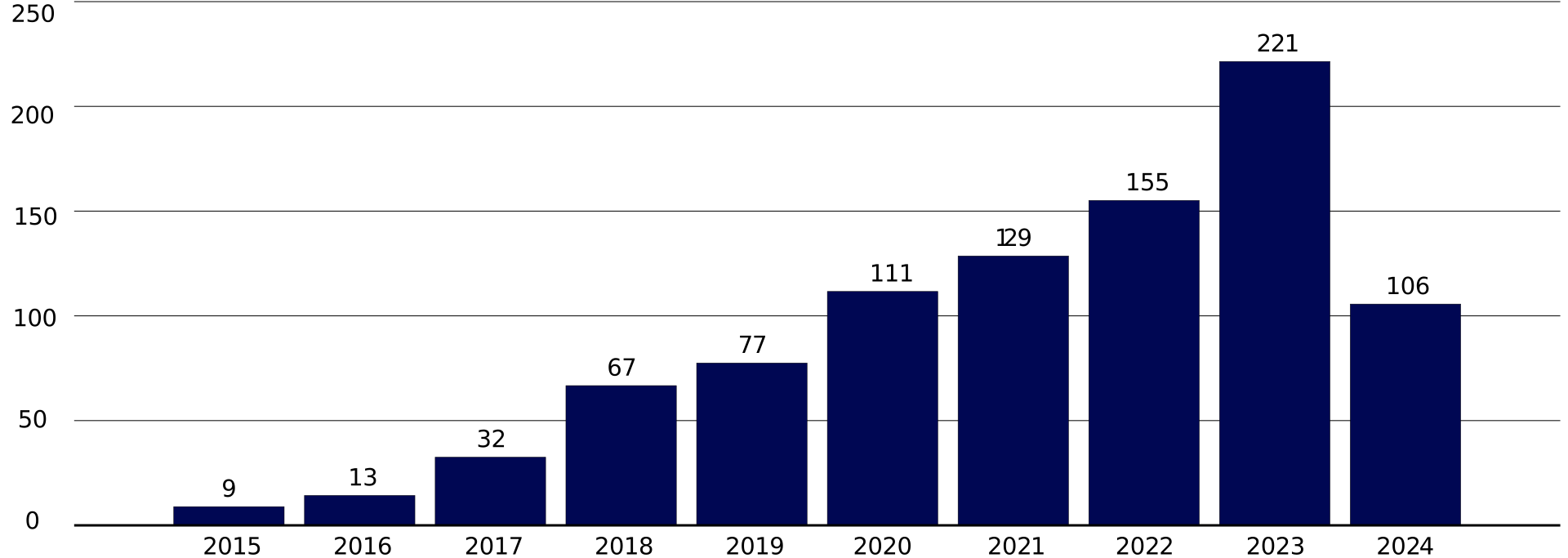
https://www.fda.gov/medical-devices/software-medical-device-samd/artificial-intelligence-enabled
-medical-devices
The steady growth in approvals demonstrates an increasing level of regulatory confidence and the mainstreaming of AI-enabled technologies.
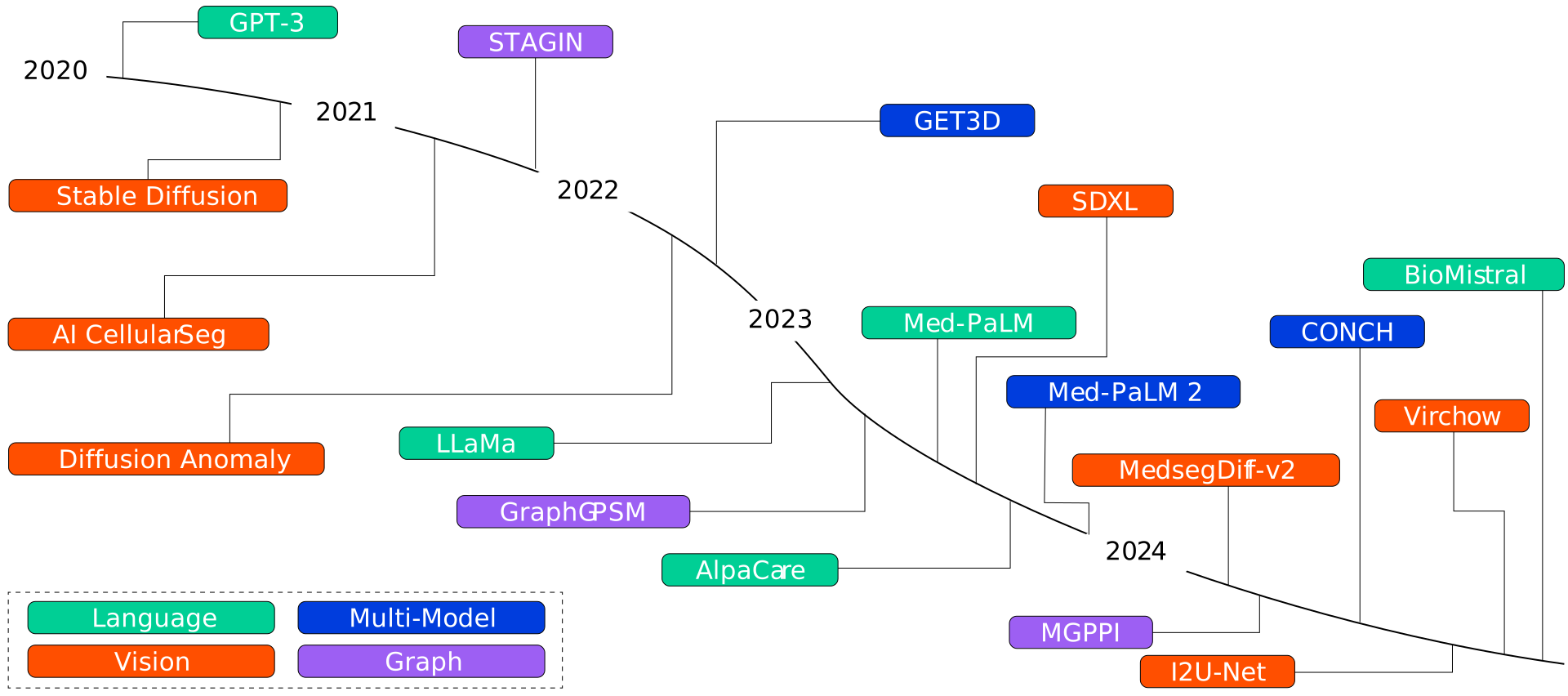
Source: Su, YunHe, Zhengyang Lu, Junhui Liu, Ke Pang, Haoran Dai, Sa Liu, Yuxin Jia, Lujia Ge, and Jing-min Yang. “Applications of large models in medicine.” arXiv preprint arXiv:2502.17132 (2025).
This timeline illustrates the rapid maturation of LLM technology and why healthcare can now safely adopt it at scale.
Healthcare AI is entering its refinement phase, and that’s where transformation happens.
We are not witnessing a decline in healthcare AI. We are witnessing:
- rising standards
- stronger regulation
- more sophisticated evaluation
- increasing clinician trust
- evidence that is finally maturing
- successful large-scale deployments
AI-enabled documentation is already reducing burden and improving care quality. Predictions, diagnostics, and workflow automation tools are progressing steadily under clearer governance frameworks.
The failures of individual start-ups are not failures of AI. They are signs of a sector getting more rigorous, more mature, and more capable of supporting technologies that deliver real, measurable, safe value.
The technology is proving itself.
The systems around it are improving.
The benefits are already visible.
Healthcare AI is not contracting, it is refining.
And refinement is how lasting transformation happens.
Authored by Tom Varghese, Global Product Marketing & Growth Manager at Orion Health.
References
- Revelation Partners. 2025. Five Takeaways on the State of AI in Healthcare from HLTH 2025. October 29.
- Kanaparthy, Naga Sasidhar, Yenny Villuendas-Rey, Tolulope Bakare, Zihan Diao, Mark Iscoe, Andrew Loza, Donald Wright, Conrad Safranek, Isaac V. Faustino, Alexandria Brackett, Edward R. Melnick, and R. Andrew Taylor. 2025. “Real-World Evidence Synthesis of Digital Scribes Using Ambient Listening and Generative Artificial Intelligence for Clinician Documentation Workflows: Rapid Review.” JMIR AI 4 (1).
- Alberta Machine Intelligence Institute. 2025. AI Scribe Cuts Admin Burden, Boosts Efficiency and Patient Care in Emergency Departments. May 21.
- Wright, Aileen P., Carolynn K. Nall, Jacob J. H. Franklin, Sara N. Horst, Yaa A. Kumah-Crystal, Adam T. Wright, and Dara E. Mize. 2025. “Enterprise-Wide Simultaneous Deployment of Ambient Scribe Technology: Lessons Learned from an Academic Health System.” Journal of the American Medical Informatics Association.
- Olson, Kristine D., Daniella Meeker, Matt Troup, Timothy D. Barker, Vinh H. Nguyen, Jennifer B. Manders, Cheryl D. Stults, Veena G. Jones, Sachin D. Shah, Tina Shah, and Lee H. Schwamm. 2025. “Use of Ambient AI Scribes to Reduce Administrative Burden and Professional Burnout.” JAMA Network Open 8 (10).
- Health Canada. 2025. Pre-Market Guidance for Machine Learning-Enabled Medical Devices. February 5.
- Sridharan, Shankar, Catherine Peters, Luke Readman, Bruno Botelho, Andrew Taylor, Neil Sebire, and Robert Robinson. 2025. “NHS TEST: Not Every AI Is Intelligent, but We Need an Intelligent Framework to Choose New Technologies.” Health Innovation Network.
- NHS England. 2024. Planning and Implementing Real-World Artificial Intelligence (AI) Evaluations: Lessons from the AI in Health and Care Award. October 16.
- NHS England. 2025. AI-Enabled Ambient Scribing Products in Health and Care Settings: An Overview for NHS Executives and Boards. April 27.
- NHS England. 2025. Guidance on the Use of AI-Enabled Ambient Scribing Products in Health and Care Settings. April 29.