

 US
US CA
CA GB
GB AU
AU NZ
NZBuild versus buy is one of those technology debates that can consume an extraordinary amount of attention. Yet the economics of digital health become much more interesting after go-live.
The more useful executive question is: what will this capability cost over its economic life, and can the organisation convert that expenditure into measurable clinical and commercial value?
What is the true total cost of ownership in digital health?
The OCI Total Cost of Ownership Guide defines total cost of ownership (TCO) broadly, incorporating acquisition, operation, maintenance and eventual decommissioning. It also includes costs that are easily overlooked during procurement, such as internal IT capacity, interfaces, and third-party software support.
A worked procurement example puts this into perspective. One supplier costs $2.33 million initially compared with $2.87 million for another. But once five years of operating expenditure, disposal, and residual value are included, their present-value costs are approximately $3.43 million and $3.47 million. The apparent advantage at acquisition has almost disappeared.
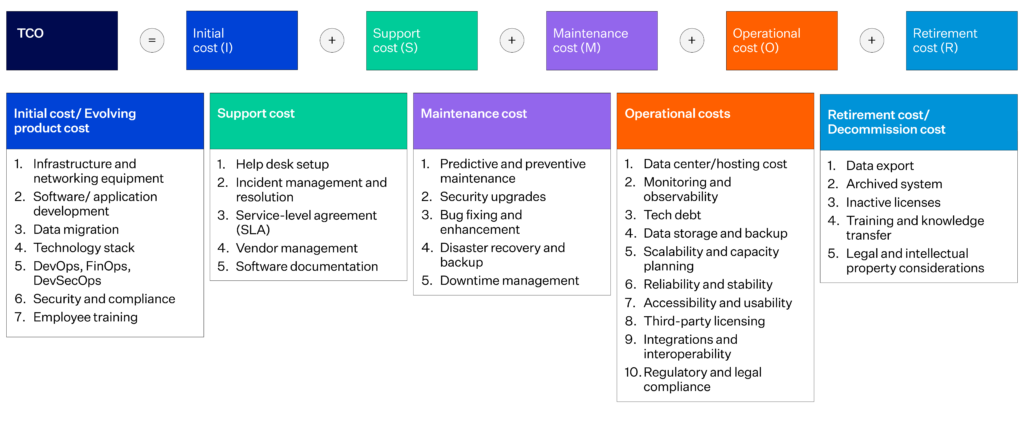
Digital products follow the same pattern. Simform’s TCO framework separates initial development from support, maintenance, operational and retirement costs.
Source: Simform
Healthcare adds another layer. Digital platforms change clinical workflows, consume clinical time during implementation and require ongoing optimisation, cybersecurity and governance.
How long does digital health ROI take to show?
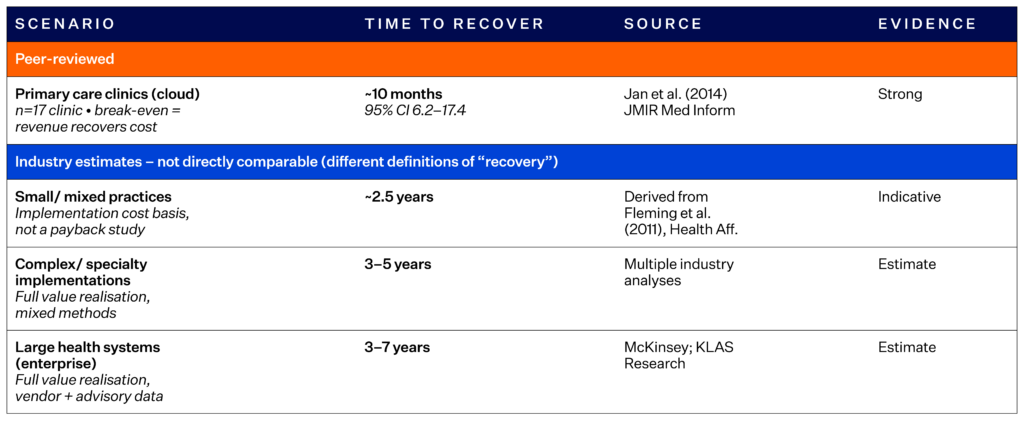
The AHRQ-funded study by Fleming and colleagues shows what this can look like in practice. Across 26 primary care practices, physician productivity fell by around 8% in the first six months after an EHR was introduced. Practice costs increased, while income initially fell before recovering.
The study also found that significant staff time went into redesigning workflows, training and supporting the go-live, on top of ongoing software and maintenance costs. In other words, digital investment costs more than money. It also requires clinical time, staff capacity and ongoing attention.
Nguyen and colleagues’ 2024 economic framework for digital hospitals reinforces the need for a longer lens. Some transformational benefits may take at least three years after implementation to emerge.
Source: Jang et al. (2014), Fleming et al. (2011), McKinsey and KLAS Research. Industry estimates are directional and not directly comparable.
Why is digital health ROI difficult to measure?
The equation looks straightforward:
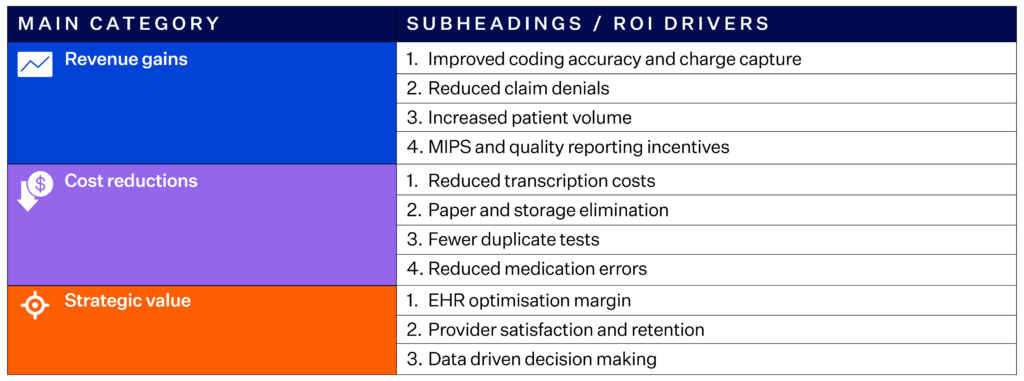
ROI = ((Total Benefits – Total Costs) / Total Costs) × 100
The difficult part is quantifying total benefits.
Wilkinson and colleagues make a simple point: saving time only creates value if the health system can put that time to better use. Saving 10 minutes in a workflow has a limited financial impact unless it allows clinicians to see more patients, reduces costs, or improves care.
Source: EHR Source
This becomes even more important at scale. Baringa’s 2026 analysis of more than half of England’s acute NHS trusts found that, at its 2024/25 peak, around 65% of local technology spending went towards keeping existing systems running.
The challenge is not just how much you spend on technology today, but how much of tomorrow’s budget is already tied up maintaining what you have.
When should healthcare organisations build or buy?
Build versus buy still matters, but it should be treated as an allocation decision.
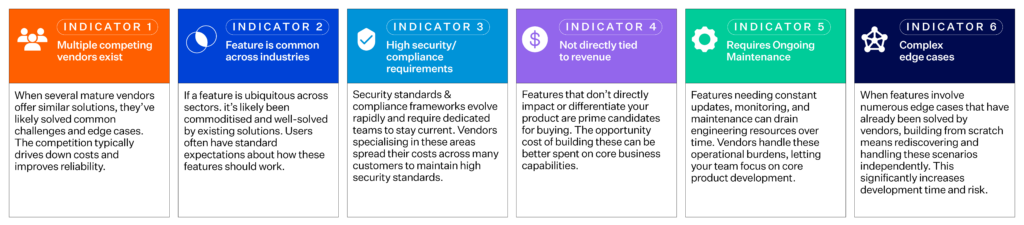
Gupta’s framework suggests a simple question: Does this capability give the organisation a real competitive advantage? If mature vendors already solve the problem, especially where security and ongoing maintenance are complex, buying can free up internal engineering teams to focus on work that delivers greater value.
Source: Aakash Gupta
Building makes more sense when the capability is central to what makes the organisation different or when greater control delivers clear value. Buying comes with its own risks, including rising contract costs, integration challenges, vendor dependency and future migration costs.
Often, the best approach is a mix of both: buy what is widely available and build what genuinely sets the organisation apart.
Digital health investment is an operating model decision.
The 2025 Digital Health Most Wired analysis found that leading digital health organisations have clear executive ownership and strong governance. Increasingly, success comes from getting more value from existing technology, not simply adding more of it.
For boards and executive teams, this means looking beyond build versus buy. Consider what the technology will cost over its entire life, including the clinical and technical resources needed to run, improve and eventually replace it. Then weigh those costs against the benefits it actually delivers.
The goal is a sustainable operating model that turns digital investment into better care and economic value.
Build or buy is simply a choice about how you get there.
Authored by Tom Varghese, Global Product Marketing & Growth Manager at Orion Health.
References
- American Medical Association. (2019). Impact of high capital costs of hospital EHRs on the medical staff (Board of Trustees Report 32 A 19). American Medical Association.
- Arcadia. (2022, September 15). Build vs. buy in healthcare IT: The battle for buy in.
- Baringa. (2026, July 22). The NHS local technology spend report.
- Dhaduk, H. (2025, January 3). CTO’s guide to the total cost of ownership (TCO) of a digital product. Simform.
- Fleming, N. S., Aponte, P., Ballard, D. J., Becker, E., Collinsworth, A., Culler, S., Kudyakov, R., McCorkle, R., & Chang, D. (2011). Exploring financial and non financial costs and benefits of health information technology: The impact of an ambulatory electronic health record on financial and workflow in primary care practices and costs of implementation (Grant No. R03HS018220 01). Agency for Healthcare Research and Quality.
- Gray, M. (2026, February 14). How much does an EHR cost? A complete pricing guide for 2026. EHR Source.
- Gupta, A. (2024, December 22). The product leader’s guide to buying vs. building software. Medium.
- Nguyen, K. H., Comans, T., Nguyen, T. T., Simpson, D., Woods, L., Wright, C., Green, D., McNeil, K., & Sullivan, C. (2024). Cashing in: Cost benefit analysis framework for digital hospitals. BMC Health Services Research, 24, Article 694.
- OCI. (2022). Total cost of ownership guide (Rev. January 2022). Innovation Procurement Toolkit.
- Paxman, E. (2025, November 12). Digital Health Most Wired: National trends 2025. KLAS Research.
- Wilkinson, T., Wang, M., Friedman, J., Gaye, Y. E., & Görgens, M. (2024). Knowing when digital adds value to health: A framework for the economic evaluation of digital health interventions. Oxford Open Digital Health, 2(Supplement 2), ii75–ii86.