

 US
US CA
CA GB
GB AU
AU NZ
NZOne of the more uncomfortable truths in digital health is that many clinicians are surrounded by information they cannot easily use.
A patient record may contain years of notes, test results, referrals, medication changes, images, discharge summaries, and patient messages. Yet at the point of care, clinicians are often still asking a simple question: Where is the information I need right now?
Healthcare has invested heavily in capturing data. Far less attention has been paid to helping clinicians efficiently retrieve, interpret, and apply that information. The result is a paradox: health systems can be rich in data yet poor in usability.
The challenge is not a lack of information. It is the growing difficulty of finding what matters within the time constraints of real clinical practice.
Research on clinical summarisation highlights the scale of the problem. Patient information is often spread across progress notes, laboratory results, office visits, referrals, and transcribed communications. Clinicians may spend up to 30 minutes reviewing a chart before making a decision, and even then, important details can be overlooked.
This means that clinical work increasingly involves assembling evidence before care decisions can begin.
Why finding information feels so hard
The problem is amplified by how many electronic health records are designed.
Researchers describe two common issues: display fragmentation and task fragmentation. Relevant information is distributed across multiple screens, tabs, and workflows, forcing clinicians to repeatedly search, switch contexts, and recheck information.
Every transition creates additional cognitive load. Instead of focusing solely on diagnosis and treatment, clinicians must hold information in memory while navigating multiple systems to locate related data.
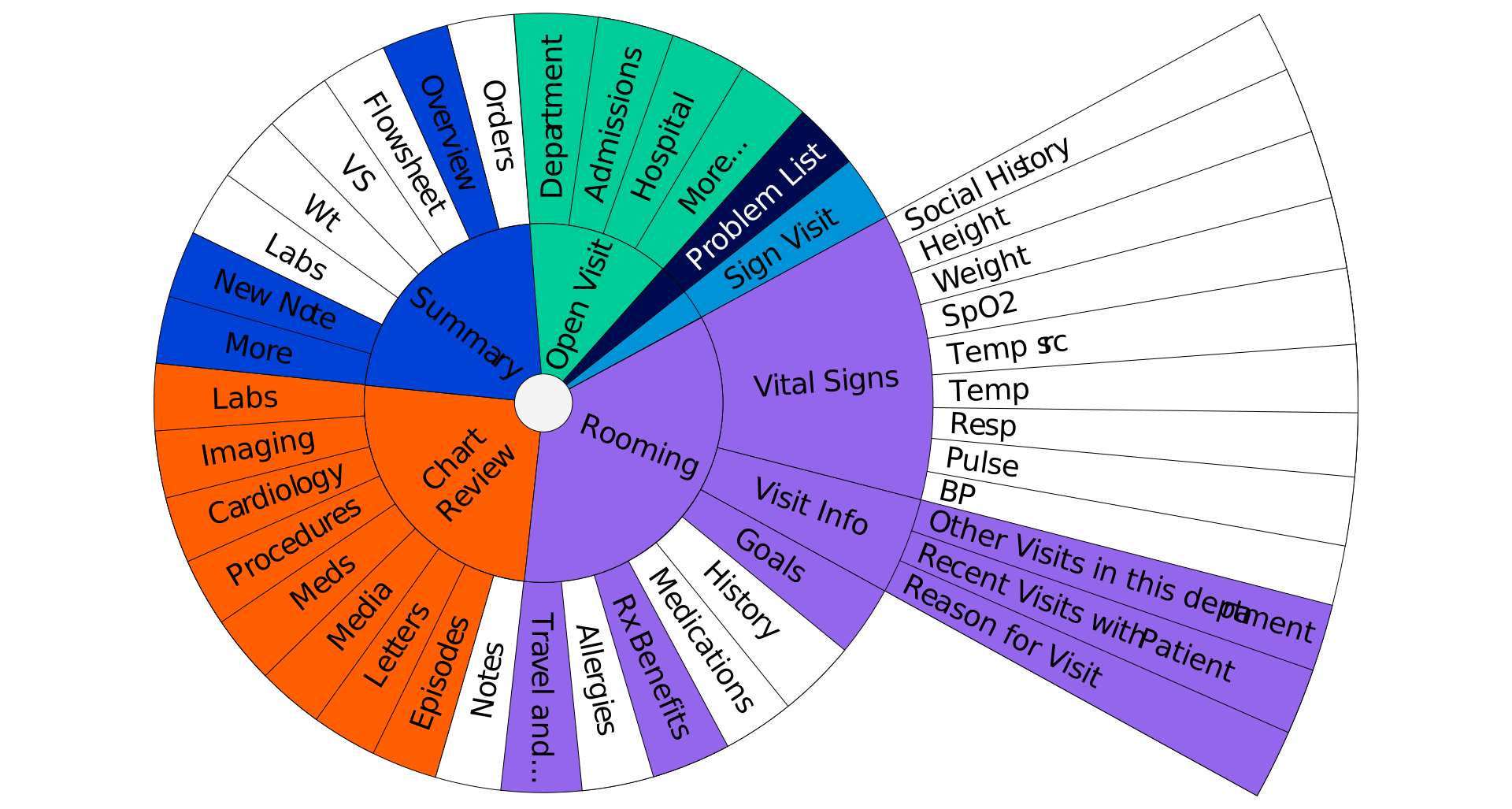
Source: Senathirajah et al. (2017)
The result is not simply inefficiency. It is a workflow that makes complex clinical reasoning harder than it needs to be.
The hidden cost of search-poor health systems
The evidence suggests this burden is significant.
A study of approximately 100 million outpatient encounters involving 155,000 US physicians found clinicians spent an average of 16 minutes and 14 seconds per encounter actively using the EHR. Chart review accounted for the largest share of that time at 33%, followed by documentation and ordering activities.
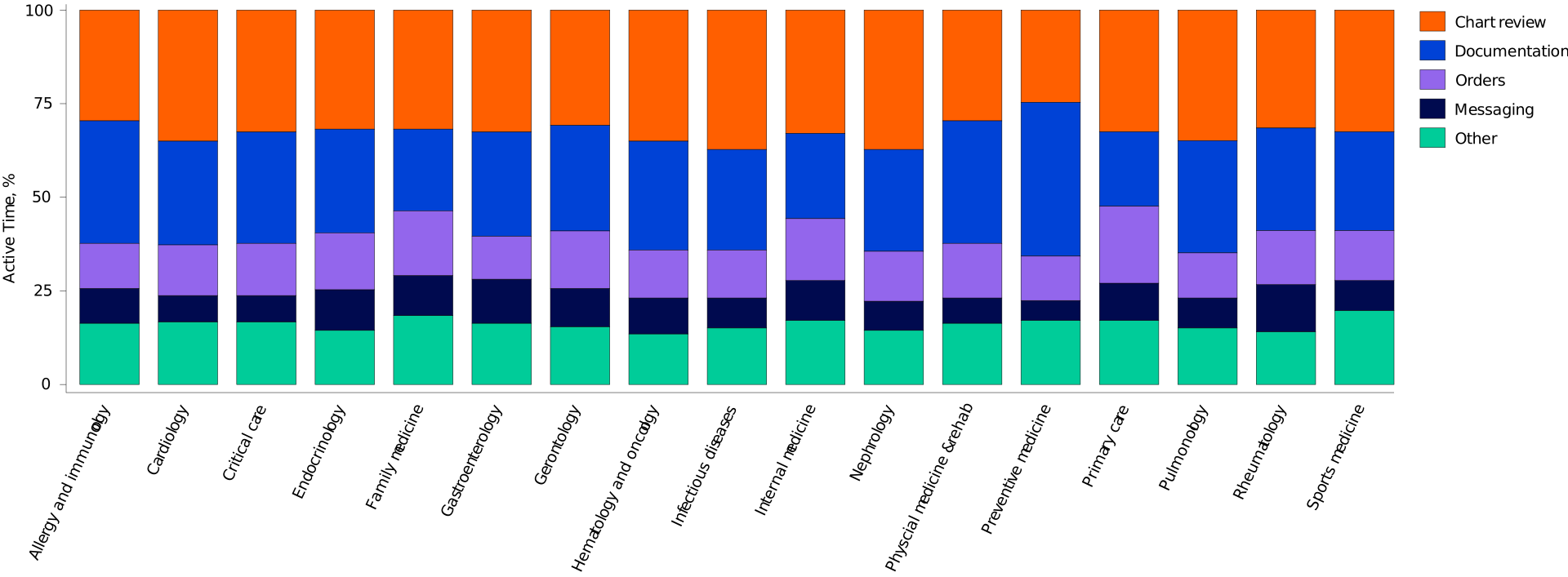
Source: Overhage & McCallie (2020)
Meanwhile, a cross-national study of 371 health systems found that US clinicians spent more time in EHRs, received more messages, and worked longer after hours than their international counterparts.
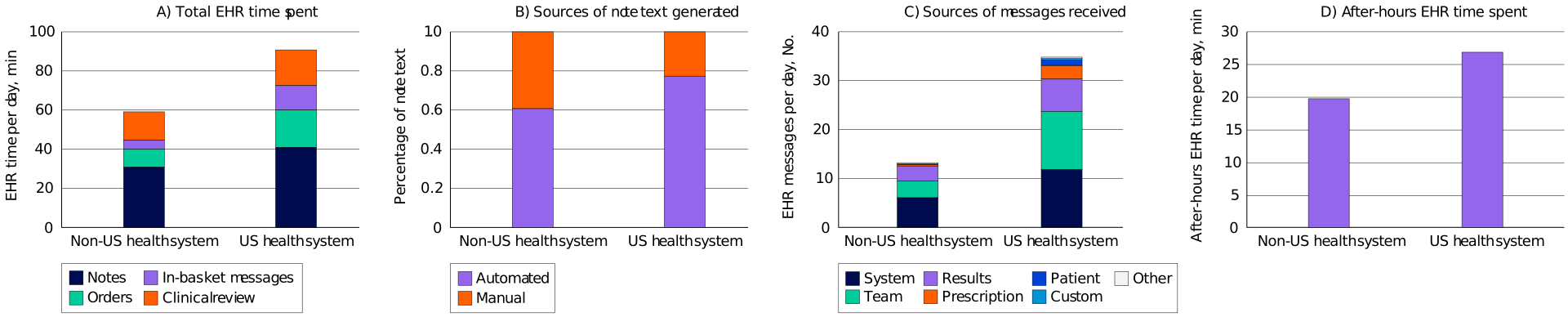
Source: Holmgren et al. (2021)
For executives, these findings represent more than workflow frustrations. Every minute spent searching for information consumes scarce clinical capacity, contributes to burnout, and reduces the value generated from digital investments.
Can AI solve the problem?
The healthcare industry is increasingly looking to AI-powered search, summarisation, and ambient documentation tools for answers.
Recent studies suggest that large language models can generate high-quality clinical summaries, in some cases matching or exceeding expert performance. Ambient AI scribes are also showing promise in reducing documentation burden and clinician fatigue.
However, faster access to information is only valuable if the information can be trusted.
Healthcare leaders must answer difficult governance questions. What source data supports the summary? How is uncertainty communicated? Who is accountable when information is omitted or misrepresented? How consistently does the system perform across specialties, populations, and care settings?
Without strong governance, AI risks becoming another layer of complexity rather than a solution.
From digital records to clinical intelligence
The real opportunity is not simply a better search. It is redesigning information access around how clinicians think.
Clinicians rarely ask for an entire record. They ask questions such as:
- What has changed?
- What is abnormal?
- What treatments have already been tried?
- What risks should I know about?
- What is still pending?
- What matters for this decision right now?
Health systems that organise information around these questions can reduce cognitive burden while improving safety and efficiency.
The next phase of digital health will not be defined by how much information organisations collect. It will be defined by how effectively that information can be transformed into clinical insight at the point of care.
Capture was the first era. Interoperability was the second. The next competitive advantage will be clinically governed retrieval: information that is findable, contextual, and usable when decisions matter most.
The organisations that solve this challenge will do more than improve user experience. They will unlock clinical capacity, strengthen patient safety, and finally turn digital investment into measurable care delivery outcomes.
Authored by Tom Varghese, Global Product Marketing & Growth Manager at Orion Health.
References:
- Budd, J. (2023). Burnout related to electronic health record use in primary care. Journal of Primary Care & Community Health, 14, 21501319231166921.
- Chien, A., Tang, H., Jagessar, B., Chang, K. W., Peng, N., Nael, K., & Salamon, N. (2024). AI assisted summarisation of radiologic reports: Evaluating GPT3davinci, BARTcnn, LongT5booksum, LEDbooksum, LEDlegal, and LEDclinical. American Journal of Neuroradiology, 45(2), 244 to 248.
- Chuang, Y. N., Tang, R., Jiang, X., & Hu, X. (2024). SPeC: A soft prompt based calibration on performance variability of large language model in clinical notes summarisation. Journal of Biomedical Informatics, 151, 104606.
- Holmgren, A. J., Downing, N. L., Bates, D. W., Shanafelt, T. D., Milstein, A., Sharp, C. D., Cutler, D. M., Huckman, R. S., & Schulman, K. A. (2021). Assessment of electronic health record use between US and non US health systems. JAMA Internal Medicine, 181(2), 251 to 259.
- Lee, C., Vogt, K. A., & Kumar, S. (2024). Assessing the role of clinical summarisation and patient chart review within communications, medical management, and diagnostics. arXiv.
- Olson, K. D., Meeker, D., Troup, M., Barker, T. D., Nguyen, V. H., Manders, J. B., Stults, C. D., Jones, V. G., Shah, S. D., Shah, T., & Schwamm, L. H. (2025). Use of ambient AI scribes to reduce administrative burden and professional burnout. JAMA Network Open, 8(10), e2534976.
- Overhage, J. M., & McCallie, D., Jr. (2020). Physician time spent using the electronic health record during outpatient encounters: A descriptive study. Annals of Internal Medicine, 172(3), 169 to 174.
- Senathirajah, Y., Kaufman, D. R., Cato, K. D., Borycki, E. M., Fawcett, J. A., & Kushniruk, A. W. (2020). Characterizing and visualizing display and task fragmentation in the electronic health record: Mixed methods design. JMIR Human Factors, 7(4), e18484.
- Senathirajah, Y., Wang, J., Borycki, E., & Kushniruk, A. (2017). Mapping the electronic health record: A method to study display fragmentation. Studies in Health Technology and Informatics, 245, 1138 to 1142.
- Van Veen, D., Van Uden, C., Blankemeier, L., Delbrouck, J. B., Aali, A., Bluethgen, C., Pareek, A., Polacin, M., Reis, E. P., Seehofnerová, A., Rohatgi, N., Hosamani, P., Collins, W., Ahuja, N., Langlotz, C. P., Hom, J., Gatidis, S., Pauly, J., & Chaudhari, A. S. (2024). Adapted large language models can outperform medical experts in clinical text summarisation. Nature Medicine, 30, 1134 to 1142.