

 US
US CA
CA GB
GB AU
AU NZ
NZHealthcare has spent decades making patient information easier to record, store and share. But even when a scan report or test result is available, a diagnosis can still be delayed.
Someone needs to review the result, understand what it means for the patient and take the next step. Healthcare technology needs to help make sure this happens.
Why does diagnosis depend on the whole health system
A diagnostic error can mean failing to explain a patient’s health problem accurately and in a timely manner, or failing to communicate that explanation to the patient. Getting a diagnosis right, therefore, depends on more than one clinician.
Patients explain their symptoms and history. Nurses share observations, while laboratories, imaging services and specialists provide findings and advice. Technology helps bring this information together, but teams also need clear responsibility for what happens next.
The framework below shows how these steps connect throughout the patient’s care.

Source: National Academies (2015), reproduced in Shafer and Gautham (2022).
Why do test results still get missed in electronic records?
Having a result in an electronic record does not mean someone will follow up on it. In 2007, Wahls and Cram found that clinicians in a highly computerised US Veterans Health Administration setting still reported missed results and treatment delays. Cancer was the condition most often linked to those reported delays.
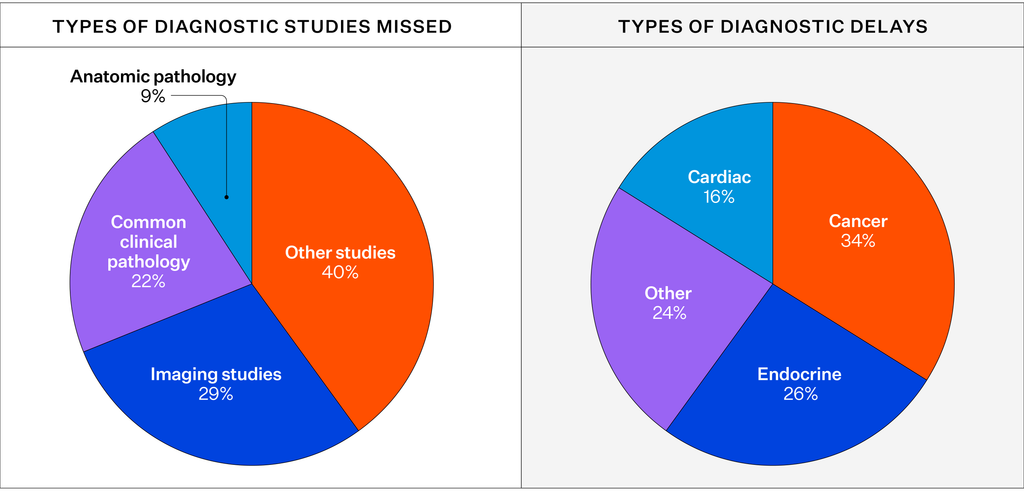
Source: Wahls and Cram (2007).
A 2013 survey of 2,590 Veterans Affairs primary care practitioners helps explain why. They reported a median of 63 electronic alerts a day. Nearly 87% felt they received too many, and almost 30% said they had missed results, delaying patient care.
Research published in 2022 found continuing problems across 12 facilities. These included uncertainty about who should follow up on unexpected imaging findings or results that arrived after a patient had left the hospital. Some ways to address these problems were already known but were not consistently used.
The recurring problem is the gap between a result arriving and someone taking the next step.
What helps teams reliably follow up on test results?
Barwise and colleagues found that diagnostic errors and delays were influenced by how services were organised, how clinicians worked and patients’ circumstances. These factors affected how information was gathered, understood and used to make and communicate decisions.
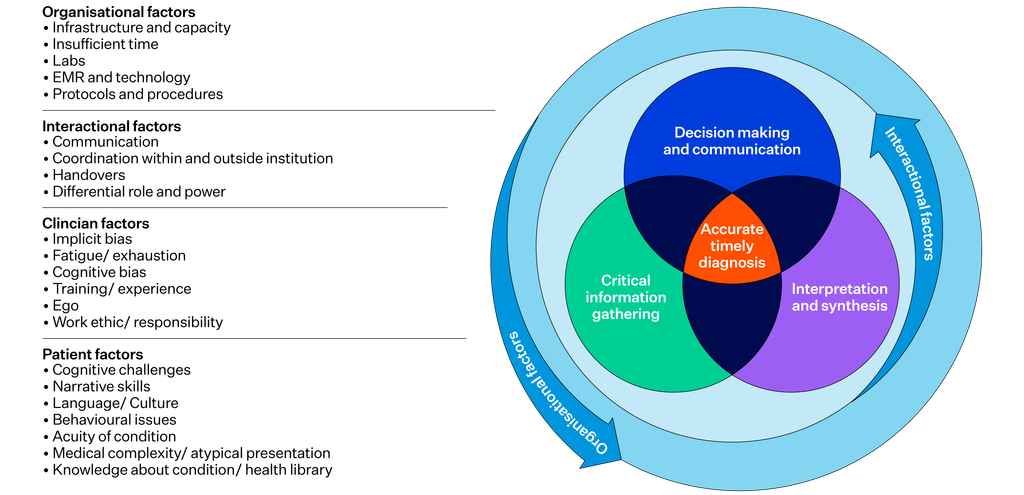
Source: Barwise et al. (2021).
For health system leaders, this raises practical questions:
- Who reviews a result when the clinician who ordered the test is unavailable?
- Who follows up on findings after a patient leaves the hospital?
- What happens when a report is updated?
- How do teams know that the patient has been informed and the next steps have been arranged?
Technology needs to support clear responsibilities and working processes. Sending an alert is only one part of making sure a result is followed up.
Can AI help identify missed diagnoses?
AI may help health systems find cases where a diagnosis was missed or delayed. A 2024 study used machine learning to review two selected groups of patients whose records had already been flagged by automated checks. It improved the identification of missed opportunities for diagnosis, although testing in other settings was still needed.
Finding problems is one step; improving care is another. A separate 2024 trial across 12 Veterans Affairs medical centres tested a programme to improve test result follow-up. It found no overall significant improvement, although the centre with the lowest follow-up rate at the start improved.
Health systems, therefore, need to measure whether new tools and processes help patients receive the care they need.
Measure what happens after a test result arrives.
When investing in diagnostic technology, health systems should consider how long patients wait for assessment, how many abnormal results still require follow-up, and whether agreed-upon next steps are completed. They should also ask whether patients understand their results and what happens next.
Healthcare has made progress in sharing information. The next challenge is making sure that information is used.
That starts with finding where results wait, where responsibility becomes unclear and where follow-up is missed. The goal is to help teams turn important findings into timely decisions and care.
Give care teams a clearer view of the patient’s story. Explore Orion Health’s Clinical Portal.
Authored by Tom Varghese, Global Product Marketing & Growth Manager at Orion Health.
References
- Newman-Toker DE. Just how many diagnostic errors and harms are out there, really? It depends on how you count. BMJ Qual Saf. 2025;34(6):355–360.
- Zubkoff L, Zimolzak AJ, Meyer AND, et al. A virtual breakthrough series collaborative for missed test results: a stepped-wedge cluster-randomized clinical trial. JAMA Netw Open. 2024;7(10):e2440269.
- Zimolzak AJ, Shahid U, Giardina TD, et al. Why test results are still getting “lost” to follow-up: a qualitative study of implementation gaps. J Gen Intern Med. 2022;37(1):137–144.
- Barwise A, Leppin A, Dong Y, et al. What contributes to diagnostic error or delay? A qualitative exploration across diverse acute care settings in the United States. J Patient Saf. 2021;17(4):239–248.
- Wahls TL, Cram PM. The frequency of missed test results and associated treatment delays in a highly computerized health system. BMC Fam Pract. 2007;8:32.
- Singh H, Spitzmueller C, Petersen NJ, Sawhney MK, Sittig DF. Information overload and missed test results in electronic health record-based settings. JAMA Intern Med. 2013;173(8):702–704.
- Zimolzak AJ, Wei L, Mir U, et al. Machine learning to enhance electronic detection of diagnostic errors. JAMA Netw Open. 2024;7(9):e2431982.
- World Health Organization. World Patient Safety Day 2024: improving diagnosis for patient safety. Geneva: World Health Organization; 2024.
- Institute of Medicine. Improving Diagnosis in Health Care. Washington, DC: National Academies Press; 2015.
- Bradford A, Ehsan S, Shahid U, Blackall L, Singh H. Electronic test result communication in the era of the 21st Century Cures Act. Rockville, MD: Agency for Healthcare Research and Quality; July 2024. AHRQ Publication No. 24-0010-3-EF.
- Auerbach AD. Laying a foundation for the use of artificial intelligence in diagnosis. JAMA Netw Open. 2024;7(9):e2431907.