


 CA
CA GB
GB AU
AU NZ
NZThe electronic health record (EHR) has become exceptionally good at remembering. It preserves years of consultations, test results, medication changes and clinical reasoning across multiple care settings. But retaining information is not the same as presenting a clinically coherent record.
The challenge facing healthcare is no longer capturing data. It helps clinicians quickly identify what is current, relevant, and trustworthy when making decisions.
When more documentation creates less clarity
A good clinical record should explain a patient’s current state. It should highlight what has changed without forcing clinicians to reconstruct the patient’s history from hundreds of separate documents.
Many EHRs struggle with this distinction. They preserve an increasingly comprehensive record but often leave clinicians to determine which information remains current, which has been superseded and which has simply been copied forward.
The scale of duplication is striking. A study analysing more than 104 million clinical notes from almost two million patients found that 50.1% of all text was duplicated in earlier documentation. Almost half of that duplicated content came from another clinician, showing duplication is embedded within team-based documentation rather than individual habits.
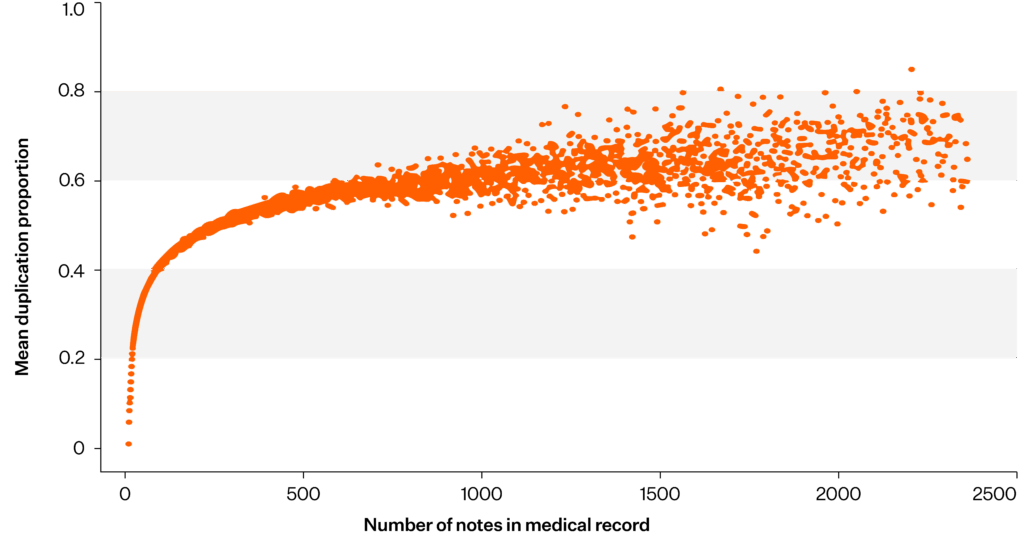
Source: Steinkamp, Kantrowitz & Airan-Javia (2022), JAMA Network Open
The problem also grows as records become larger. Between 2015 and 2020, duplicated content increased from 33% to 54.2%, with the largest records approaching 60% duplication.
When comprehensive records become harder to use
Duplication is more than an administrative issue. It affects clinical decision-making.
When important findings are surrounded by repeated text, clinicians spend more time determining what is new, what remains accurate and what can safely be ignored. Errors copied into multiple notes also become harder to correct because fixing one version does not remove the others.
Research in paediatric ophthalmology found that serial visit notes averaged 6.5 pages, yet only 32% of the content was new. Despite extensive documentation being available, attending physicians reviewed just two prior notes on average, only 7% of the patient’s available record.
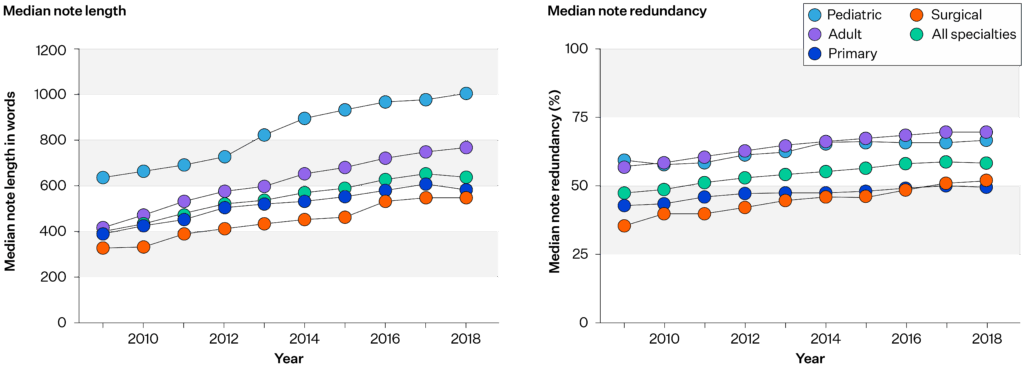
Source: Steinkamp, Kantrowitz & Airan-Javia (2022), JAMA Network Open
The record may therefore be comprehensive in theory while only partially usable in practice.
The real problem isn’t copy-and-paste.
The obvious response might be to prohibit copy-and-paste. The evidence suggests that it would be the wrong solution.
A study of almost nine million clinical notes found substantial variation in reuse across clinicians and settings. The researchers cautioned against treating copied content as a proxy for poor documentation. Reusing information can reduce administrative burden while preserving important clinical context.
The objective should therefore not be eliminating reuse. It should make reused information visible, traceable and easy to verify.
The paper record still shapes the digital one
Today’s documentation architecture forces clinicians into an unnecessary trade-off. They can repeat unchanged information in every note, creating duplication, or document only new developments, scattering the patient’s story across dozens of encounters.
This is largely a design problem rather than a documentation problem.
Most EHRs still organise information by time and author, reflecting the structure of paper records. Yet clinicians think in terms of problems, diagnoses and care plans, not individual encounters.
An alternative is a living clinical workspace where information is organised around clinical problems. Unchanged information remains in place while clinicians update only what has changed. Version history preserves previous states, records authorship and makes changes immediately visible. Early research has shown this model is technically feasible, although it has not yet been evaluated at scale.
Better documentation supports better care.
None of this suggests EHRs have failed. Quite the opposite.
A systematic review of 116 randomised clinical trials involving more than 204,000 participants found that EHR-based interventions reduced the odds of 30-day hospital readmissions by 17% and 90-day readmissions by 28%.
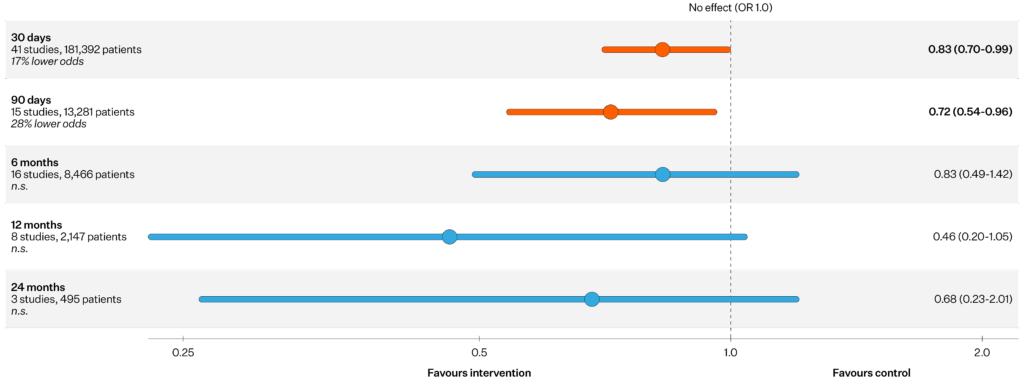
Source: Pattar et al. (2025), JAMA Network Open
EHRs clearly improve patient outcomes. The opportunity now is to improve how clinicians interact with the information they already have.
The next challenge for digital health
Documentation quality should be viewed as a strategic capability, not simply an informatics issue.
Healthcare leaders should ask whether clinicians can identify meaningful clinical change without reading entire notes, whether errors can be corrected at their source, and whether information remains coherent across care settings. Governance should focus on reducing information overload rather than simply increasing documentation.
The EHR has largely solved the problem of preserving the record.
The next generation of digital health must solve the more important one: making the record clinically intelligible.
Authored by Tom Varghese, Global Product Marketing & Growth Manager at Orion Health.
References
- Chiang, M. F. (2019, April 1). EHR documentation reflects ‘paper note paradigm’ (P. Nale, Reporter). Healio.
- Pattar, B. S. B., Ackroyd, A., Sevinc, E., Hecker, T., Turino Miranda, K., McClurg, C., Weekes, K., James, M. T., Pannu, N., Ravani, P., Ronksley, P. E., Ahmed, S. B., & Harrison, T. G. (2025). Electronic health record interventions to reduce risk of hospital readmissions: A systematic review and meta-analysis. JAMA Network Open, 8(7), Article e2521785.
- Steinkamp, J., Kantrowitz, J., Sharma, A., & Bala, W. (2021). Beyond notes: Why it is time to abandon an outdated documentation paradigm. Journal of Medical Internet Research, 23(4), Article e24179.
- Steinkamp, J., Kantrowitz, J. J., & Airan-Javia, S. (2022). Prevalence and sources of duplicate information in the electronic medical record. JAMA Network Open, 5(9), Article e2233348.
- Steinkamp, J., Sharma, A., Bala, W., & Kantrowitz, J. J. (2021). A fully collaborative, noteless electronic medical record designed to minimize information chaos: Software design and feasibility study. JMIR Formative Research, 5(11), Article e23789.
- Vawdrey, D. K., Cauthorn, C., Francis, D., Hackenberg, K., Maloney, G., & Hohmuth, B. A. (2022). A practical approach for monitoring the use of copy-paste in clinical notes. AMIA Annual Symposium Proceedings, 2021, 1178–1185.