


 CA
 GB
 AU
 NZ
A coded diagnosis can tell a care team that someone has diabetes. A clinical note may explain that they are struggling to afford food. The usefulness of a patient record depends partly on how effectively these different forms of information can inform a clinical decision.
Structured and unstructured data are complementary parts of that record. Connecting them can help care teams understand both the clinical picture and the circumstances that shape a person’s care.
What is the difference between structured and unstructured healthcare data?
Structured information occupies defined fields, often using agreed terminology. Laboratory results can be compared with previous measurements, while coded diagnoses can support population analysis and service planning. Consistent definitions make these activities easier, although the quality of the underlying documentation still matters.
Unstructured information includes clinical narratives and other content, such as medical images. A referral letter may explain why a symptom is concerning. A discharge summary may describe the practical support a person needs at home.
These differences become especially consequential when information crosses organisational boundaries. As Eastwood describes, information structured at its source can arrive elsewhere as a document, leaving the receiving organisation with further work before it can use that information in analysis or decision support.
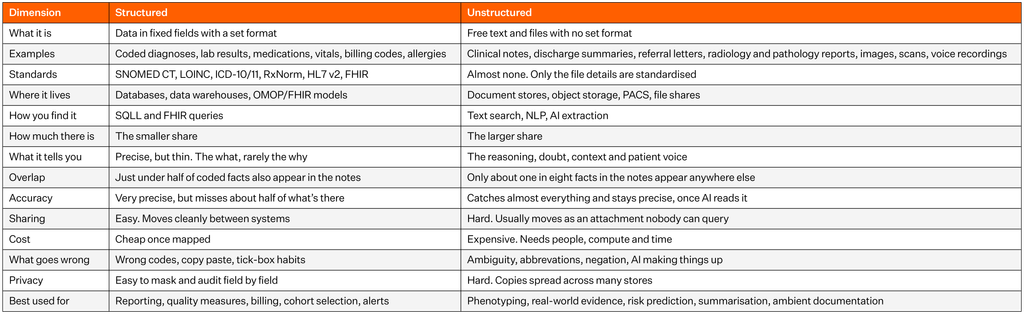
Table compiled with generative AI assistance; sources verified by the author. Eastwood (2023), Li and colleagues (2022), Seinen and colleagues (2025), and Healthcare IT News (2019).
Why do patient records need both forms of information?
Seinen and colleagues examined records covering 1.8 million patients in Dutch primary care. At the patient record level, 13% of concepts extracted from clinical notes had similar structured counterparts, while 42% of structured concepts had similar matches in the notes.
The findings depended on the extraction approach and the threshold used to judge similarity. Nevertheless, they show why the formats deserve attention together: each represented information that the other did not consistently contain.
Earlier research by Kharrazi and colleagues provides a practical example. Among 18,341 older adults, adding information extracted from clinical notes identified substantially more geriatric syndromes than structured claims and record data alone. Falls and lack of social support were among the areas where narrative information added visibility.
The value emerges when relevant context becomes available at the point where someone can act on it.
How does natural language processing make clinical text more usable?
Natural language processing (NLP) provides methods for making clinical text usable at scale. Reviews by Li and colleagues and Kumar and colleagues describe capabilities ranging from extracting clinical concepts to generating summaries.
Reliable extraction requires attention to meaning. A relative’s diagnosis needs to remain distinct from the patient’s diagnosis, just as suspected conditions need to remain distinct from confirmed findings.
The following diagram outlines how clinical text can move through language processing and analysis to produce information for review.

Source: Kumar and colleagues (2026), Natural Language Processing in Healthcare: From Unstructured Data to Clinical Intelligence.
Recent results support carefully chosen applications. Van Veen and colleagues demonstrated strong performance from adapted language models on clinical summarisation tasks. A separate 2025 evaluation by Ntinopoulos and colleagues tested extraction using 50 synthetic medical notes, offering evidence of technical capability while leaving questions about performance in routine documentation.
Does better model performance mean better care?
Improved model performance provides a rationale for investigating a clinical application. Demonstrating benefit requires evaluating what happens when people use it.
A systematic review by Seinen and colleagues found that combining clinical text with structured information generally improved predictive performance, though external validation was limited. A 2025 review of NLP for cognitive decline similarly identified promising results and substantial challenges in applying models across different settings.
Together, these findings reinforce the need to evaluate applications in the workflows and populations they are intended to support.
What does it take to create lasting value from healthcare data?
The investment case must include the work needed to sustain an application. Adnan and colleagues identify interoperability and information extraction among recurring challenges, while Sedlakova and colleagues describe the resources required to prepare and enrich unstructured data.
These challenges extend from preparing the data to interpreting the results.
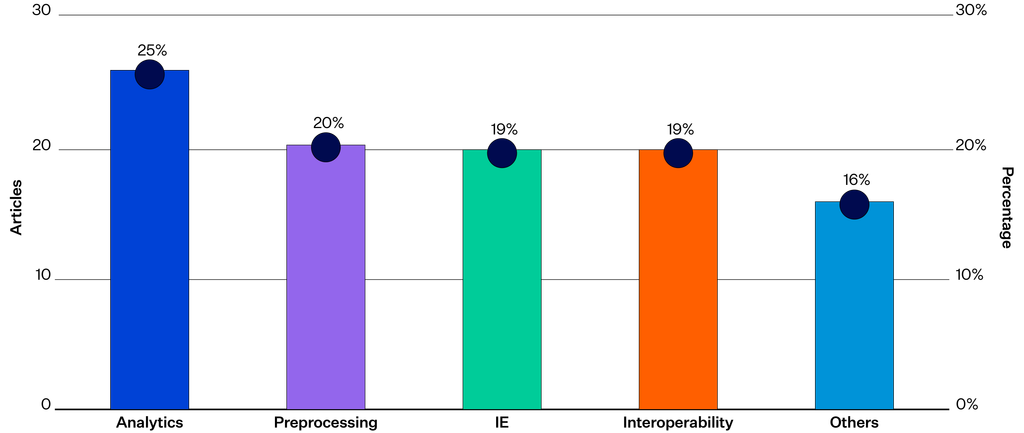
Source: Adnan and colleagues (2020), Role and Challenges of Unstructured Big Data in Healthcare. The chart groups challenges discussed in selected literature; it does not measure their prevalence across healthcare organisations.
Integration, ongoing quality assurance and governance therefore belong in the operating model from the beginning. Staff need access to the original source and a clear understanding of how an extracted finding was produced. Organisations also need defined responsibilities for resolving discrepancies and appropriate access controls.
For technology suppliers, expansion becomes more credible when they can demonstrate repeatable value and account for the effort required in each new setting. Differences in documentation practice can affect both deployment cost and clinical performance, so commercial assumptions should be tested alongside clinical ones.
Connecting patient information to decisions that matter
The strategic task is to connect the record’s complementary information to decisions that matter, then establish the conditions under which that connection creates value.
Start with a clear clinical need, evaluate the application in everyday workflows and account for the effort needed to sustain it. That gives health systems a practical basis for deciding whether broader deployment is warranted.
Authored by Tom Varghese, Global Product Marketing & Growth Manager at Orion Health.
References:
- Adnan K, Akbar R, Khor SW, Ali ABA. Role and challenges of unstructured big data in healthcare. In: Data Management, Analytics and Innovation. Advances in Intelligent Systems and Computing. Vol 1042. Springer; 2020:301–323.
- Assale M, Dui LG, Cina A, Seveso A, Cabitza F. The revival of the notes field: leveraging the unstructured content in electronic health records. Front Med (Lausanne). 2019;6:66.
- Eastwood B. How to navigate structured and unstructured data as a healthcare organization. HealthTech. Published May 8, 2023.
- Hernandez-Boussard T, Monda KL, Crespo BC, Riskin D. Real world evidence in cardiovascular medicine: ensuring data validity in electronic health record-based studies. J Am Med Inform Assoc. 2019;26(11):1189–1194.
- Kharrazi H, Anzaldi LJ, Hernandez L, et al. The value of unstructured electronic health record data in geriatric syndrome case identification. J Am Geriatr Soc. 2018;66(8):1499–1507.
- Kumar D, Choudhary N, Gupta V, et al. Natural language processing in healthcare: from unstructured data to clinical intelligence. Intelligent Systems with Applications. 2026;31:200698.
- Li I, Pan J, Goldwasser J, et al. Neural natural language processing for unstructured data in electronic health records: a review. Computer Science Review. 2022;46:100511.
- Miliard M. Unstructured EHR data more useful for predictive analytics, study shows. Healthcare IT News. Published October 30, 2019.
- Ntinopoulos V, Rodriguez Cetina Biefer H, Tudorache I, et al. Large language models for data extraction from unstructured and semi-structured electronic health records: a multiple model performance evaluation. BMJ Health Care Inform. 2025;32(1):e101139.
- Sedlakova J, Daniore P, Horn Wintsch A, et al. Challenges and best practices for digital unstructured data enrichment in health research: a systematic narrative review. PLOS Digit Health. 2023;2(10):e0000347.
- Seinen TM, Fridgeirsson EA, Ioannou S, et al. Use of unstructured text in prognostic clinical prediction models: a systematic review. J Am Med Inform Assoc. 2022;29(7):1292–1302.
- Seinen TM, Kors JA, van Mulligen EM, Rijnbeek PR. Using structured codes and free-text notes to measure information complementarity in electronic health records: feasibility and validation study. J Med Internet Res. 2025;27:e66910.
- Shankar R, Bundele A, Mukhopadhyay A. Natural language processing of electronic health records for early detection of cognitive decline: a systematic review. npj Digit Med. 2025;8:133.
- Van Veen D, Van Uden C, Blankemeier L, et al. Adapted large language models can outperform medical experts in clinical text summarization. Nat Med. 2024;30(4):1134–1142.