


 US
US CA
CA GB
GB NZ
NZ
Patient records should clarify care, not distort visibility.
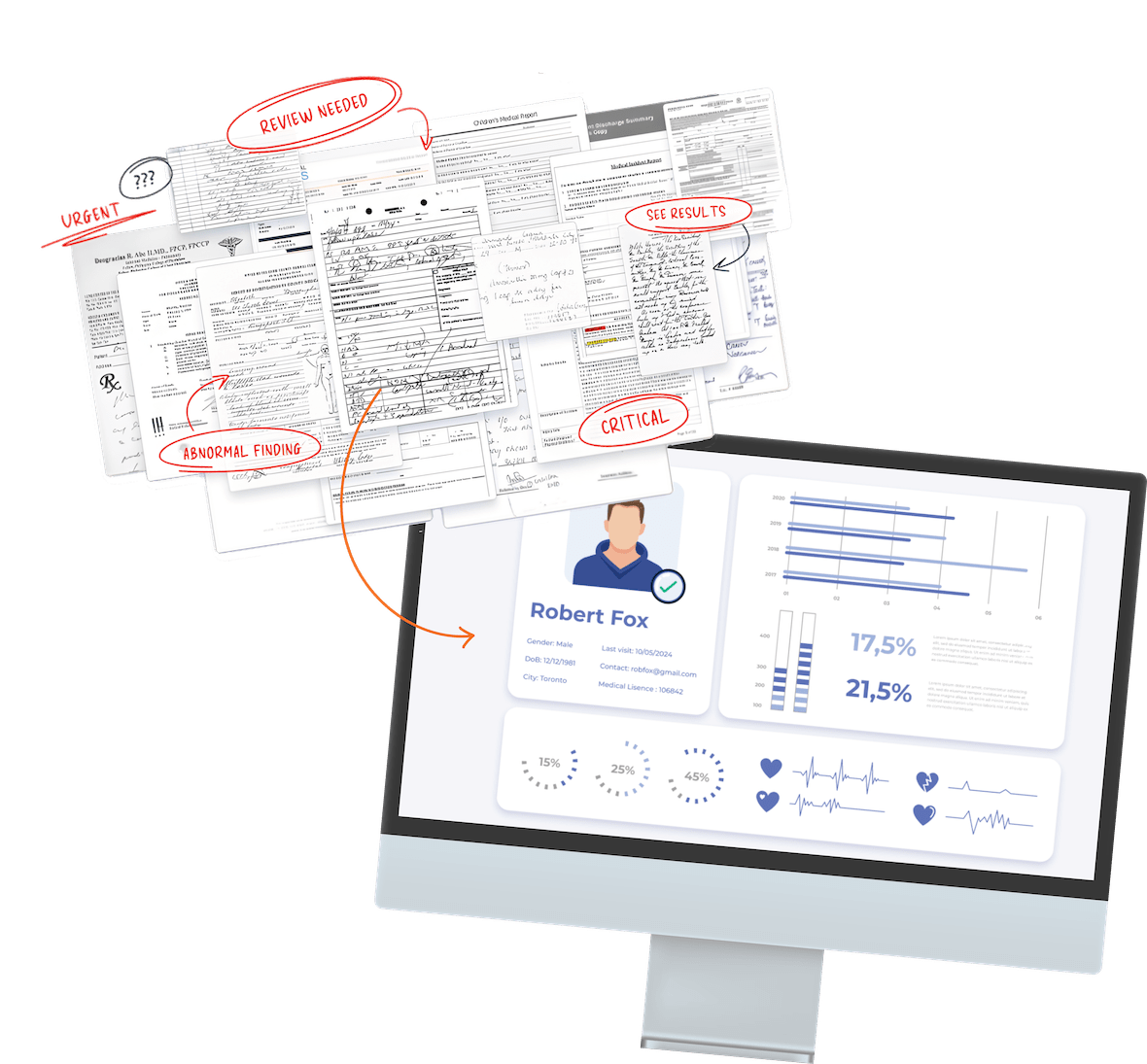
When key clinical criteria live in narrative documentation, relevant patients can be difficult to find. SMART Identify helps care teams search structured and unstructured data using defined criteria to surface relevant patients for clinician review – with source-linked evidence they can verify.
Benefits
SMART Identify helps you:
Support Clinical Quality
Surface patients who meet guideline criteria visible with evidence clinicians can verify.
Increase Operational Clarity
Reduce manual chart review and fragmented interpretation.
Support Service Line Growth
Surface relevant patients for review and follow-up.
Reduce Care Gaps
Surface care gaps and provide a clear, traceable basis for clinical review and intervention.
THE PATIENTS YOU'RE LOOKING FOR MAY ALREADY BE IN YOUR SYSTEM
Eligibility Is Not the Same as Visibility.
Echo reports. Progress notes. Imaging narratives. Discharge summaries.
Relevant clinical information can exist across the record without being easy to find at scale.
When those signals stay buried:
- Patients relevant to defined criteria can be difficult to find
- Population-level review requires significant manual effort
- Potential care gaps can be harder to see
- Service line opportunities can remain hidden
For complex and rare conditions, relevant clinical information may be scattered across years of documentation and multiple care settings.
*Healthcare Informatics Research (2019)
Explainable AI for patient identification
Built for Clinical Accountability.
SMART Identify enables clinicians to search unstructured health information using criteria they define, surfacing patients whose records match those search parameters.
Each result links back to the supporting source information, giving clinicians the context to review the result and independently assess its relevance.
Clinicians define the search. Results are traceable to the source. Clinical review and assessment remain with the clinician.
Every flagged patient includes:
The source sentence
The clinical variable extracted
The guideline criteria met
The context required for review
From data to patient identification
From Clinical Narrative to Actionable Identification.
Ingest
Structured and unstructured EHR data
Interpret
Clinically validated variables using the DARWEN™ AI engine
Surface
Surface matching records with supporting source evidence.
Verify
Clinicians review the source evidence and independently assess each result.
Ingest
Unstructured EHR and other system data.
Interpret
Clinically relevant variables using the DARWEN™ AI engine.
Surface
Surface matching records with supporting source evidence.
Verify
Clinicians review the source evidence and independently assess each result.
externally validated
Built on Clinical Research.

SMART Identify is powered by HEALWELL AI’s DARWEN™ AI engine, backed by more than nine years of clinical research and 47+ peer-reviewed publications across 11+ therapeutic areas.
DARWEN AI is designed to extract clinically relevant information from complex health records, with results traceable to source data for review and verification.
SMART Identify is part of SMART Suite, a set of AI-enabled health intelligence tools, available within the Amadeus AI platform or alongside existing healthcare environments.
Interested in learning more?
Surface What Your Structured Fields Miss.
See how SMART Identify searches unstructured documentation using defined criteria and surfaces relevant patients with source-linked evidence for review.