

 US
US CA
CA GB
GB AU
AU NZ
NZHealthcare organisations put considerable effort into developing the business case and implementing digital technology. Yet the improvements that justify the investment often depend on years of operational change after the system goes live.
During implementation, responsibilities are usually clear, with delivery milestones and governance in place. Once the system becomes operational, who is responsible for ensuring the promised benefits are delivered?
As healthcare organisations face growing pressure to demonstrate value from existing digital investments, this question deserves greater attention.
Why digital health benefits depend on more than implementation
Benefits realisation management is the ongoing process of identifying, delivering and evaluating the improvements an investment is expected to achieve. In their systematic literature review, Pereira, Sempiterno and Jerónimo (2021) describe a process that continues through evaluation and review.
They also distinguish between responsibilities: project sponsors generally remain accountable for benefits, while project managers focus on delivering agreed outputs.
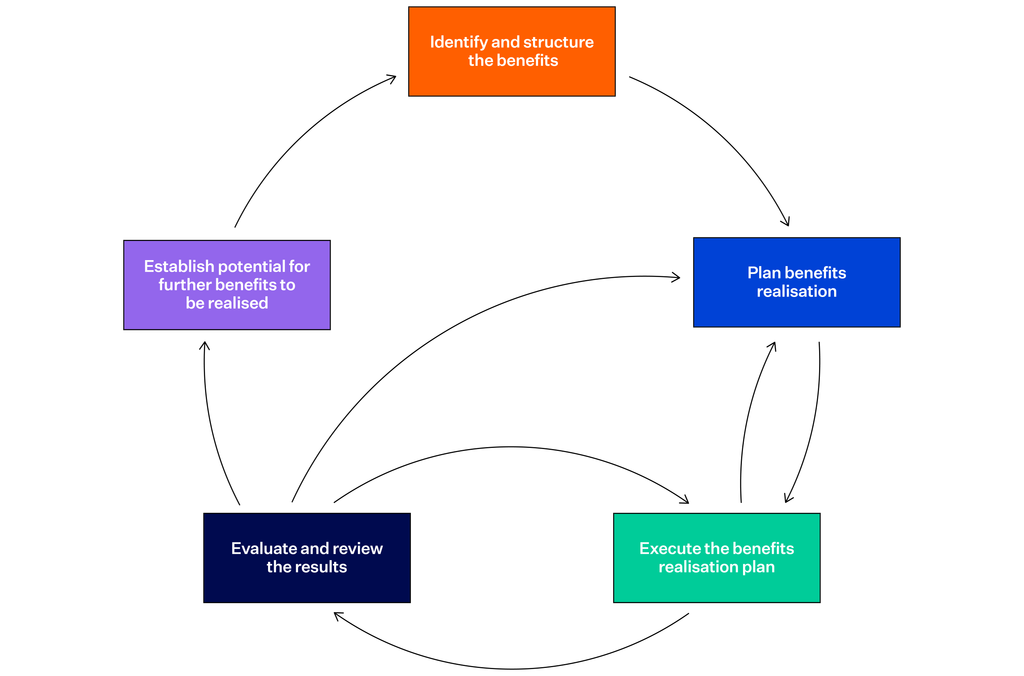
Source: Pereira, Sempiterno and Jerónimo (2021), Benefits realisation management: A systematic literature review.
In healthcare, these responsibilities become more complicated when improvements depend on clinical behaviour and organisational change.
A hospital might introduce a clinical information system that makes patient records easier to access. But better care coordination or less duplicate administration also requires changes to how people work, alongside checks that those improvements are happening.
A project can therefore close successfully while much of its expected value remains unrealised.
What counts as value in digital healthcare?
Casey and colleagues (2026) examined benefits realisation within an NHS electronic rostering initiative. Financial savings became the dominant measure of success, while care quality and staff experience received less attention. When the expected savings did not materialise, benefits management activity was eventually suspended.
This illustrates that the benefits in a business case reflect choices about what matters. Focusing too narrowly on financial savings can overlook other valuable improvements.
The study also raises questions about supplier involvement. Technology companies bring valuable expertise, but giving them too much responsibility for defining benefits can weaken a healthcare organisation’s ability to evaluate value for itself.
A benefits framework needs enough authority to question the original assumptions, rather than simply report against them.
How ongoing services could support digital health value
Other industries have addressed aspects of this challenge through servitisation: adding services that support a product’s ongoing use and performance.
Industrial equipment manufacturers, for example, may provide monitoring, maintenance and performance improvement throughout the equipment’s working life. Digital technology can help them deliver these services consistently across customers and locations.
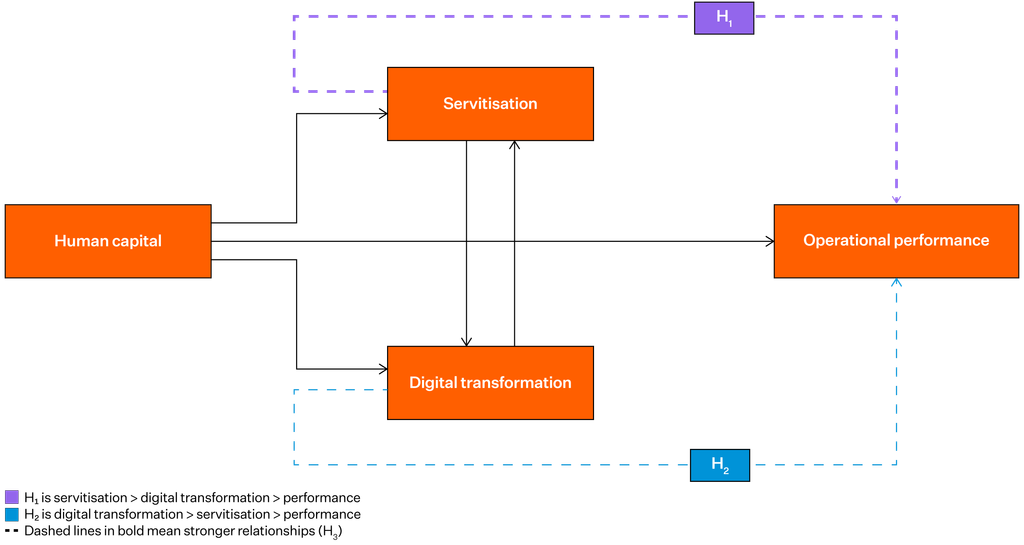
Source: Vendrell-Herrero and colleagues (2024), The order of the factors matters: How digital transformation and servitization integrate more efficiently.
Vendrell-Herrero and colleagues studied 127 Spanish product firms. They found stronger relationships with operational performance when firms developed service capabilities first, then used digital technology to standardise delivery.
The distinction is relevant to healthcare software: define the service and its intended value before deciding how technology will support it.
Manufacturing evidence cannot be applied directly to clinical environments, where patient safety and professional judgement bring different requirements. Nevertheless, it offers a useful direction for healthcare technology suppliers.
Ongoing services could support workflow improvements, helping teams adopt technology and measure progress. This would extend the supplier relationship beyond keeping software available to helping customers achieve specific operational goals.
Why sustained support matters after go-live
Healthcare implementation research reinforces the importance of continuing support. Greenhalgh and colleagues’ NASSS framework (2017) explains how adoption and sustainability depend on the interaction between technology, the people using it and the wider care environment.
Capacho-Alfonso and colleagues (2025) also include continuous assessment and improvement in their adoption framework. Effective deployment depends on organisational readiness and the ability to adapt over time.
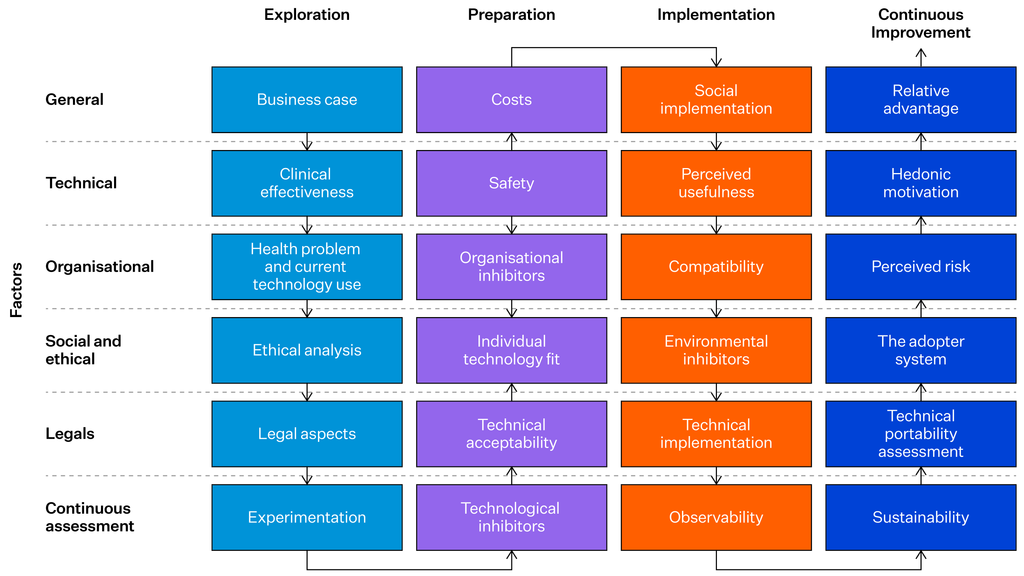
Source: Capacho-Alfonso, Soto-Durán and Jiménez-Builes (2025), Health technology adoption model for big data integration in hospitals: A systematic approach in the era of health 4.0.
At a health system level, Cresswell and Williams (2026) examined three major NHS digitalisation programmes through evaluations spanning 15 years. They identified persistent challenges with legacy systems, shifting priorities and retaining lessons across successive programmes.
Together, these studies suggest that benefits realisation needs to be an ongoing organisational capability, with governance and investment that continue after implementation.
Who should be accountable for digital health benefits?
My view is that ultimate accountability should remain with the healthcare organisation. Ideally, an executive sponsor should have enough authority to oversee the operational changes needed to deliver the business case.
Clinical leaders must retain responsibility for care decisions and patient safety. Operational leaders need the capacity to redesign services and allocate resources.
Technology suppliers should also have clearly defined responsibilities for supporting the benefits associated with their products. These could include an agreed improvement plan after implementation or continuing expertise to help teams use the system effectively.
Those responsibilities must reflect what suppliers can influence. They can affect software performance and service quality, but have much less control over clinical staffing or a health system’s wider financial circumstances.
How procurement can support benefits realisation
Procurement agreements could include measurable benefits alongside technical service requirements. Ongoing support could be funded through recurring fees, with selected performance measures informing commercial incentives, so that each party’s contribution can be credibly assessed.
This requires care. Time saved by clinicians does not automatically become a cash saving. It may instead increase capacity or improve the care experience. Both can be valuable, but their financial implications differ.
The costs of ongoing training and operational improvements must also be included when assessing the return on investment of digital initiatives.
For suppliers, greater involvement creates opportunities for deeper customer relationships and recurring revenue, as well as obligations that require specialist capabilities. For health systems, it can connect digital spending more closely with the improvements it is expected to deliver.
Making digital healthcare investment deliver lasting value
Benefits realisation remains an organisational responsibility, supported by collaboration across the healthcare technology ecosystem.
Servitisation offers a way to structure that collaboration around continuing performance. The next step is to establish clear ownership of benefits and sustain the support needed to achieve them after go-live.
Healthcare organisations that do this will be better placed to demonstrate what their digital investments deliver.
Authored by Tom Varghese, Global Product Marketing & Growth Manager at Orion Health.
References
- Capacho-Alfonso, V. H., Soto-Durán, D. E., & Jiménez-Builes, J. A. (2025). Health technology adoption model for big data integration in hospitals: A systematic approach in the era of health 4.0. Health Services and Outcomes Research Methodology, 25, 410–437.
- Casey, R., Ivory, C., Walsh, L., & Harrison, D. (2026). Digital transformation and the politics of benefits realization management. Public Money & Management. Advance online publication.
- Cresswell, K., & Williams, R. (2026). Large-scale system-level digitalisation initiatives in the National Health Service in England: Insights from three national evaluations. npj Digital Medicine, 9, Article 301.
- Ginting, H., Utami, H. N., Riyadi, R., & Hutahayan, B. (2024). Exploring the landscape of digital servitization: A systematic review. F1000Research, 13, Article 813.
- Greenhalgh, T., Wherton, J., Papoutsi, C., Lynch, J., Hughes, G., A’Court, C., Hinder, S., Fahy, N., Procter, R., & Shaw, S. (2017). Beyond adoption: A new framework for theorizing and evaluating nonadoption, abandonment, and challenges to the scale-up, spread, and sustainability of health and care technologies. Journal of Medical Internet Research, 19(11), e367.
- NHS England. (2026). Digital Maturity Assessment report 2024 and 2025 results. NHS England Digital.
- Pereira, L., Sempiterno, M., & Jerónimo, C. (2021). Benefits realisation management: Systematic literature review. International Journal of Agile Systems and Management, 14(2), 333–351.
- Vendrell-Herrero, F., Para-González, L., Mascaraque-Ramírez, C., & Freixanet, J. (2024). The order of the factors matters: How digital transformation and servitization integrate more efficiently. International Journal of Production Economics, 271, Article 109228.
- You, J. G., Hernandez-Boussard, T., Pfeffer, M. A., Landman, A., & Mishuris, R. G. (2025). Clinical trials informed framework for real world clinical implementation and deployment of artificial intelligence applications. npj Digital Medicine, 8, Article 107.