


 US
US CA
CA GB
GB NZ
NZClinicians often work around digital systems when those systems do not align with how they actually work. Those workarounds can tell us where technology is creating more work instead of making care easier.
Health technology delivers value when clinicians use it because it genuinely helps them do their jobs and deliver better care, not simply because it has been implemented.
What makes clinicians adopt health technology?
The Technology Acceptance Model offers a useful clue.
Holden and Karsh reviewed more than 20 studies across 16 health technology data sets. The clearest driver of adoption was usefulness, which was linked to clinicians’ intention to use technology in every test. Confidence and a supportive working environment were also important, while ease of use mattered most when it helped clinicians see the technology as useful.
In other words, clinicians adopt technology when it improves their work experience. Clinicians implicitly ask whether a system helps them understand the patient, complete a task, preserve attention and exercise clinical judgement. A tool can be technically impressive and still fail that exchange test.
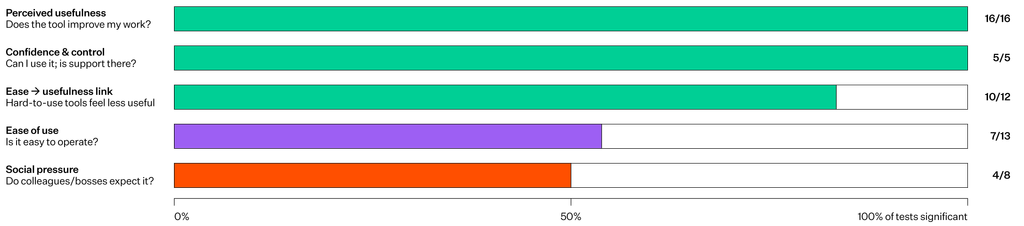
Source: Holden RJ, Karsh BT. The technology acceptance model: its past and its future in health care. Journal of Biomedical Informatics. 2010. Graphic generated using Claude.
Why do clinicians create EHR workarounds?
When that exchange of value breaks down, workarounds become understandable.
Olakotan and colleagues’ review of 28 studies identified recurring EHR usability challenges, including workflow fragmentation, excessive navigation, duplicated documentation and poorly organised information. One included study found that clinicians averaged 1.4 task switches per minute.
Paper notes, spreadsheets and external tools can therefore reflect unmet workflow needs rather than simply a lack of training.
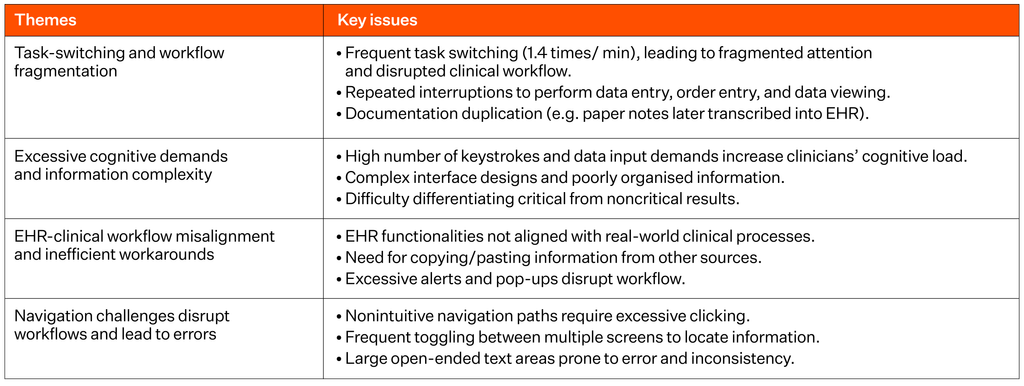
Source: Olakotan O, Samuriwo R, Ismaila H, Atiku S. Usability Challenges in Electronic Health Records: Impact on Documentation Burden and Clinical Workflow. Journal of Evaluation in Clinical Practice. 2025.
Moy and colleagues found a similar pattern in emergency departments. Their interviews with physicians and nurses identified burdens arising from poor interface design, high volumes of manual work, workflow blockages and limited optimisation for clinicians. Their cognitive burden map is particularly instructive because it reaches beyond screen design.
Clinicians described information overload, difficulty offloading tasks, inconsistencies with clinical mental models, an absence of useful cognitive aids, and a loss of agency.
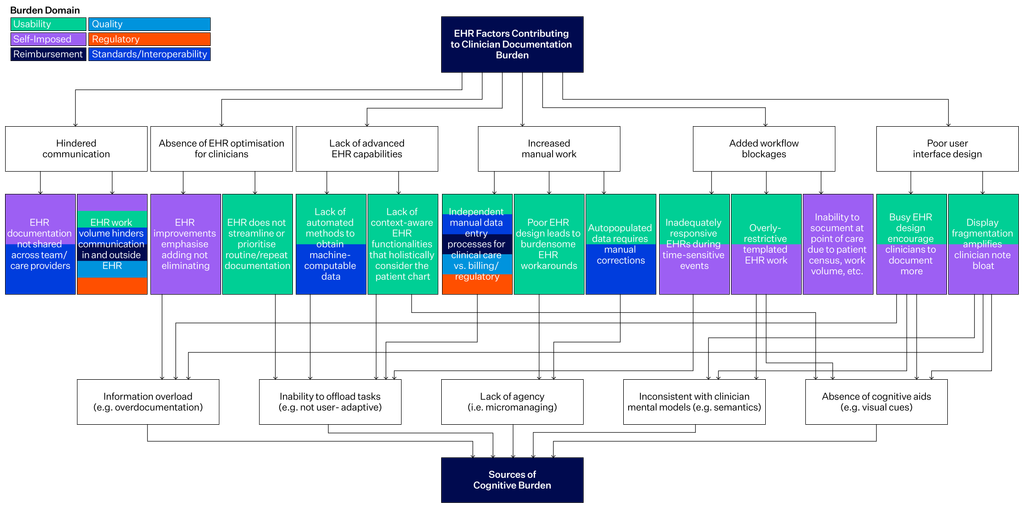
Source: Moy AJ, Hobensack M, Marshall K, et al. Understanding the perceived role of electronic health records and workflow fragmentation on clinician documentation burden in emergency departments. JAMIA. 2023.
Is poor technology adoption really a change management problem?
The evidence suggests the problem often lies less with clinicians’ willingness to change and more with how well the technology fits their work.
A 2025 national survey of 1,933 physicians found 50% considered their EMR inefficient and 56% felt it did not enhance patient safety. Differences between EMRs explained 38% of variation in usability ratings, while hospital-level differences within EMRs accounted for another 51%. Only 11% sat at the physician level.
Similarly, a 2025 systematic review found that EHR design across searchability, automation, customisation, data entry, workflow, guidance and interoperability could enhance or undermine usability and medication safety.
That should change the executive conversation. When adoption is weak, examine the product, configuration, implementation environment and clinical workflow before assuming clinicians simply need more training or encouragement.
Why clinician adoption matters commercially
A health technology business can win a procurement process through breadth of capabilities, enterprise architecture, governance maturity, and a credible economic case. Expansion inside the customer depends on the realised value.
If clinicians save time, find information faster, reduce duplication or experience fewer interruptions, their experience becomes evidence for the next deployment decision. If technology shifts work elsewhere or adds cognitive overhead, adoption friction can eventually become commercial friction: slower expansion, greater support requirements, weaker advocacy and higher retention risk.
Research involving family physicians reinforces the point: efficiency strategies improved satisfaction when the underlying EHR was already highly usable. Adding more capability to a poor workflow foundation has limits.
What can ambient AI teach us about clinician adoption?
Ambient AI provides an interesting contemporary test.
A 2026 observational study across Spain’s Quirónsalud network found voluntary use of an ambient documentation tool grew from 2.7% to around 31% of outpatient consultations over 16 months, exceeding 2.33 million assisted encounters. Other recent studies have reported reduced documentation and EHR time, while a multicentre study found burnout fell from 51.9% to 38.8% after 30 days of ambient AI use.
But adoption cannot come at the expense of trust. The Quirónsalud researchers cautioned that their observational study could not establish causality or independently demonstrate clinical correctness. Clinicians remained responsible for reviewing documentation before it entered the record.
The lesson extends beyond AI: workflow value can accelerate adoption, while clinical oversight, validation, transparency, and measurement protect the trust on which adoption depends.
How should health systems measure digital health adoption?
Usage alone is not enough.
AHRQ identified 11 categories for assessing documentation burden, including EHR time, after-hours work, workflow fragmentation and usability. For healthcare leaders, this points to a broader adoption scorecard that combines usage with clinical time returned, workflow burden, safety signals, and user experience.
For technology providers, those measures can then be connected to retention, expansion, service costs and renewal confidence.
Clinician adoption is ultimately a design, implementation, governance and change outcome that becomes visible in everyday work. Health systems that measure it this way can better distinguish technology that has simply been deployed from technology that is genuinely creating value.
At scale, perhaps the strongest adoption strategy is also the simplest: make the clinical day measurably better – and prove it.
To explore how Orion Health connects health information and intelligence into clinical workflows, learn more about Amadeus AI.
Authored by Tom Varghese, Global Product Marketing & Growth Manager at Orion Health.
References
- Holden RJ, Karsh BT. The technology acceptance model: its past and its future in health care. J Biomed Inform. 2010;43(1):159-172.
- Olakotan O, Samuriwo R, Ismaila H, Atiku S. Usability Challenges in Electronic Health Records: Impact on Documentation Burden and Clinical Workflow: A Scoping Review. J Eval Clin Pract. 2025;31(4):e70189.
- Moy AJ, Hobensack M, Marshall K, et al. Understanding the perceived role of electronic health records and workflow fragmentation on clinician documentation burden in emergency departments. J Am Med Inform Assoc. 2023;30(5):797-808.
- Schwappach D, Hautz W, Krummrey G, Pfeiffer Y, Ratwani RM. EMR usability and patient safety: a national survey of physicians. npj Digit Med. 2025;8(1):282.
- Cahill M, Cleary BJ, Cullinan S. The influence of electronic health record design on usability and medication safety: systematic review. BMC Health Serv Res. 2025;25(1):31.
- Holmgren AJ, Hendrix N, Maisel N, et al. Electronic Health Record Usability, Satisfaction, and Burnout for Family Physicians. JAMA Netw Open. 2024;7(8):e2426956.
- Alcázar-Peral JM, Álvaro-de la Parra JA, Blanco D, et al. Real-world evaluation of an ambient AI scribe in Spanish outpatient care after 2.3 million uses: impact on clinician experience, semantic agreement, and workflow efficiency. Front Digit Health. 2026;8:1874919.
- Olson KD, Meeker D, Troup M, et al. Use of Ambient AI Scribes to Reduce Administrative Burden and Professional Burnout. JAMA Netw Open. 2025;8(10):e2534976.
- Ma SP, Liang AS, Shah SJ, et al. Ambient artificial intelligence scribes: utilization and impact on documentation time. J Am Med Inform Assoc. 2025;32(2):381-385.
- Wang Z, West CP, Vaa Stelling BE, et al. Measuring Documentation Burden in Healthcare. Technical Brief No. 47. AHRQ Publication No. 24-EHC023. Rockville, MD: Agency for Healthcare Research and Quality; 2024.