


 US
US CA
CA GB
GB AU
AUElectronic health record (EHR) certification is an important milestone, but it isn’t the finish line. A certified EHR can pass every test and still fail clinicians in everyday practice. For health systems, vendors and executive teams, recognising that distinction is becoming increasingly important.
Certification creates a baseline of assurance that defined capabilities, standards and conformance requirements have been met. It supports interoperability, transparency and trust in a sector where technology directly influences patient care. But certification alone does not demonstrate whether an EHR is usable in the fast-paced reality of clinical practice.
Usability is defined as the extent to which a system enables specified users to achieve their goals effectively, efficiently and satisfactorily in a particular context. A product that performs well in a controlled testing environment may behave very differently in an emergency department, oncology clinic, rural general practice, virtual care service or shared care environment. This is where the gap emerges between certified capability and clinical usability.
Why does EHR usability matter beyond certification?
Research consistently shows meaningful differences in clinician experience across certified EHR platforms. Studies of family physicians found that EHR-specific design and implementation explained much of the variation in clinician satisfaction, despite similar functionality and certification requirements. Other research reported that fewer than one-third of family physicians were highly satisfied with their EHR, with satisfaction closely linked to workflow, information retrieval, documentation, alert design and overall usability. Better usability was also associated with lower clinician burnout.
Certification answers a relatively narrow question: Does the product meet defined technical requirements? Clinicians ask a different question: Does it help me deliver safe, efficient care?
Those are not the same question.
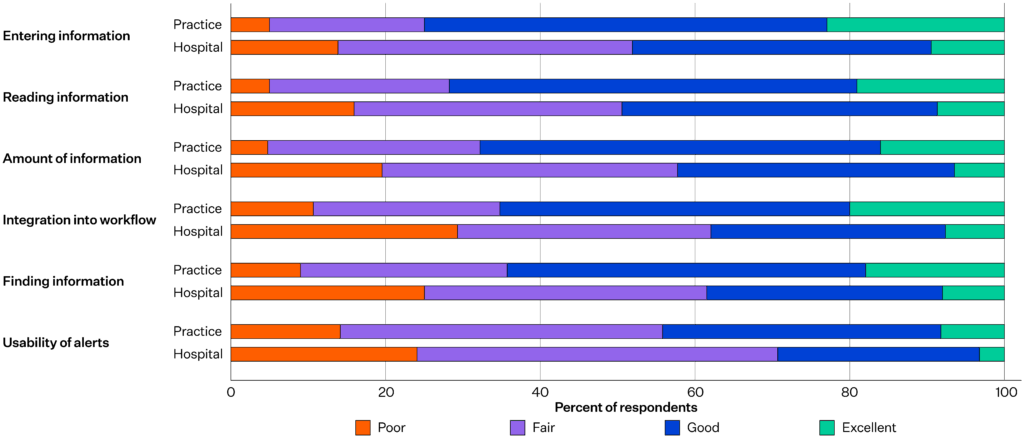
Source: Hendrix, N. et al. Variation in Family Physicians’ Experiences Across Different Electronic Health Record Platforms (2023).
The usability gap has patient safety implications.
The gap between certification and everyday experience extends well beyond clinician satisfaction. Growing evidence links poor EHR usability with medication safety risks, confusing information displays, difficult-to-interpret alerts, documentation burden and workflow disruption.
Searchability, automation, workflow support, interoperability, user guidance and thoughtful interface design are all part of the safety architecture of digital healthcare. Poor usability increases cognitive load, making it harder for clinicians to find, interpret and act on critical information when time matters most.
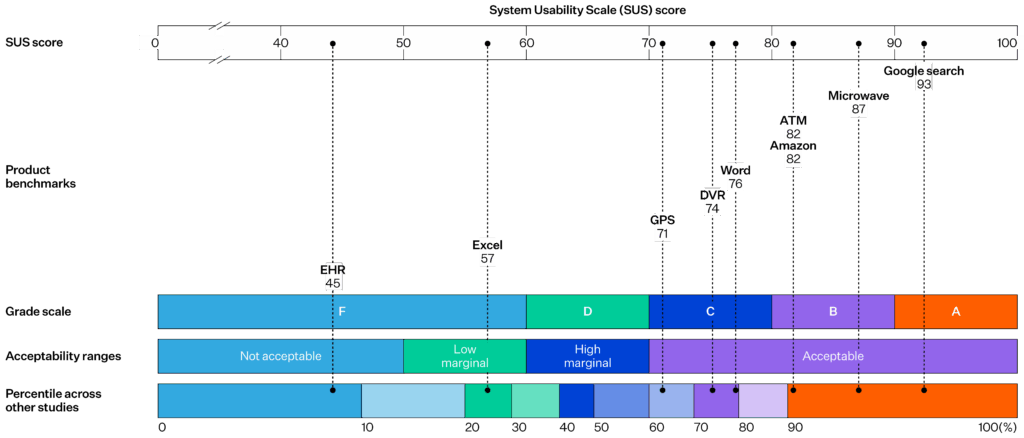
Source: Melnick, E.R. et al. Mayo Clinic Proceedings (2020).
Certification is the floor, not the ceiling.
One of the biggest risks in digital transformation is assuming certification guarantees success.
Certified does not automatically mean usable. Go-live does not guarantee adoption. Integration does not always deliver value.
A certified EHR must still prove itself in real clinical environments. Can clinicians quickly locate the latest test result? Do alerts distinguish meaningful risks from unnecessary noise? Can multidisciplinary teams work efficiently without increasing administrative burden? Can organisations measure usability after implementation instead of relying solely on project milestones?
These are the questions that determine whether digital investment delivers clinical value.
Measuring usability after go-live.
Usability should be treated as an operational performance measure rather than an implementation milestone.
Health systems should require evidence of usability in their own clinical settings, using representative users, real workflows, and safety-critical tasks. Vendors should view usability evidence as a strategic asset that strengthens adoption, customer advocacy and long-term growth.
Organisations should continue to measure clinician-reported experience after deployment alongside metrics such as documentation burden, alert fatigue, workflow fragmentation, after-hours system use, and patient safety events. These indicators provide a far more accurate picture of digital maturity than certification alone.
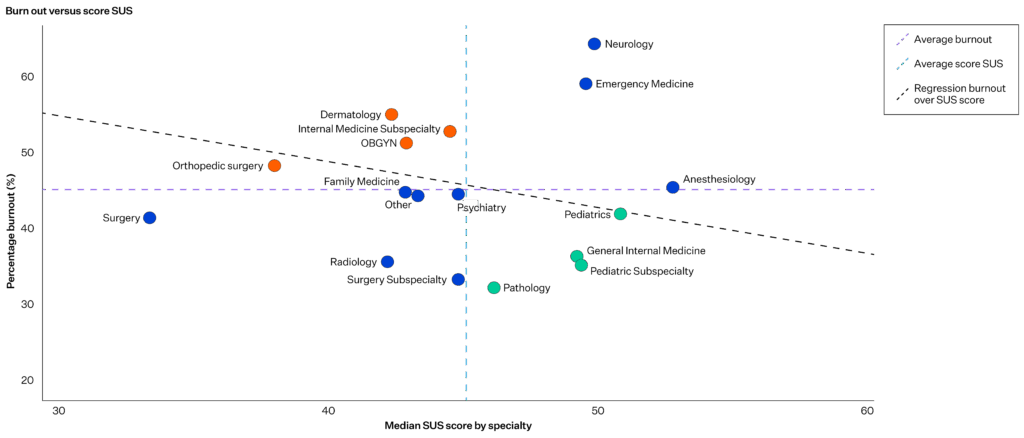
Source: Melnick, E.R. et al. Mayo Clinic Proceedings (2020).
From certified technology to trusted care
Digital maturity is not measured by whether an EHR is certified and deployed. It is measured by whether clinicians can use that technology to deliver safe, efficient and trusted care at scale.
Certification establishes an essential baseline, but usability determines whether organisations realise the full value of their investment. The health systems that will lead the next generation of digital transformation will be those that close the gap between formal compliance and lived clinical experience.
By combining certified technology with continuous usability measurement, workflow optimisation and clinician-centred design, healthcare organisations can improve adoption, reduce burnout and ultimately deliver better patient outcomes.
Authored by Tom Varghese, Global Product Marketing & Growth Manager at Orion Health.
References
- Agency for Healthcare Research and Quality. (2024). Measuring documentation burden in healthcare. Agency for Healthcare Research and Quality.
- Asgari, E., Kaur, J., Nuredini, G., Balloch, J., Taylor, A. M., Sebire, N., Robinson, R., Peters, C., Sridharan, S., & Pimenta, D. (2024). Impact of electronic health record use on cognitive load and burnout among clinicians: Narrative review. JMIR Medical Informatics, 12, e55499.
- Cahill, M., Cleary, B. J., & Cullinan, S. (2025). The influence of electronic health record design on usability and medication safety: Systematic review. BMC Health Services Research, 25, 31.
- Franks, A. M., Clements, C., Bannister, T., Mays Kingston, A., Beaty, A., Korkmaz, A., Parker, J. A., Jr., & Petrany, S. M. (2024). Optimization of electronic health record usability through a department led quality improvement process. Annals of Family Medicine, 22(2), 81 to 88.
- Hendrix, N., Bazemore, A., Holmgren, A. J., Rotenstein, L. S., Eden, A. R., Krist, A. H., & Phillips, R. L. (2023). Variation in family physicians’ experiences across different electronic health record platforms: A descriptive study. Journal of General Internal Medicine, 38, 2980 to 2987.
- Holmgren, A. J., Hendrix, N., Maisel, N., Everson, J., Bazemore, A., Rotenstein, L., Phillips, R. L., & Adler Milstein, J. (2024). Electronic health record usability, satisfaction, and burnout for family physicians. JAMA Network Open, 7(8), e2426956.
- Melnick, E. R., Dyrbye, L. N., Sinsky, C. A., Trockel, M., West, C. P., Nedelec, L., Tutty, M. A., & Shanafelt, T. (2020). The association between perceived electronic health record usability and professional burnout among US physicians. Mayo Clinic Proceedings, 95(3), 476 to 487.
- Melnick, E. R., West, C. P., Nath, B., Cipriano, P. F., Peterson, C., Satele, D. V., Shanafelt, T., & Dyrbye, L. N. (2021). The association between perceived electronic health record usability and professional burnout among US nurses. Journal of the American Medical Informatics Association, 28(8), 1632 to 1641.
- Merriweather, C. A., Jr., Lyytinen, K., Aron, D., & Cauley, M. R. (2026). When better data meets better design: How EHR data usability and system usability shape physicians’ cognitive load. npj Digital Medicine, 9, 104.
- Office of the National Coordinator for Health Information Technology. (2024). ONC Health IT Certification Program overview. U.S. Department of Health and Human Services.
- Office of the National Coordinator for Health Information Technology. (2024). HTI 1 Insights Condition fact sheet: Health Data, Technology, and Interoperability: Certification Program Updates, Algorithm Transparency, and Information Sharing final rule. U.S. Department of Health and Human Services.
- Office of the National Coordinator for Health Information Technology. (2026). Real world testing. U.S. Department of Health and Human Services.
- Office of the National Coordinator for Health Information Technology. (2026). Safety enhanced design. U.S. Department of Health and Human Services.
- Olakotan, O., Samuriwo, R., Ismaila, H., & Atiku, S. (2025). Usability challenges in electronic health records: Impact on documentation burden and clinical workflow: A scoping review. Journal of Evaluation in Clinical Practice, 31, e70189.
- Schwappach, D., Hautz, W., Krummrey, G., Pfeiffer, Y., & Ratwani, R. M. (2025). EMR usability and patient safety: A national survey of physicians. npj Digital Medicine, 8, 282.