


 US
US CA
CA GB
GB AU
AU
Healthcare has quietly become one of the most data-intensive industries in the world. Vast volumes of information are generated across clinical records, imaging, diagnostics, and an expanding ecosystem of connected devices.
Even with all this data, only a small part is regularly used to improve care. Many people see the potential of health data, but its real value is still not fully reached.
For more than two decades, interoperability has been positioned as the key to unlocking that value. Governments invested heavily in electronic health records (EHRs), standards bodies developed frameworks for exchanging information, and health systems built networks to connect organisations that historically operated in isolation.
These steps were important and have helped, but they haven’t fully solved the problem. Just being connected doesn’t mean the shared information is actually useful.
Interoperability is necessary, but not enough.
In many healthcare systems, the technical ability to exchange data exists. Yet clinicians still struggle to integrate external information into routine workflows.
Records may arrive in formats that require manual interpretation. Information may be incomplete or inconsistently structured. Clinical systems often lack workflows designed to incorporate data originating outside their organisation.
So, while systems may be technically connected, the real benefits are still limited.
Tracking progress in hospital interoperability.
Efforts are underway to measure progress more systematically. Researchers have recently proposed composite indices to assess how effectively hospitals exchange and use data across systems.
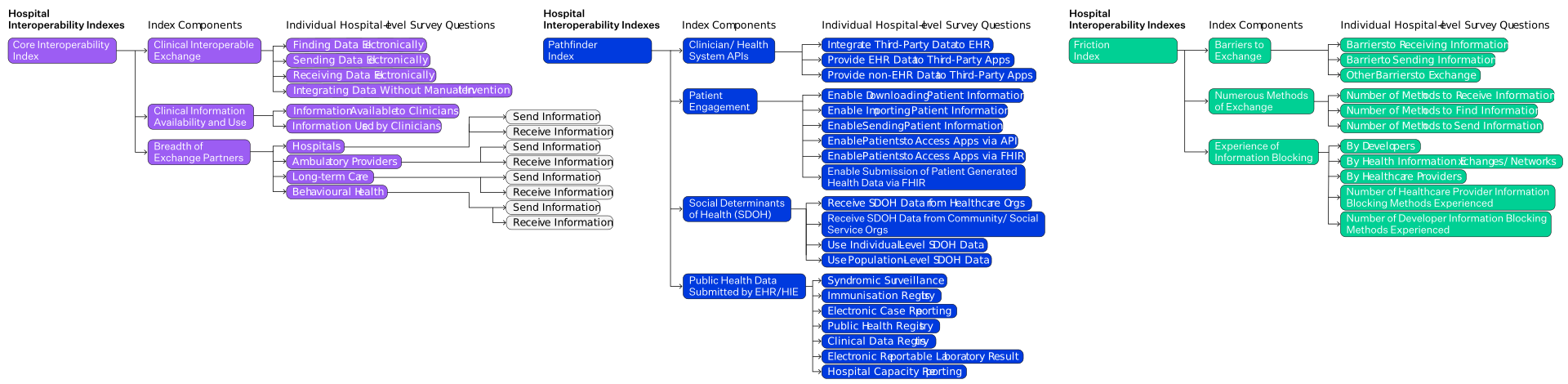
Source: Strawley, C. E., Adler-Milstein, J., Holmgren, A. J., & Everson, J. (2025). New indices to track interoperability among US hospitals. Journal of the American Medical Informatics Association.
These measures are meant to show progress and highlight differences between organisations as policies change. Most importantly, they show that true interoperability is not just about being connected, but about actually using the shared data well.
Connectivity vs liquidity.
A new concept is now emerging within digital health: data liquidity.
In practical terms, data liquidity refers to the ability for health information to move securely, reliably, and meaningfully across organisations and workflows. Crucially, that data must also be interpretable and actionable without excessive friction.
While connectivity focuses on whether systems can technically exchange data, liquidity focuses on whether that data can be immediately understood and used within clinical workflows. A system may be connected, but if information arrives incomplete, poorly structured, or difficult to interpret, its value remains limited.
When health data becomes liquid rather than static, it enables:
- Real-time clinical decision-making
- Improved care coordination across providers
- Large-scale population health insights
- Structured inputs for AI-driven clinical tools
The difference between just being connected and having true data liquidity might seem small, but it matters a lot. Many healthcare systems can share information, but still struggle to use it in daily operations.
Policy momentum is turning interoperability into infrastructure.
Policies are changing, too. In many places, new rules focus more on standard ways to share data and push back against practices that limit access to health information.
National data exchange systems are being set up, patients expect more access, and interoperability is becoming a basic part of healthcare, not just a goal.
Once something becomes part of the basic infrastructure, the focus shifts. It’s no longer about whether systems can connect, but whether the whole system can work safely, reliably, and transparently at scale.
| Country | Initiative |
|---|---|
| United States | TEFCA with QHIN Network |
| European Union | European Health Data Space and MyHealth at EU |
| United Kingdom | NHS Spine and Federated Data Platform |
| Australia | My Health Record and National Digital Health Strategy |
| Canada | Canada Health Infoway standards alignment |
| Singapore | National Electronic Health Record |
| UAE | UAE Riayati Unified Health Record |
| Saudi Arabia | NPHIES health information exchange |
| New Zealand | National Health Index, HISO Standards, HISO, NZCDI |
Source: Healthcare Connectivity Report 2025 (Access Newswire)
National frameworks such as TEFCA illustrate how interoperability is evolving into national infrastructure. The ASTP model highlights the foundational layers required to make that infrastructure work in practice.
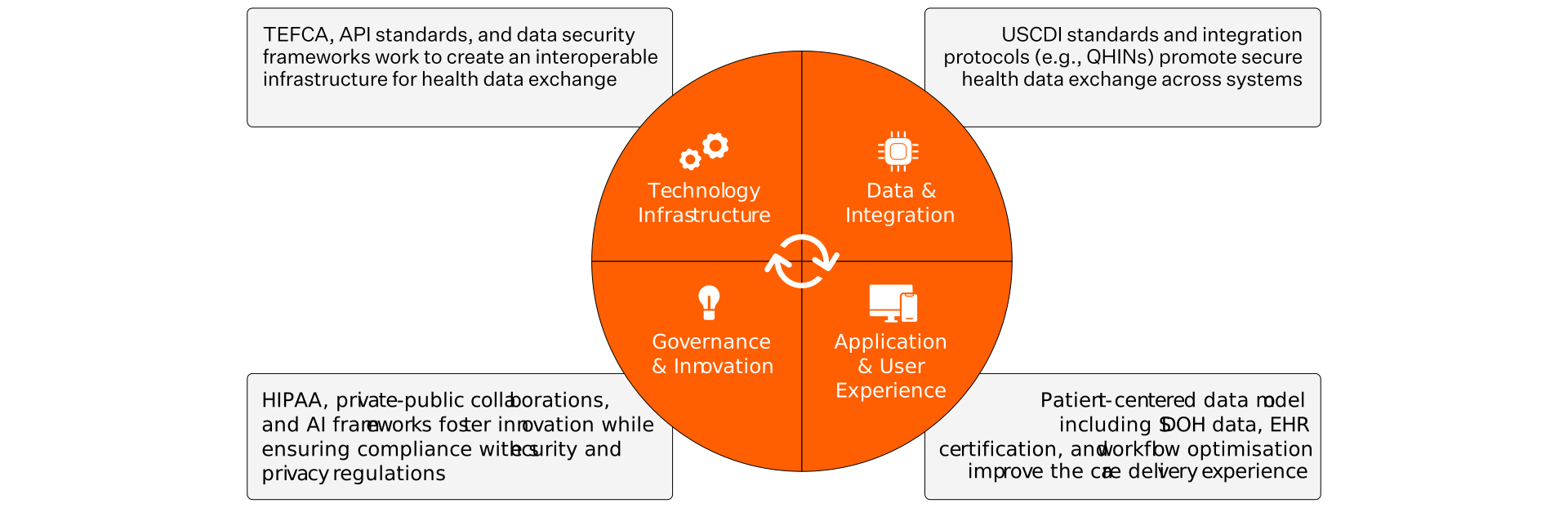
Source: National Academy of Medicine (NAM). Toward a National Health Digital and Data Architecture: Laying the Foundation for Digital Transformation.
As these national frameworks evolve, healthcare organisations increasingly rely on data exchange in everyday clinical practice. Governance, operational processes, and accountability must therefore mature alongside the technology enabling the exchange.
Why traditional healthcare IT models struggle with liquidity.
Many healthcare operating models were never designed for a world of fluid data exchange.
Electronic health records were originally developed to replace paper documentation and support billing processes within a single organisation. As a result, their architecture often reflects institutional priorities rather than the needs of a connected ecosystem.
Clinical workflow optimisation and external data integration were frequently secondary considerations rather than foundational design principles.
Today, many health systems have digital records, but still work as if data will mostly stay within their own walls. When data starts to move more freely, the limitations of this approach become clear:
- Information quality issues become harder to ignore.
- Fragmented workflows create operational bottlenecks.
- Governance questions arise around access, responsibility, and trust.
This dynamic suggests that the next phase of digital health transformation will be defined less by technology adoption and more by organisational adaptation.
Designing health systems for a shared data ecosystem.
Health systems that do well with liquid data won’t just be the ones with interoperable platforms.
Instead, the winners will be organisations that redesign clinical workflows, governance models, and incentive structures to operate effectively within a shared information ecosystem.
The benefits are significant:
- Clinicians gain access to a more complete patient history.
- Unnecessary test duplication can be reduced.
- Care teams can coordinate more effectively across settings.
- Population health insights become easier to generate.
At the system level, liquid data also enables policymakers to respond more quickly to emerging public health challenges.
Why AI raises the stakes for interoperability.
Artificial intelligence is amplifying the importance of data liquidity.
AI-driven clinical decision support tools depend on structured, timely, and high-quality data. Fragmented information systems and inconsistent exchange, therefore, do not simply create inefficiencies, but they can directly affect the performance of algorithmic tools designed to support clinical judgement.
Yet even here, the most important questions remain organisational rather than technological.
Health system leaders must ask:
- Are our clinical workflows designed to incorporate external data?
- Do our governance models support cross-organisational data sharing?
- Do financial incentives encourage coordinated care rather than institutional optimisation?
The strategic question for healthcare leaders.
The infrastructure enabling interoperability is already emerging.
Technical standards are becoming more stable. National data exchange systems are being built. Policies are moving toward more openness and accountability in how health data is used.
So, the main challenge is changing.
It is no longer simply a matter of whether interoperability will arrive. Instead, healthcare leaders must consider how their organisations will function once data exchange becomes an expected part of everyday clinical operations.
Systems that treat interoperability as a checkbox may struggle to adapt. Those who view data liquidity as a strategic capability will be better positioned to navigate the transition.
The future of healthcare depends on liquid data.
The next wave of healthcare performance will not be determined solely by who has the most advanced digital platforms.
It will be determined by who can operate confidently in an environment where data moves fluidly across institutions and informs decisions throughout the care continuum.
Which leads to a question worth asking sooner rather than later:
If interoperability became enforceable tomorrow, would your operating model survive?
Unlocking the value of shared health data.
Achieving true data liquidity requires more than technical interoperability. It requires platforms that can connect clinical systems, normalise data across sources, and deliver meaningful insights directly into care workflows.
Orion Health’s Shared Care Record solutions are designed to help healthcare systems move beyond simple connectivity, enabling trusted data sharing across organisations and supporting coordinated, data-driven care.
Authored by Tom Varghese, Global Product Marketing & Growth Manager at Orion Health.
References
- Abernethy, A., Afsar, N., Anderson, B., Barfield, W., Bharel, M., Brown, J., Embí, P., Eschenlauer, A., Gordon, W., Gregurick, S., James, B., Jena, A., Lee, P., Maddox, T., Mandl, K., Parikh, R., Petersen-Lukenda, L., Sarich, T., Shaikh, A., Speyer, P., & Yale, K. (2026). Toward a national health digital and data architecture: Laying the foundation for digital transformation. National Academy of Medicine.
- Assistant Secretary for Technology Policy. (2026). Data liquidity, affordability, and access: The history and growth of TEFCA. U.S. Department of Health and Human Services.
- Finkley, K. (2026). Advancing interoperability through governance and sustainability: A qualitative comparative case study of state health information exchanges in the United States (Doctoral dissertation, Georgia Southern University).
- Global Digital Health Partnership. (2020). Advancing interoperability together globally: GDHP white paper on interoperability.
- Jordan, P. (2026, March 4). My view – Interoperability & consumer access: Is it time for regulation? Health Informatics New Zealand.
- Lane, P. (2026, March 10). Interoperability’s inflection point. Health Gorilla.
- Office of the National Coordinator for Health Information Technology. (2024). TEFCA awareness and planned participation among U.S. hospitals: 2023 (Health IT Data Brief No. 72).
- Pimenta, N., Chaves, A., Sousa, R., Abelha, A., & Peixoto, H. (2023). Interoperability of clinical data through FHIR: A review. Procedia Computer Science, 220, 856–861.
- Tuan, J. (2026, March 5). TEFCA is live: The practical playbook for getting patient data into your app. Topflight Apps.