


 US
US CA
CA GB
GB AU
AU
Artificial intelligence (AI) is widely positioned as a transformative force in healthcare. From improving diagnosis and treatment to increasing efficiency at scale, its potential is undeniable. Yet despite strong performance in laboratory settings and clinical trials, the translation of AI into everyday clinical practice has been slow.
The evidence is increasingly clear: AI will not succeed in healthcare unless it is deeply and deliberately integrated into clinical practice.
The translational gap between performance and practice
A consistent theme across the literature is the gap between technical success and real-world clinical impact. Many AI models perform well on curated datasets or narrowly defined tasks, but their effectiveness drops sharply when deployed in live clinical environments.
Real-world care is messy. Patient populations are heterogeneous, data is incomplete, workflows evolve, and clinicians operate under constant time pressure. This translational gap is not simply a technical issue. It reflects a deeper misalignment between how AI systems are designed and how healthcare is actually delivered.

Source: Karalis, Vangelis D. The Integration of Artificial Intelligence into Clinical Practice (2024)
Why clinical decision making cannot be automated away
Clinical decision making (CDM) refers to the cognitive, professional, and contextual processes clinicians use to assess information, weigh risks and benefits, and make care decisions for individual patients. It combines clinical evidence, patient data, professional expertise, ethical judgement, and patient preferences to determine the most appropriate course of action in a given situation.
Importantly, CDM is not a linear or purely data-driven process. It is shaped by uncertainty, incomplete information, time pressure, and the realities of real-world care delivery. Clinicians continuously interpret signals, apply contextual judgement and professional experience, and adjust decisions based on evolving patient conditions and system constraints.
Evidence-based practice itself relies on integrating research evidence with clinical expertise. AI tools that attempt to automate decisions without supporting clinical reasoning often disrupt care rather than enhance it. Qualitative studies consistently show that such systems are abandoned when they fail to align with established routines or threaten professional accountability.
Standalone AI tools rarely scale in healthcare.
Another recurring finding is that standalone AI tools struggle to scale or sustain themselves in practice. Poor interoperability, particularly limited integration with electronic health record systems, creates friction and adds to clinician workload.
Lack of transparency and explainability undermines trust, especially in high-stakes decisions where responsibility ultimately remains with human professionals. Concerns about algorithmic bias, data quality, and patient privacy further complicate adoption, particularly when training data does not reflect real clinical populations.
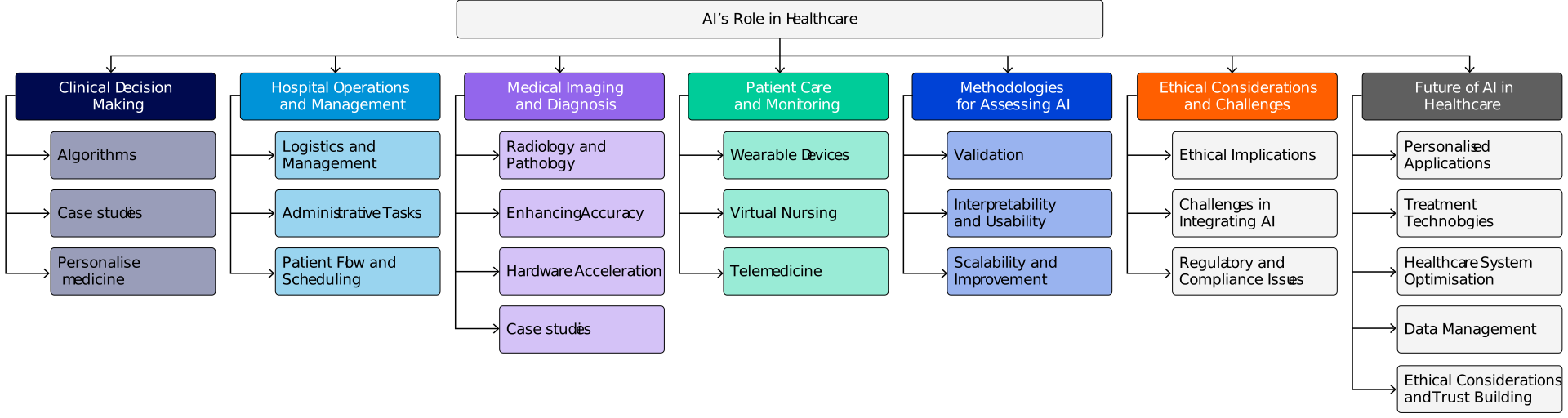
Source: Maleki Varnosfaderani & Forouzanfar, The Role of AI in Hospitals and Clinics (2024)
What successful clinical AI looks like in practice.
Where AI adoption has been more successful, common characteristics emerge. These systems are designed as decision support tools rather than autonomous decision-makers.
They are embedded directly into clinical workflows, delivering relevant insights at the point of care. They are co-developed by clinicians, data scientists, and healthcare organisations, and evaluated not only on technical accuracy but on patient outcomes and quality of care.
Crucially, they are monitored and adapted over time, recognising that clinical environments and patient populations are dynamic.
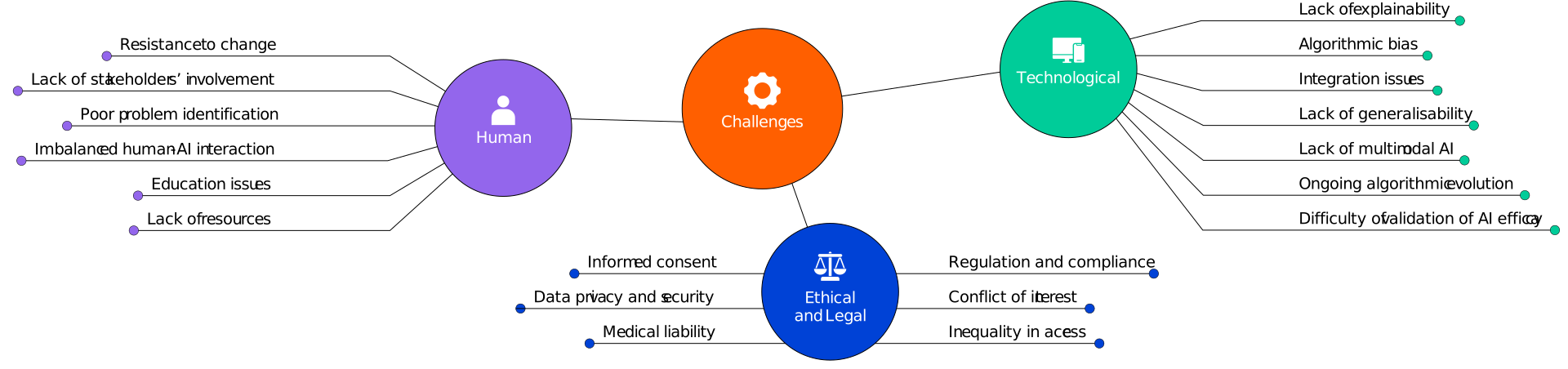
Source: Maleki Varnosfaderani & Forouzanfar, The Role of AI in Hospitals and Clinics (2024)
A sociotechnical approach to AI in healthcare.
Recent frameworks emphasise the importance of a sociotechnical approach to AI. This perspective treats AI not as an isolated technology, but as part of a broader system that includes people, processes, infrastructure, regulation, and organisational culture.
From this viewpoint, clinical integration is not a final implementation step. It is a guiding principle throughout the entire lifecycle of an AI system. Real-world validation, continuous user feedback, and clear governance around responsibility and accountability are essential.
Why technical excellence alone is not enough.
Overemphasising technical performance can be counterproductive. AI systems optimised to outperform clinicians on narrow benchmarks may deliver limited real-world value if they do not address genuine clinical needs.
In contrast, modest tools that support consistency, reduce cognitive burden, or surface relevant information at the right moment often have a greater impact. Their success lies in being usable, acceptable, and trusted by clinicians.
From replacement to partnership: The future of Clinical AI
The future of AI in healthcare is not about replacing clinicians. It is about partnership.
AI has real potential to augment clinical expertise, improve safety, and support more sustainable healthcare systems. Realising this potential depends on moving beyond standalone tools and embracing clinical integration as the foundation for success.
Without integration, AI risks remaining trapped in a cycle of hype and disappointment. With it, AI can become a meaningful part of everyday care.
Moving from potential to practice
For healthcare organisations looking to move beyond pilots and proofs of concept, the priority is clear: invest in platforms and approaches that embed intelligence directly into clinical workflows, support clinical reasoning, and evolve alongside care delivery.
Authored by Tom Varghese, Global Product Marketing & Growth Manager at Orion Health.
References
- Abd-Alrazaq, Alaa, Barry Solaiman, Yosra Magdi Mekki, Dena Al-Thani, Faisal Farooq, Metab Alkubeyyer, Mohamed Ziyad Abubacker, et al. 2025. “Hype vs Reality in the Integration of Artificial Intelligence in Clinical Workflows.” JMIR Formative Research 9 (1): e70921.
- Alami, Hassane, Pascale Lehoux, Chrysanthi Papoutsi, Sara E. Shaw, Richard Fleet, and Jean-Paul Fortin. 2024. “Understanding the Integration of Artificial Intelligence in Healthcare Organisations and Systems through the NASSS Framework: A Qualitative Study in a Leading Canadian Academic Centre.” BMC Health Services Research 24: 701.
- Chustecki, Margaret. 2024. “Benefits and Risks of AI in Health Care: Narrative Review.” Interactive Journal of Medical Research 13: e53616.
- .El Arab, Rabie Adel, Mohammad S. Abu-Mahfouz, Fuad H. Abuadas, Husam Alzghoul, Mohammed Almari, Ahmad Ghannam, and Mohamed Mahmoud Seweid. 2025. “Bridging the Gap: From AI Success in Clinical Trials to Real-World Healthcare Implementation—A Narrative Review.” Healthcare 13 (7): 701.
- Karalis, Vangelis D. 2024. “The Integration of Artificial Intelligence into Clinical Practice.” Applied Biosciences 3 (1): 14–44.
- Nilsen, Per, David Sundemo, Fredrik Heintz, Margit Neher, Jens Nygren, Petra Svedberg, and Lena Petersson. 2024. “Towards Evidence-Based Practice 2.0: Leveraging Artificial Intelligence in Healthcare.” Frontiers in Health Services 4: 1368030.
- Sokol, Kacper, James Fackler, and Julia E. Vogt. 2025. “Artificial Intelligence Should Genuinely Support Clinical Reasoning and Decision Making to Bridge the Translational Gap.” npj Digital Medicine 8: 345.