


 US
US CA
CA GB
GB AU
AU
Healthcare leaders across Australia and New Zealand are taking a closer look at their Electronic Medical Record (EMR) strategies, and for good reason. The environment for which EMRs were originally designed is no longer the one in which health systems operate today. Workforce shortages, rising demand, cyber risk, and care delivery increasingly happening outside hospital walls are all reshaping expectations for core clinical platforms.
That context is clearly reflected in Black Book Market Research’s State of Australian Healthcare IT 2026 report, an independent assessment based on feedback from more than 450 Australian clinicians, digital health leaders, and executives. The findings point to a market at an inflection point: EMRs are firmly embedded as essential infrastructure, but confidence in their ability to support long-term transformation is far from uniform.
Across EMR systems in Australia and New Zealand, national digital health strategies are also lifting the bar. Interoperability, shared records, data use and consumer access are no longer future ambitions; they are current requirements. As a result, EMR decisions are becoming less about feature checklists or vendor scale and more about how well a platform aligns with local models of care, system maturity, and long-term strategic direction.
Against this backdrop, a common question is emerging: are EMRs simply helping health systems run yesterday’s workflows more efficiently, or are they truly equipped to support how care needs to be delivered next?
This article outlines the key priorities shaping EMR systems in Australia and New Zealand, based on independent market research and regional digital health strategy.
- EMRs must enable new models of care, not just digitise old ones.
- Clinical usability and medication safety remain the foundation.
- Interoperability is now core health infrastructure.
- Data readiness and AI must deliver real clinical value.
- Transformation is an ongoing journey, not a go-live event.
- Resilience, cloud and partnership value are rising fast.
EMRs must enable new models of care, not just digitise old ones.
Across Australia and New Zealand, EMRs are being reassessed through a sharper strategic lens. The real value of a modern EMR is no longer found in digitising clinical documentation alone, but in its ability to enable new models of care that health systems urgently need.
As care delivery increasingly extends beyond hospital walls into virtual, community and home-based settings, EMRs are expected to act as connective tissue, supporting seamless information flow across clinicians, care settings, organisations and regions. This shift reflects growing pressure on health systems to improve access, safety and sustainability while managing workforce constraints and rising demand.
While EMRs have delivered measurable gains in patient safety and access to information, their contribution to genuine care model transformation has been uneven. The next phase of digital health maturity in Australia and New Zealand demands platforms designed for evolution, supporting interoperability, data-driven decision-making and continuous improvement, rather than optimising static acute workflows.
Clinical usability and medication safety remain the foundation.
Source: Black Book Market Research, State of Australian Healthcare IT 2026, Section 5.1 (N=454 respondents)
Despite growing strategic expectations, Australian and New Zealand evidence is unequivocal: clinical usability remains non-negotiable. Clinician workflow fit and medication safety consistently outrank all other EMR selection criteria.
Transformation cannot succeed if EMRs increase cognitive load or disrupt real-world clinical practice. High adoption is not achieved through mandate alone; it requires systems that make daily work easier, safer and more intuitive. Sustained clinician engagement, training and post-go-live optimisation remain critical to long-term success.
This aligns with findings from global clinician experience research, reinforcing that usability and medicines management underpin every other digital ambition.
Interoperability is now core health infrastructure.
Interoperability has moved decisively from aspiration to baseline requirement.
In Australia, seamless integration with My Health Record and national digital services is now central to EMR evaluation. In New Zealand, national shared record initiatives are driving similar expectations, focusing on reducing fragmentation and improving continuity of care across regions.
EMRs must support open, standards-based data exchange to enable interdisciplinary care. Standards like HL7, FHIR and SNOMED CT are no longer technical nice-to-haves. Instead, they are foundational enablers for collaborative decision-making and integrated service planning at scale.
Data readiness and AI must deliver real clinical value.
Health systems across Australia and New Zealand are moving beyond retrospective reporting towards real-time insight, predictive analytics and AI-enabled decision support.
EMRs are now expected to provide a robust data foundation to support use cases such as early clinical deterioration detection, patient flow optimisation and readmission risk prediction. Generative AI is already showing promise in summarising complex patient records and reducing administrative burden.
However, the priority in Australia and New Zealand remains pragmatic. Health systems are less interested in experimentation than in demonstrable improvements to safety, flow and outcomes. This places a premium on EMRs architected for continuous evolution, where data, analytics and AI are embedded by design rather than added as bolt-ons.
Transformation is an ongoing journey, not a go-live event.
A recurring theme across both Australian research and real-world experience is that EMR value is not delivered at go-live. It emerges over time through continuous measurement and adaptation.
Too often, adoption data and usage patterns are underutilised, despite offering powerful insight into what is working and where intervention is required. Leading organisations are treating EMR deployment as a long-term capability journey, supported by ongoing benefit measurement.
This approach recognises that care models, clinical expectations and digital maturity will continue to evolve, and that EMRs must evolve alongside them.
Resilience, cloud and partnership value are rising fast.
Cybersecurity, reliability and business continuity have become board-level concerns. Cloud and managed service models are gaining acceptance across the region, provided that sovereignty and security requirements are met.
Equally important is partnership behaviour. EMR programmes span decades, and Australian evidence shows an increasing sensitivity to vendor responsiveness, transparency and whole-of-life value. Health systems are increasingly wary of platforms that promise transformation without delivery capability or long-term alignment to national and organisational digital health strategies.
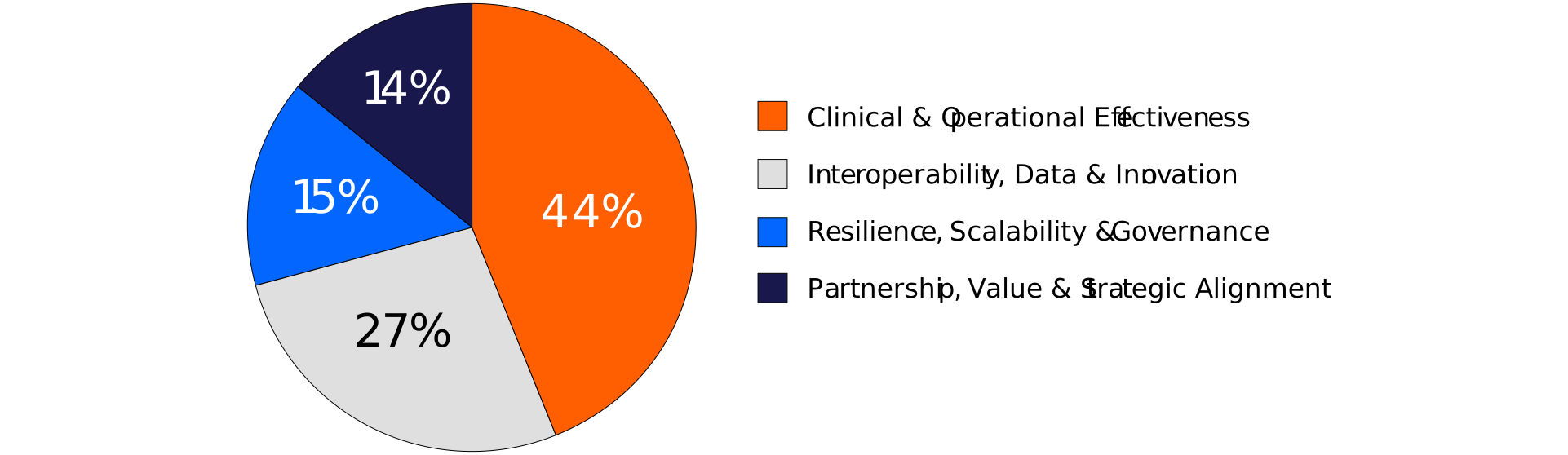
Choosing the right EMR is about strategic fit, not size or features.
There is no single “best” EMR for Australia or New Zealand. What matters is strategic fit, the right balance of clinical usability, interoperability, data capability, resilience and partnership value for each health system’s context and ambition.

Source: Black Book Market Research, State of Australian Healthcare IT 2026, Section 6. Based on feedback from Australian acute-care clinicians, digital leaders and executives.
The EMRs most likely to succeed over the next decade will be those that move beyond transactional digitisation and actively enable integrated, patient-centred models of care. The real question is no longer which EMR is the most powerful, but which is best able to evolve alongside healthcare itself.
What this means for EMR strategy in Australia and New Zealand
Across Australia and New Zealand, EMRs are no longer judged by scale or feature depth alone. Success increasingly depends on strategic fit: how well a platform supports clinicians, enables interoperability, uses data responsibly, and evolves alongside changing models of care. The EMRs that will deliver lasting value over the next decade will be those designed not just to digitise healthcare, but to adapt with it.
Explore how Orion Health supports strategic-fit EMR approaches
As health systems across Australia and New Zealand rethink what they need from EMRs, many are looking beyond monolithic platforms to solutions that strengthen interoperability, shared records and care coordination across settings.
Orion Health works with public and private healthcare organisations to enable connected, patient-centred models of care, supporting interoperability at scale, region-wide shared care records, and digital foundations tailored to private healthcare environments.
- Explore interoperability solutions to enable connected care across organisations and regions.
- Discover shared care record solutions designed to support continuity, collaboration and national digital health strategies.
- Learn how Orion Health supports private healthcare providers with flexible, interoperable digital solutions.
Whether you’re evolving an existing EMR environment or building a more connected digital ecosystem, Orion Health helps health systems choose solutions that can adapt as care continues to change.
References
- Black Book Market Research LLC. Healthcare IT 2026: State of Australian Healthcare IT. January 2026.
- Jones, D. “EMR solutions evolve to help transform healthcare.” Health Services Daily, April 2025.
- Deloitte. 2025 Global Health Care Outlook. 2024.
- KLAS Research. Arch Collaborative Global EHR Satisfaction Report. 2024.