


 US
US CA
CA AU
AU NZ
NZDigital health has developed many ways to assess whether technology is safe, effective and ready for clinical use. The problem is that evidence accepted by one health system or market may not be recognised by another.
This creates uncertainty for everyone. Health systems need confidence before investing in new technology. Developers need to know what evidence buyers will accept. Investors and partners need to distinguish products that are ready to scale from those that have simply reached the market.
The challenge is not a lack of evidence. It is a lack of shared recognition of that evidence.
Why is digital health validation so fragmented?
In 2023, Jacob et al. examined how the quality and impact of eHealth tools are assessed. Across 40 studies, they identified 19 existing frameworks or guidelines, while nine studies developed new assessment frameworks. Their synthesis identified 36 criteria spanning technical, social and organisational considerations.
Collectively, these frameworks reveal how many different routes exist to answering essentially the same question: Is this technology good enough to trust?
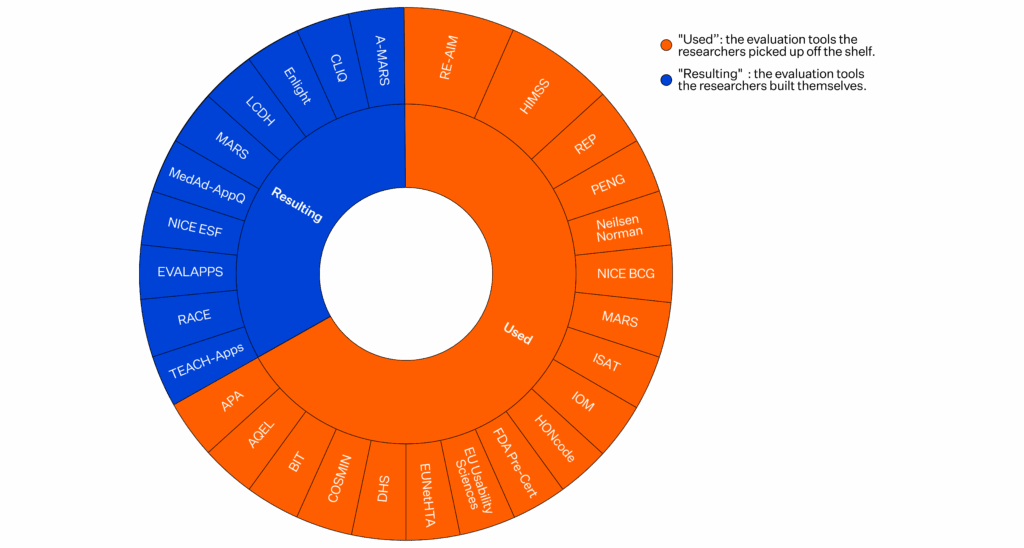
Source: Jacob et al. (2023), Assessing the Quality and Impact of eHealth Tools — JMIR Human Factors
Research published in 2025 reinforces just how many different ways digital health products are assessed, identifying 160 sources covering regulations, frameworks, industry standards and assessment tools. Despite this variety, most focus on the same fundamentals: strong evidence, usability, privacy and security, clinical outcomes, and whether the technology is fit for purpose.
In other words, there is growing agreement about what makes a good digital health product, but not yet a consistent way to assess or recognise it.
What makes digital health technology trustworthy?
Earlier work proposed four core areas for digital health evaluation: technical performance, clinical performance, usability and cost.
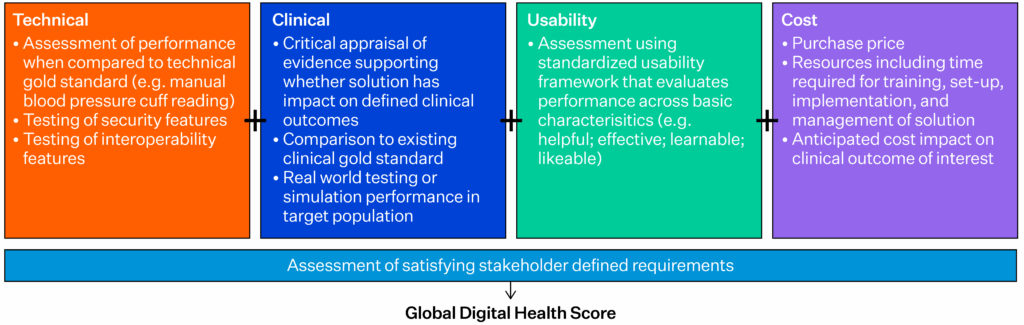
Source: Mathews et al. (2019), Digital health: a path to validation, npj Digital Medicine
Later approaches have added greater sophistication to privacy, equity, and implementation, but the executive question remains largely the same. Can this technology demonstrate sufficient value and assurance to justify committing scarce resources to it?
Clinical evidence alone is not enough. A product can demonstrate strong outcomes and still fail to scale if it doesn’t integrate into clinical workflows, adds to workload or lacks an effective implementation model.
The cost of repeatedly proving trust
For commercial leaders, validation is about more than earning a certification. Good evidence builds trust and gives health systems greater confidence to buy, fund or deploy a technology.
The problem is that health systems and payers often have their own assessment processes. This means tech companies may need to prove the same things repeatedly in different markets, while healthcare organisations spend time and expertise reviewing evidence that another trusted organisation has already assessed.
That duplication comes at a cost. Time spent repeatedly proving that a technology can be trusted is time that could be spent implementing it, improving clinical workflows or measuring whether it delivers better outcomes.
Can digital health evidence become portable?
The challenge is turning shared principles into evidence that can be trusted across organisations and markets. Independent programmes such as the DiMe Seal aim to make this easier by bringing evidence, privacy, security, and usability requirements into a single assessment.

Source: Digital Medicine Society — How the DiMe Seal works
Industry analysis found that companies with the DiMe Seal had more published evidence, clinical trial activity and partnerships than a broader comparison group. While this does not prove validation drives commercial success, it suggests credible, recognised evidence can build trust, support procurement, and help digital health products scale.
Portable trust cannot mean lower standards.
Standardisation also has risks. Research into Germany’s DiGA pathway has raised concerns about the quality of evidence supporting some approved digital health applications. A common standard only works if the evidence behind it is strong.
Health systems need a shared approach in which the level of evidence matches the clinical risk, trusted assessments are recognised across organisations, and products are reassessed as they evolve.
Local checks will still matter, but they should focus on local needs and workflows rather than repeatedly proving the same basic product quality.
The next step for digital health is making trust portable. Done well, this could help credible technology scale with less duplication, lower costs and greater confidence.
Authored by Tom Varghese, Global Product Marketing & Growth Manager at Orion Health.
References
- Borges do Nascimento, I. J., Abdulazeem, H., Vasanthan, L. T., Martinez, E. Z., Zucoloto, M. L., Østengaard, L., Azzopardi Muscat, N., Zapata, T., & Novillo Ortiz, D. (2023). Barriers and facilitators to utilizing digital health technologies by healthcare professionals. npj Digital Medicine, 6, 161.
- Digital Medicine Society. (n.d.). DiMe Seal: Adopter. Digital Medicine Society.
- Essén, A., Stern, A. D., Haase, C. B., Car, J., Greaves, F., Paparova, D., Vandeput, S., Wehrens, R., & Bates, D. W. (2022). Health app policy: International comparison of nine countries’ approaches. npj Digital Medicine, 5, 31.
- European Commission. (2024). The first European Digital Health Technology Assessment framework co created by all stakeholders along the value chain: EDiHTA. CORDIS.
- Galen Growth. (2025, October 22). Beyond funding: Evidence and partnerships give DiMe Seal ventures the edge. The Rest is Digital Health.
- Goldsack, J. C., Holliday, C., Sharma, Y., Mirsky, D., Zanetti, C., & Vandendriessche, B. (2025). Development of an evidence based evaluation framework for digital health software products. Scientific Reports, 15, 38150.
- Gordon, W. J., Landman, A., Zhang, H., & Bates, D. W. (2020). Beyond validation: Getting health apps into clinical practice. npj Digital Medicine, 3, 14.
- Jacob, C., Lindeque, J., Klein, A., Ivory, C., Heuss, S., & Peter, M. K. (2023). Assessing the quality and impact of eHealth tools: Systematic literature review and narrative synthesis. JMIR Human Factors, 10, e45143.
- Mathews, S. C., McShea, M. J., Hanley, C. L., Ravitz, A., Labrique, A. B., & Cohen, A. B. (2019). Digital health: A path to validation. npj Digital Medicine, 2, 38.
- National Institute for Health and Care Excellence. (n.d.). Evidence standards framework for digital health technologies. NICE.
- Sippli, K., Deckert, S., Schmitt, J., & Scheibe, M. (2025). Healthcare effects and evidence robustness of reimbursable digital health applications in Germany: A systematic review. npj Digital Medicine, 8, 495