


 US
 CA
 AU
 NZ
Point solution sprawl happens when healthcare organisations accumulate standalone applications that solve local problems but add costs, maintenance and workflow complexity across the health system. Managing it means understanding what each application costs to sustain, how it supports care and what it would take to replace or retire it.
A department may have a clear reason to buy a new product. Over time, however, each purchase can bring another interface to maintain, another system for clinicians to check and another legacy application to keep available for its historical records. These commitments can limit the capacity to invest in what comes next.
How widespread is application sprawl in healthcare?
A 2026 HLTH article describes typical health organisations managing 400 to 1,000 applications, with some large networks reaching around 2,000 after acquisitions. Separately, a vendor-sponsored 2025 survey found that 86% of IT executives said departments were buying software outside formal governance.
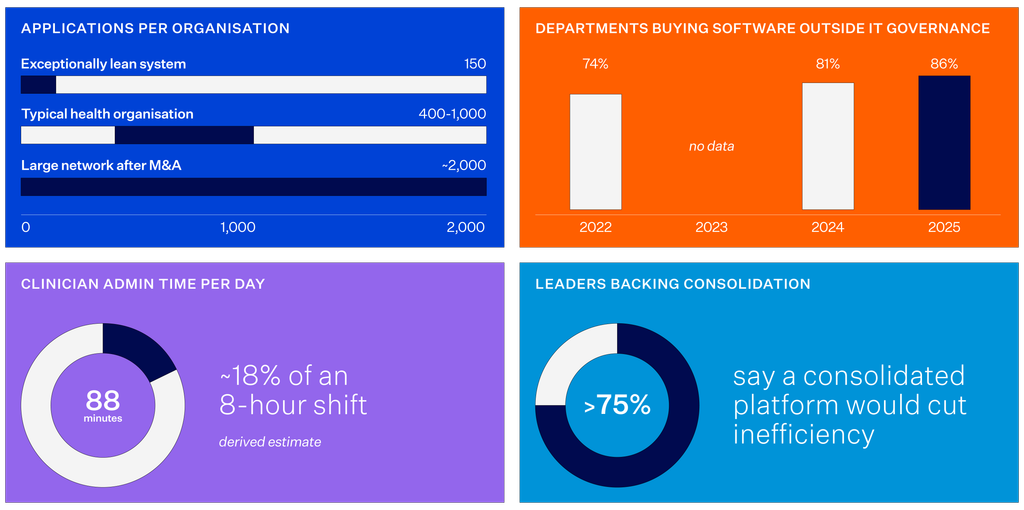
Source: HLTH, “Application Rationalization in Healthcare: Why CIOs Can’t Afford to Wait”
Together, these findings point to a leadership challenge: can the organisation explain what its application portfolio costs to sustain, and what value it delivers?
Why application sprawl is a clinical issue
The effects reach beyond IT. HSSIB’s 2025 investigation into electronic communications at discharge found that limited interoperability increased the risk of information being lost or missed. Unclear accountability added to the problem.
Information needs to reach the right place, and people need to know who is responsible for acting on it. That makes application architecture a clinical concern as well as a technical one.
AI adds further dependencies to workflows that may already be difficult to manage. In a 2025 NEJM AI study, a change to a note template temporarily reduced ICD-10 documentation accuracy from 79% to 35%. Accuracy recovered after the template was redesigned and users received training. The example shows how changes around a tool can affect its performance.
The FUTURE-AI consensus guideline in The BMJ also highlights the need to monitor AI after deployment. Investment cases should account for ongoing evaluation and support, with clear responsibility for checking that expected benefits continue.
How to rationalise a healthcare application portfolio
Consolidation needs the same care as procurement. Gartner’s TIME framework assesses applications by their technical and business fit, helping leaders consider whether to tolerate, invest in, migrate or eliminate them. In healthcare, that review should also consider clinical dependencies and access to historical patient records.
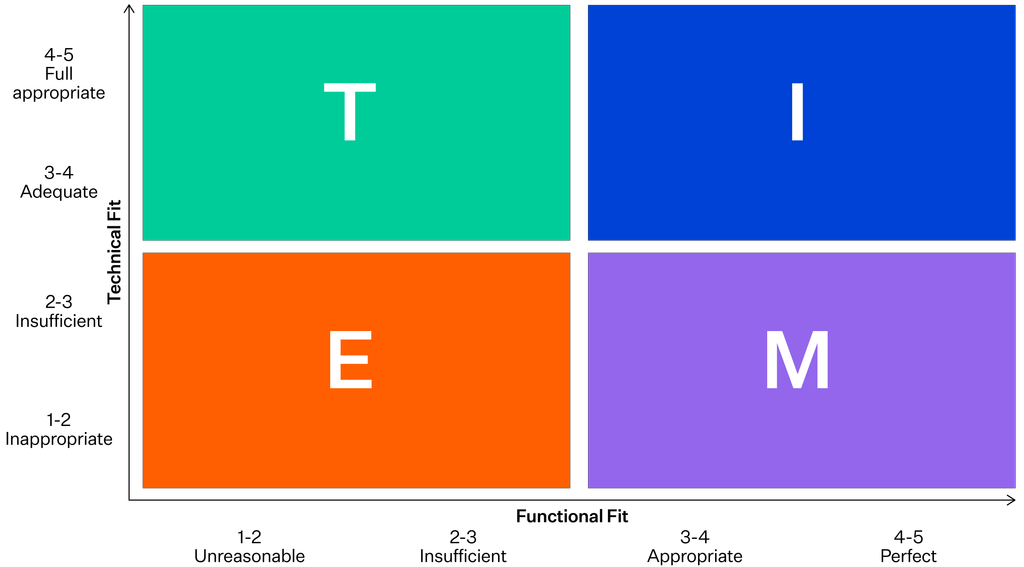
Source: Gartner, “Tool: How to rationalize your applications portfolio”
Retirement can require significant investment, especially when records still have clinical value. Gartner’s Trinity Health case study reports that the organisation archived data from more than 540 applications and systems through 2024, alongside approximately US$68 million in annual operating expense savings. The results reflect one organisation’s circumstances, but illustrate how preserving access to historical data can support application retirement.
The same planning matters after a merger. Projected savings depend on deciding which systems to retain and how to withdraw the others. That transition needs a realistic budget and an accountable owner.
Build a credible investment case
Expected benefits need careful scrutiny. Langer and colleagues’ 2026 perspective on digital health tools describes how selection bias and regression to the mean can distort evaluations of population health point solutions. Leaders should ask how much of an observed improvement can reasonably be attributed to the product.
Finance and clinical leaders should agree what a realised benefit means before committing further resources. Time released for clinicians may improve their working day or create capacity for care. Cash savings depend on expenditure that can actually be removed. Clear measures make the investment case more credible and help the organisation assess progress fairly.
Application portfolios reflect years of decisions about where an organisation puts its money and its people. Reviewing them should be an ongoing leadership responsibility, so capacity can be released deliberately for the investments that matter next.
Authored by Tom Varghese, Global Product Marketing & Growth Manager at Orion Health.
References
- Becker’s Healthcare. (2026, June 29). Healthcare operations’ next frontier: How leaders are moving from point solution sprawl to a consolidated, integrated platform.
- CIO Research Team. (2024, May 21). Tool: How to rationalize your applications portfolio. Gartner.
- Engel-Morton, J., Foo, Y. C., Palagani, S., Adil, M., & Giannoudi, M. (2026, May 8). Digital ambitions and analogue realities: Results of the RCPE T&MC UK-wide digital experience survey. Royal College of Physicians of Edinburgh.
- Healthcare Financial Management Association & Eliciting Insights. (2025). Health system readiness for artificial intelligence. Report overview.
- Health Services Safety Investigations Body. (2025, July 10). Workforce and patient safety: Electronic communications on patient discharge from acute hospitals. Investigation report.
- Langer, C., Shaw, J., & Glover, W. (2026). Digital health tools and point solutions: Pitfalls in population health program measurement. Frontiers in Digital Health, 8, Article 1785058.
- Lekadir, K., et al. (2025). FUTURE-AI: International consensus guideline for trustworthy and deployable artificial intelligence in healthcare. The BMJ, 388, e081554.
- Meadows, T. (2026, February 16). Application rationalization in healthcare: Why CIOs can’t afford to wait. HLTH. Sponsored by symplr.
- Rose, J. Z. (2025). How application portfolio management accelerates M&A value in healthcare [White paper]. Clearsense.
- Runyon, B. (2025, June 27). Case study: Trinity Health drives IT cost optimization with legacy decommissioning (Research ID G00836537). Gartner.
- symplr. (2025). Progress stalled: How crisis culture is costing healthcare. Compass Survey report, conducted in partnership with CHIME.
- symplr. (2026, October 13). symplr’s Compass Survey finds nearly half of healthcare operations remain manual [Press release].
- Wessinger, D. (2026, June 30). Why AI point solutions may be doing more harm than good. Forbes Business Council. Council post.