

 US
US CA
CA GB
GB AU
AU NZ
NZHealthcare leaders often treat digital transformation as a procurement exercise. But buying technology is the easy part. The real challenge starts after go-live.
In healthcare, buying a system is not the same as adopting it. Adoption is not the same as sustained use. Yet organisations still measure success by contracts signed, systems launched, or early login numbers, instead of asking the harder question: has care actually improved?
That distinction matters because healthcare technology rarely fails solely on functionality. It fails when transformation is treated as a software rollout instead of a systems design challenge.
Why healthcare technology adoption is a systems problem.
Digital health exists inside one of the most operationally complex environments imaginable. Clinical care is unpredictable, time-pressured, fragmented, and heavily dependent on human judgement. Technology doesn’t replace that complexity. It inherits it.
The NASSS framework helps explain why so many healthcare programmes struggle to scale or sustain momentum. Rather than focusing solely on the technology, the framework considers the conditions shaping adoption, including clinical need and user buy-in, as well as organisational readiness and long-term adaptability.
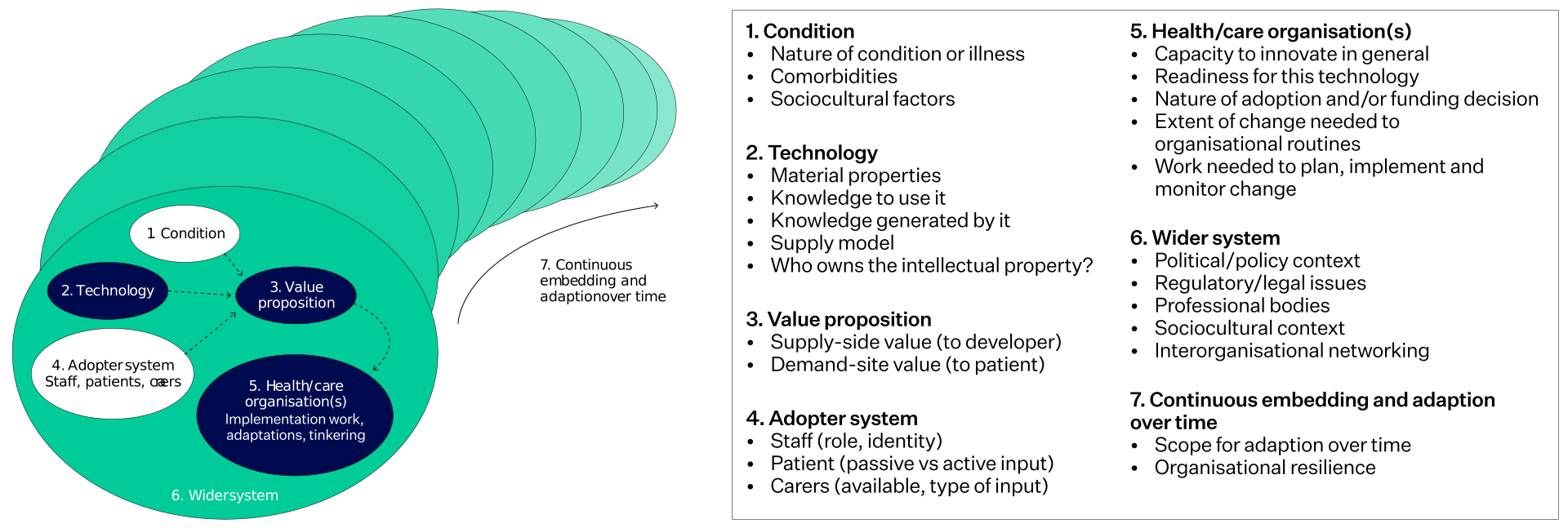
Source: Greenhalgh et al. – JMIR (https://www.jmir.org/2017/11/e367/PDF)
The important insight is: digital health is never just a technology intervention. It is organisational change embedded inside operational pressure.
That changes the executive conversation entirely. Instead of asking whether a platform has enough features, leaders need to ask whether the organisation has the operational capacity, governance, and workflow maturity to absorb change at scale.
Technology only works if people change their behaviour.
The first test of any healthcare technology is whether it solves a problem painful enough to change behaviour.
If the only people who see the value are the vendor, programme team, or executive sponsor, adoption will remain fragile. Clinicians need to feel that the technology improves decisions, reduces friction, or makes patients safer. Patients need to see better access, clearer communication, or stronger continuity of care. Executives need evidence that operational and financial pressures are improving.
Without aligned value across those groups, usage becomes compliance rather than commitment.
This is where many implementations quietly stall. Health systems often assume access equals engagement. It doesn’t. Most clinicians already operate at cognitive overload. If a platform introduces extra clicks, duplicates documentation, or disrupts workflow, staff will find ways around it regardless of how strategically important the programme seemed during procurement.
Workflow friction is an infrastructure issue.
Healthcare organisations frequently frame adoption challenges as training problems. In reality, they are often infrastructure problems.
Poor interoperability, fragmented data flows, inconsistent governance, and disconnected workflows create operational drag long before the user interface becomes the issue. Clinicians don’t experience “digital strategy” as a concept. They experience it as friction during a consultation.
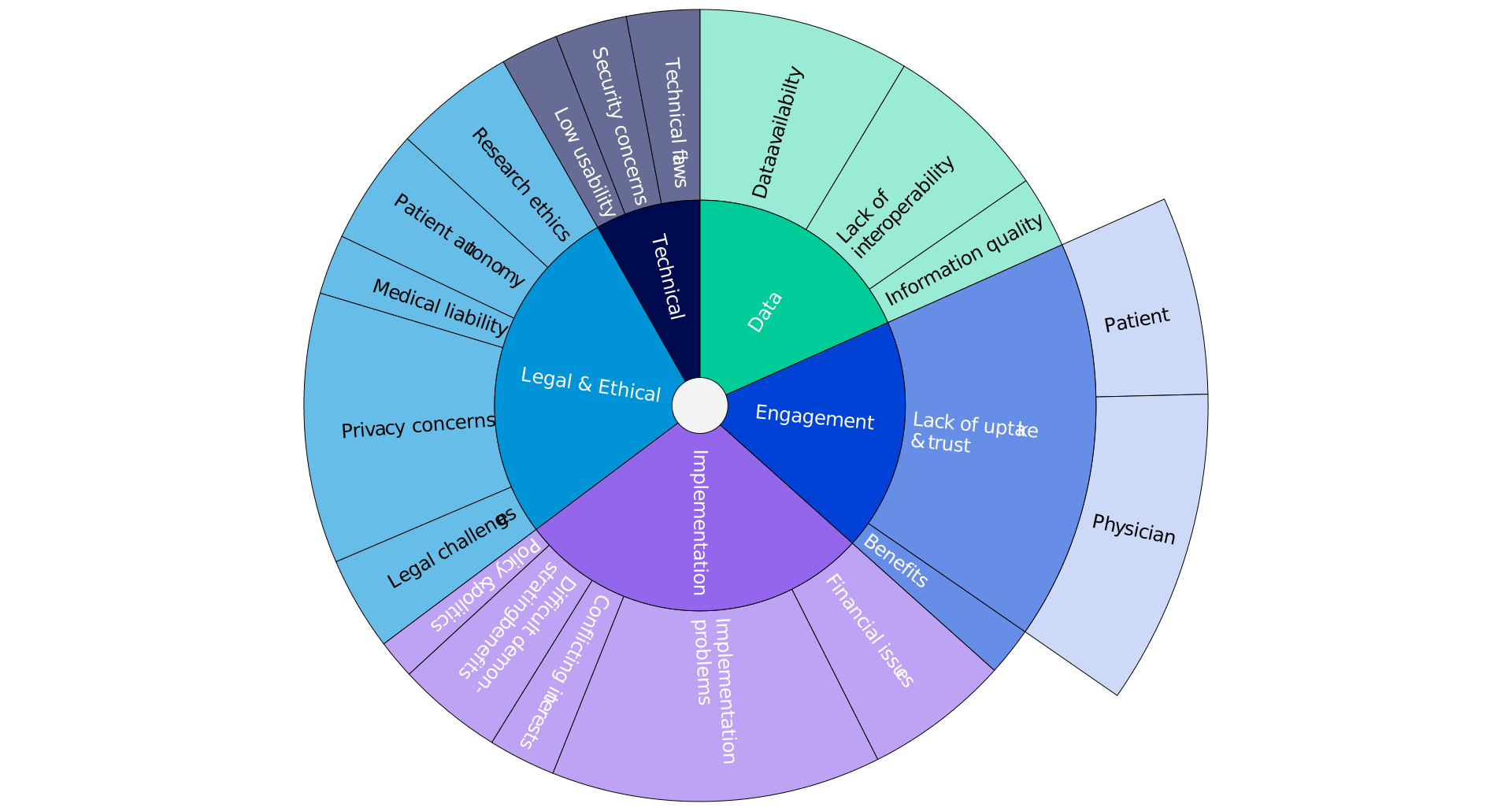
Source: Journal of the American Medical Informatics Association (https://pmc.ncbi.nlm.nih.gov/articles/PMC8363797/pdf/ocab096.pdf)
This is why digital transformation succeeds less through individual tools and more through coherent system design. Organisations that achieve long-term success tend to focus on shared infrastructure, integrated data foundations, and operational alignment rather than on isolated applications.
In other words, sustainable adoption is usually a consequence of better system architecture.
The real risk starts after launch.
Healthcare programmes rarely fail during implementation. They fail afterwards.
The energy, funding, and executive attention invested in procurement and go-live often dissipate once the implementation team leaves. Meanwhile, the difficult work of workflow redesign, governance, optimisation, and continuous adaptation begins.
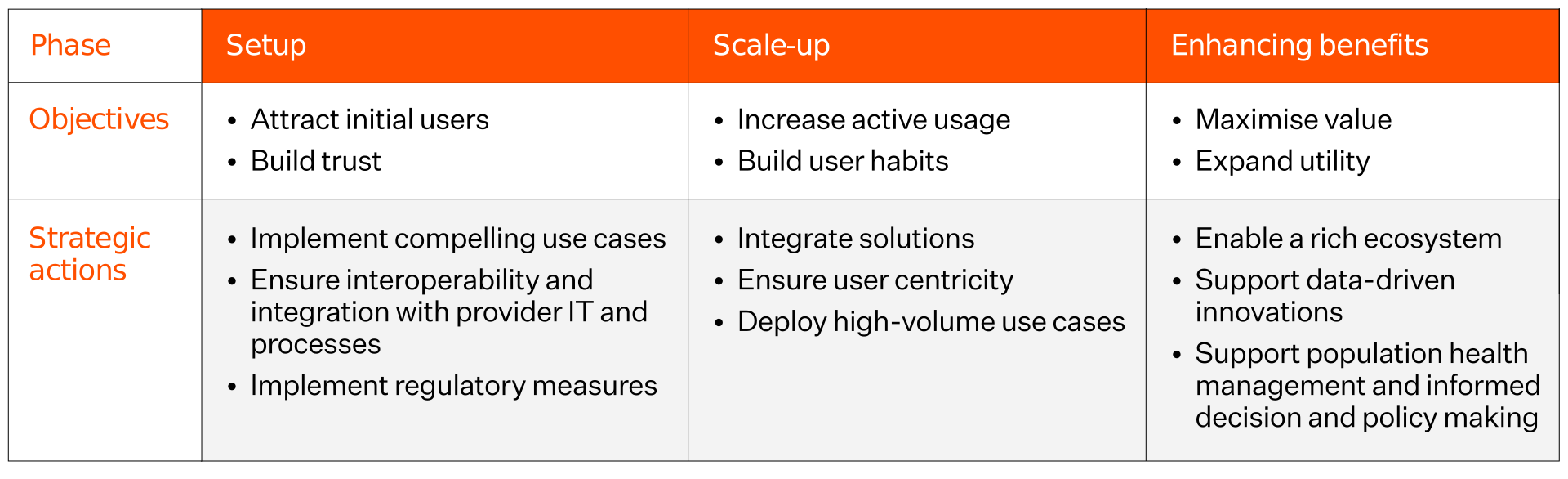
Source: McKinsey & Company (https://www.mckinsey.com/industries/healthcare/our-insights/scaling-national-e-health-bestpractices-from-around-the-world)
Sustained success requires organisations to continuously absorb change. That means long-term ownership, operational discipline, ongoing funding, and the ability to adapt technology as clinical realities evolve.
Without that capability, health systems end up with portfolios of promising tools competing for attention but failing to compound into meaningful system-wide value.
The practical lesson for healthcare executives is simple: stop confusing inputs with outcomes.
Success is not whether technology has been purchased, implemented, or launched. Success is whether the behaviour has changed. Whether the workflow improved. Whether decisions became faster or safer. Whether the organisation operates differently a year later.
Bought is not adopted. Adopted is not sustained.
The real test of healthcare technology has never been whether it gets through the door. It’s whether the system around it is capable of turning technology into better healthcare.
Authored by Tom Varghese, Global Product Marketing & Growth Manager at Orion Health.
References
- Amiri, S., Mahmood, N., Mustafa, H., Javaid, S. F., & Khan, M. A. (2024). Occupational risk factors for burnout syndrome among healthcare professionals: A global systematic review and meta analysis. International Journal of Environmental Research and Public Health, 21(12), 1583.
- lobayli, F., O’Connor, S., Holloway, A., & Cresswell, K. (2023). Electronic health record stress and burnout among clinicians in hospital settings: A systematic review. Digital Health, 9, 1 to 17.
- Nagarajan, R., Ramachandran, P., Dilipkumar, R., & Kaur, P. (2024). Global estimate of burnout among the public health workforce: A systematic review and meta analysis. Human Resources for Health, 22, 30.
- National Academies of Sciences, Engineering, and Medicine. (2019). Taking action against clinician burnout: A systems approach to professional well being. The National Academies Press.
- Shanafelt, T. D., West, C. P., Sinsky, C., Trockel, M., Tutty, M., Wang, H., Carlasare, L. E., & Dyrbye, L. N. (2025). Changes in burnout and satisfaction with work life integration in physicians and the general US working population between 2011 and 2023. Mayo Clinic Proceedings, 100(7), 1142 to 1158.